

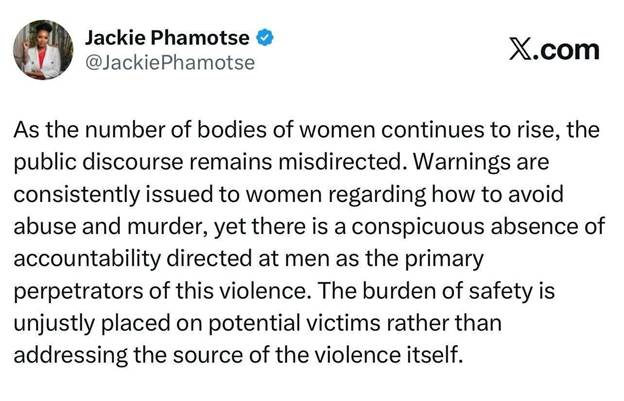
There is a way of talking about violence against women in South Africa that begins from a morally serious concern and ends somewhere much less useful. A woman is murdered, raped or assaulted and almost immediately ordinary men are told that they need to “hold other men accountable”.
Men are told to have difficult conversations with their friends, to examine the behaviour of other men and, in some formulations, to understand themselves as collectively implicated in the violence committed by strangers.

I want to treat this carefully because the underlying issue is profoundly emotive. Violence against women is real, serious and often devastating. But we should be careful about confusing a moral exhortation with a crime-control strategy.
The first problem is that men and women experience violence differently.
According to the 2016 South African Demographic and Health Survey, 26% of ever-partnered women aged 18 and older had experienced physical, sexual or emotional intimate-partner violence in their lifetime. That is an appalling figure. It means roughly one in four women in the relevant population has experienced this form of violence. But it also means that the overwhelming majority of ever-partnered women—about 74%—did not report experiencing it in those terms. That distinction matters, not because the 26% figure is somehow unimportant, but because statistics tell us something about the distribution of violence and therefore about where interventions should be directed.
The same pattern appears in more recent data. Statistics South Africa’s 2025/26 Governance, Public Safety and Justice Survey recorded an increase in the number of people experiencing assault, from 363,000 in 2024/25 to 408,000 in 2025/26. Men experienced assault more frequently than women. But the relationship between victim and perpetrator was dramatically different: 31.4% of female assault victims said the perpetrator was a spouse or intimate partner, compared with just 2.2% of male victims.
That tells us something important. There is a specific and very serious problem of intimate-partner violence against women. It should be confronted directly. But it does not follow that the average man walking down the street is part of the problem simply because the overwhelming majority of serious interpersonal violence is committed by men.
Indeed, men themselves constitute the overwhelming majority of victims of lethal violence.
A South African study examining homicide through post-mortem data found that males accounted for 87% of homicide victims in 2017. The male homicide rate in the study population was 59.7 per 100,000, compared with 9.0 per 100,000 for women—a roughly sevenfold difference. The forms of violence also differed, with firearms, sharp-force injuries and blunt-force trauma disproportionately affecting men.
This does not diminish violence against women. It tells us that South Africa has a broader violence problem which happens to contain a particularly severe gendered component.
And that matters because if we want to reduce violence, we need to understand who is doing the violence, where it occurs and what mechanisms actually interrupt it.
One of the most useful findings in criminology is that serious offending is not evenly distributed across populations. A small group of highly active offenders can account for a disproportionately large share of violent crime. A well-known Swedish population study found that approximately 1% of the population accounted for 63.2% of violent-crime convictions. I would not present that as a South African statistic—it is not—but it illustrates a broader finding replicated across criminological research: persistent violent offending is heavily concentrated among a relatively small number of people.
This is where our conversation about violence needs to become much more concrete.
The question is not simply: “What are men doing to stop other men?”
It is: “How do we identify the people repeatedly committing serious offences, connect their crimes to one another, gather evidence against them, prosecute them efficiently and prevent them from continuing to victimise people?”
That is a very different question.
Consider sexual violence. The evidence from the United States is particularly instructive, not because American criminal justice institutions are directly transferable to South Africa, but because forensic investigation has revealed things that are extremely difficult to see when each rape is treated as an isolated incident.
Researchers who examined thousands of previously untested sexual-assault kits in Detroit found that 35.7% of unique perpetrators in the sample had two or more sexual assaults linked through DNA. Another study of 900 previously unsubmitted kits generated 259 CODIS DNA hits, of which 69 linked to another sexual-assault case.
The research also complicates the popular idea that sexual offenders are a neatly defined category of people who commit only sexual offences. Researchers have found substantial evidence of criminal versatility: many serial sexual offenders also have histories involving robbery, domestic violence, drugs and other forms of serious offending. The National Institute of Justice summarises research from Cuyahoga County in which thousands of previously untested sexual-assault kits were analysed and many of the individuals identified through those cases had broader criminal histories.
This is why the Uyinene Mrwetyana case is so instructive.
Luyanda Botha pleaded guilty to raping and murdering Uyinene and received three life sentences. But he was not a man who suddenly materialised in society to commit one horrifying crime. He had a previous robbery conviction and had previously been sentenced to eight years for that offence. The government subsequently acknowledged that an investigation had found he had a criminal record while employed by the Post Office.
That case should force us to ask institutional questions.
What did the state know?
What databases existed?
What information was accessible to whom?
Why was a person with a criminal history occupying a position where he could potentially encounter vulnerable members of the public?
What forensic and investigative information was available?
And what happens when an offender’s previous conduct is sitting in one part of the state and a subsequent offence occurs somewhere else?
Those are much more consequential questions than whether some random group of men had a conversation in a bar about accountability.
South Africa’s current forensic problems make the distinction even more stark.
In March 2025, Parliament’s police portfolio committee said the SAPS Forensic Science Laboratory was facing a DNA case backlog exceeding 140,000 cases. By 2026, parliamentary information reported that the Biology Section had 298,710 DNA exhibit entries on hand, including 47,283 crime-index entries, while 228,017 entries had exceeded internal processing timelines. For cases involving rape, murder and sexual offences against children, 62,975 entries were on hand. The reported average age of entries was about 800 days.
This is what institutional failure looks like.
A rape kit that sits untested for months or years is not an abstract administrative problem. It may mean that evidence which could identify a perpetrator, connect one crime to another or strengthen a prosecution is not being used when it is most valuable.
A database that cannot reliably connect offenders and cases is not merely a technological inconvenience. It makes it easier for repeat offending to remain fragmented across police stations, dockets and victims.
An investigative system without sufficient specialised capacity cannot consistently turn evidence into convictions.
And these are precisely the things that informal male “accountability” cannot fix.
Men can certainly tell their friends that rape is evil. They can intervene when they see someone behaving badly. They can refuse to tolerate abusive behaviour in their own homes and social circles. All of that can be morally valuable.
But none of it tests a rape kit.
None of it creates a functioning forensic database.
None of it links a suspect in one case to evidence from another.
None of it gives a detective the resources to investigate a serial offender.
None of it creates a dedicated investigative unit capable of dealing with especially complex sexual and violent crimes.
None of it guarantees that prosecutors receive a properly constructed docket.
And none of it creates the certainty that a violent offender will actually be caught.
That last point is particularly important. The evidence on deterrence is remarkably clear that the certainty of being caught generally matters more than the severity of the eventual punishment. The National Institute of Justice’s summary of the research notes that increasing the likelihood that offenders believe they will be apprehended is more important for deterrence than simply increasing sentence lengths.
This is why policing strategy matters.
Violence is not distributed randomly across cities. It clusters in particular places and around particular people. A systematic review of hot-spots policing research found that focused police interventions in high-crime locations produced significant reductions in violence, including reductions in robbery, assault and violent firearm crime, without simply displacing that crime into immediately adjacent areas.
This is the part of the debate that is often missing.
Safe societies do not become safe because millions of individual citizens constantly remind one another to behave.
They become safe because the probability of being victimised is reduced by a combination of policing, functioning courts, competent investigations, credible consequences, urban design, surveillance, social order and institutions capable of identifying and incapacitating people who repeatedly commit serious crimes.
You can see the institutional difference in something as mundane as whether people feel safe walking home at night.
Gallup’s 2025 Global Safety Report found that only 33% of South Africans said they felt safe walking alone at night in the area where they lived in 2024. Among South African women the figure was 25%, compared with 43% for men. By contrast, 90% of people in the United Arab Emirates reported feeling safe walking alone at night, while the equivalent figure for Malaysia was 78%. These are perceptions rather than direct crime measurements, and they are country-level figures rather than city-level comparisons, but they demonstrate the extraordinary gap in lived perceptions of public safety.
The important lesson is not that men in those societies are somehow better at policing one another.
It is that institutions create environments in which criminal behaviour is harder to carry out and more likely to attract a response from the state.
This is what I mean when I say that South Africa has to become more morally serious about violence.
We should stop treating violence as primarily a referendum on whether ordinary men have sufficiently examined their consciences. The state has a monopoly on legitimate coercive power for a reason. A functioning civilisation does not outsource public safety to informal moral policing among millions of people who have no knowledge of the crime, no access to the evidence and no power to prosecute the offender.
There is also a danger in turning the problem into a form of gendered bean-counting. Men are more likely to be murdered. Women are more likely, in particular circumstances, to experience intimate-partner and sexual violence. Both facts can be true at the same time. A serious society should be capable of holding both in its head without treating one as a rebuttal of the other.
The objective should therefore be much simpler: make it harder to commit violent crime and much more likely that people who do commit it are identified, arrested, prosecuted and prevented from doing it again.
That means properly functioning police stations. It means specialised investigative capacity. It means functioning forensic laboratories. It means rape kits being available and processed. It means databases that allow investigators to connect offenders and cases. It means intelligence-led policing focused on the people and places generating disproportionate amounts of violence. And it means courts capable of processing serious cases without years of institutional drift.
A woman should not have to hope that the men around her have collectively developed sufficient moral consciousness to keep her safe.
A man should not have to hope the same.
We should build a state that is actually capable of doing the job.
[Image: crime scene]
The views of the writer are not necessarily the views of the Daily Friend or the IRR.
If you like what you have just read, support the Daily Friend