

Speaking at Waterkloof Air Force Base, defence and military veterans minister Angie Motshekga opened the 13th Africa Aerospace and Defence (AAD) exhibition with a message worth taking seriously. She told delegates that July’s Defence Industry Lekgotla had produced a roadmap built on “localisation and sovereign capability, ensuring South Africa designs, manufactures, and sustains its own defence technologies.” She pointed to President Cyril Ramaphosa’s recent visit to Denel as proof that government backs the sector, and she framed the exhibition’s drones, aerospace platforms and cyber systems as engines of industrialisation.
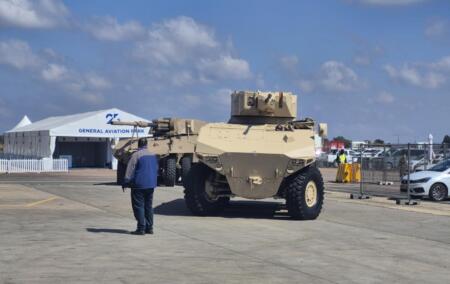
A lot of this is correct, and worth agreeing with in public. Despite its relative decline, South Africa has a defence-industrial base worth protecting. Denel exhibited at AAD for the first time as a state enterprise with the Department of Defence as shareholder, showing off the T5-52 and Badger armoured vehicles, the Rooivalk attack helicopter, and a range of missile and unmanned systems. A tangible industrial asset, built over decades, has survived years of state capture and near-collapse. The minister is also right that South Africa faces a more unsettled world than it has in a generation. The Israel-Iran conflict already showed how quickly a Strait of Hormuz disruption can move the fuel price and the rand. Washington’s Section 301 tariff threats, and the AGOA disputes have shown that trade access can no longer be assumed. In this environment, a country that wants to be taken seriously as a middle power needs more than a speech about sovereign capability; it needs the force structure and the industrial base to back it up.
That is where the gap opens. The Department of Defence’s 2026/27 budget is R57.6 billion, a nominal cut from the year before and a real terms cut of around 5% once inflation is factored in. Defence spending has fallen to about 0.7% of GDP, the lowest share since the declaration of the republic in 1960, and well below the 1.5% to 2% range that government’s own “Journey to Greatness” plan sets as the eventual target. The CRA estimates the real recovery number closer to 2.5% of GDP. So, the Lekgotla’s language of sovereign capability and export competitiveness is being asked to do a great deal of work without the money to match it.
This leaves South Africa with two paths. The first is for Treasury to move the defence budget toward the 1.5% of GDP that Cabinet has already endorsed in principle. That would not fix every structural problem in the South African National Defence Force (SANDF) – most of which come from a personnel bill that eats about two-thirds of the budget – but it would start to shrink the maintenance backlogs and put ships and aircraft back into service.
The second path is the one that was crystal clear at AAD 2026: building capability through the private and parastatal defence-industrial base rather than only through the defence budget itself. Denel’s re-emergence as an exhibitor, the “ease of doing business” and export-competitiveness pillars from the Lekgotla, and the presence of more than 300 exhibitors from over 40 countries all point in the same direction. A modernised regulatory environment, faster export approvals, and a government procurement policy that actually favours local manufacturers (on quality, merit, and value for money) would let South African firms earn foreign revenue and sustain skills even while the fiscus is constrained. Dual-use applications, from earth observation to agricultural drones, give this industry a commercial market well beyond the SANDF’s own procurement budget.
What South Africa cannot do is keep both tracks rhetorical. A middle power’s claim to sovereignty is tested by whether it can arm, sustain and deploy its own forces, and by whether its domestic industry can compete and export without depending on a state that spends 0.7% of GDP on defence. The minister’s speech set out the right ambitions. Whether they become real now depends on a budget vote and a procurement policy, not another Lekgotla communiqué.
[Image: Ricardo Teixeira]
The views of the writer are not necessarily the views of the Daily Friend or the IRR.
If you like what you have just read, support the Daily Friend