

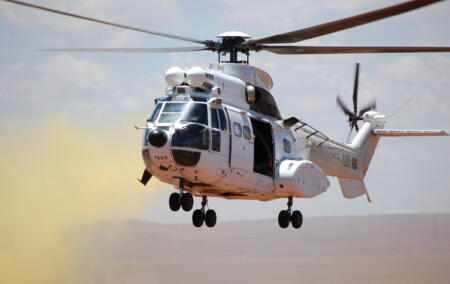
The African Aerospace & Defence (AAD) exhibition took place between 16 and 18 September 2026 at Air Force Base Waterkloof outside Pretoria. A revisit of my 2022 and 2024 opinion pieces indicate a steady regression in the scale and participation over the last three AAD expos.
The AAD 2026 exhibition theme was “Africa’s Gateway to Defence and Aerospace Collaboration”, and the AAD website states that the AAD expo is “the premier exhibition of air, land and sea technologies on the African continent.”
The biggest positive of AAD 2026 is the visibility of South African government decision makers across multiple departments linked to the aerospace, defence and security sectors. AAD 2026 received formal SA cabinet approval. Similarly, the SANDF decision makers were very well represented across all three days.
Anecdotal feedback from exhibitors indicates a good quality of attendees and delegations. Quality is good, but the quantity of both attendees and delegations seems to have dropped significantly. The AAD website indicates that there were official delegations from 33 countries in 2024. The 2026 delegation list released prior to the trade days only included 13 countries. Looking at the list, many African nations north of SADC decided not to attend AAD 2026. Many people will speculate that the recent xenophobia-type discussions internal to the country had an effect. Realistically that should not influence trade shows. The question then is, what else has occurred on the African continent that could have had an effect.
1. El Alamein International Airshow. This Egyptian airshow also happens in September every two years. It is more aviation focused with over 200 exhibitors. However, every other year there is now the Egypt Defence Expo that seems to attract more exhibitors than AAD.
2. Africa International Defence Exhibition (AFRIDEX). This Nigerian exhibition at the end of October is being planned as an annual exhibition. Indications are that over 500 exhibitors are expected.
These two aerospace, defence and security-related exhibitions seem to provide a different value proposition for various African nations, but also for several foreign exhibitors. Can AAD rightfully state that the South African exhibition is really the gateway to the continent. Even more worrying is whether AAD can state that it is the premier defence-related technology exhibition. The Egypt air show attracted a varied set of aircraft solutions, including the Russian SU-57, two Chinese Y-20s and a next-generation Dornier 228. The AAD flight line had limited static displays. If Airbus had not attended with the CASA C295 tactical multi-mission transport and the H145M, then the AAD flightline would have been in a very sorry state.
This addresses the reduction in foreign visitors, but what about the local visitors?
It appears there were significantly fewer people walking around at the exhibition. The registration process changed for AAD 2026. The addition of a security clearance process was perhaps in line with the cabinet approval of the exhibition, the increase in VIPs and the use of a national key point. But feedback on the application process was not timeous. This was then also offset by some members wanting to visit the trade days being charged to enter. The process of obtaining passes for entry was also perceived to take far too long. These are own goals and could have had an impact on the turnout.
There seems to be significant friction between South Africa and foreign representatives. Third-hand information indicates that AAD was instructed to gather additional information from these participants, while limiting official attendants. These are generally the eyes of the foreign countries that purchase our technology. This is the main focus of local exhibitors, as the domestic government is not purchasing at present. This is a problem for exhibitors when evaluating the Return on Investment of a stand.
Local-entity co-operation has increased for AAD 2026. The number of smaller companies sharing stands with larger system integrators has increased. This may have been a contributing factor to the reduction in the number of exhibitors from AAD 2024. The AADs in the early 2010s filled six full hangars with exhibitors. The scale of AAD 2026 was reduced to a set exhibitors who could fill three hangars maximum. The physical size of AAD was maintained, with exhibitors distributed over more hangars and the flightline apron. The use of the chalet line as a display exhibition gained more traction. The use of chalets could be attributed to the desire to host a higher-quality of exhibit visitor.
People go to exhibitions for different reasons.
My reason was to see new developments and engage directly with developers. AAD 2026 provided limited new-product releases, very few MOU announcements and zero contract-award notices. More worrying were the engagements at the exhibitor stalls. The South African defence industry (SADI) has a problem that was highly visible at AAD 2026, with the larger suppliers generally having people aged 50-plus manning the exhibitions. This can be ascribed to showing expertise. The smaller companies had maybe one 50-year-old complemented by a team of technical subject-matter experts who were under 35. The SADI has a visible “missing middle” between 35 and 50 years of age. If the technical know-how is not transferred soon, it may be lost. Once a capability is lost, it costs time and money to re-establish.
The best hall to visit was by far the hall that housed the DTIC, Armscor and Space industry-sponsored smaller companies. I could name one or two, but that would be unfair on those that are left out. My impression was that there is still good innovation in the SADI.
An honourable mention must also go to the AMD Project CLASSS initiative, and specifically Colin Singarum. The interactive terminal had a slick user interface giving easy access to recent product developments. It was offset by a small stand that showcased recent developments.
This was a hit-and-miss AAD. A significant refresh of the concept is needed if we want to compete on the continent and still provide good ROI for exhibitors and visitors alike. For what it is worth; a suggestion could be to take AAD to Cape Town or Durban for a year or two, maybe on a rotation basis. A second suggestion could be to take the show away from defence installations to cut some of the perceived red tape that has been growing in recent years.
[Image: Ricardo Teixeira]
The views of the writer are not necessarily the views of the Daily Friend or the IRR.
If you like what you have just read, support the Daily Friend