

The Free Market Foundation sent a mission to the US in support of AfriSol’s lobbying for Afrikaner interests. I think this is a grave mistake.
The FMF sent its delegation – consisting of its CEO, David Ansara, and its head of policy, Martin van Staden – to the United States to “engage with a number of stakeholders” to outline its assessment of “conditions in South Africa that continue to damage [the Pretoria Washington] relationship”.
“Some of these conditions,” said the organisation’s Ayanda Zulu, “include threats to private property, racially discriminatory legislation, and the incitement of violence against ethnic minorities.”
This could be a carbon copy of the agenda that the Solidarity Movement and its affiliate, AfriForum, took to the US in late February 2025, grandly titled the Washington Memorandum.
This memorandum very likely contributed to a slew of punitive measures against South Africa, including a 30% “reciprocal” import tariff on exports to the United States which was in effect until the US Supreme Court struck them down (only to be replaced by a 12.5% tariff on even more spurious grounds).
In response, I commented: “How does this improve the [Free Market Foundation’s] ability to influence policy decisions in favour of free markets? Why follow AfriMAGA into divisive activism that is certain to antagonise policymakers and turn them against the FMF’s usually excellent policy advice?”
Despite considering both Ansara and Van Staden personal friends, and agreeing with the bulk of their political views (or perhaps because of that), I called it a “poor show”.
Hostile politicians
Zulu responded quickly, with a well-considered argument that comes down to the observation that ANC politicians are already hostile to the values the FMF represents, these policy disagreements are existential, and they require action beyond merely trying to convince policymakers.
I don’t want to misrepresent anyone’s views, so I’ll quote extensively from the ensuing discussion, with links to the full exchange.
I reiterated my core objection: “I think you can either engage in politically hostile activism (which is not ipso facto a bad thing), or in positive engagement that influences the minds of policymakers. You can’t do both.”
Van Staden responded with a bit more vim: “Is ‘Afri MAGA’ in the room with us now, Ivo? I wished you did the work of spending even a little bit of time with the likes of AfriForum or Lex Libertas – whose values are essentially identical with classical liberal decentralisation, non-racialism, and limited government – before gratuitously making public assumptions about them. But I’ve given up the dream that your wing of our movement will ever make that effort. The rest of us, though, eagerly will.”
And further: “And if I antagonist (sic) a communist, it’s a good day. The FMF has not believed in banging its head against a brick wall for some time now. ‘Policymakers’ have had a closed door for decades. We tried the niceities (sic) route and are now more interested in the pressure them or humiliate them round. Our door, of course, is always open to them, but we’re done pleading.”
Clearly, the gloves are off. But is that a good thing?
Afrikaners
In further discussion, he asserts that my only reason for objecting is that it involves the FMF working with the Afrikaner minority, as opposed to any other minority group, and that if I have a problem with Afrikaner nationalism, then I have a problem with Afrikaners in general.
I wrote: “Afrikaners do have a particularly fraught history in South Africa. It is naïve to pretend it is just like any other minority. I think aligning with any brand of identity politics harms the cause of individual freedom and free markets, and blunts a think tank’s policy influence.”
He replied: “Thank God Afrikaners are done waiting for permission, in that case, since the ‘fraught history’ will seemingly always deliver a ‘no’. I happily stand with them, as one of them, proudly donning a liberal hat.
“The cause of individual freedom has usually been served by advocating for minorities. Was the case with religious freedom, sexual freedom, and all sorts besides. True throughout history. True right now. You fight the battle that is actually being waged, not the one you’d love to wage under ideal circumstances.
“Some think tanks work by waiting outside state offices for politicians, so they can ‘influence’ them. Other think tanks speak to the public and other nexes of power to exert pressure and incentivise change.”
This raises a few important points. First, it goes to confirm that the FMF embarked on this mission in support of the Solidarity Movement and AfriForum, and that the suspiciously similar agenda is not merely a coincidence.
Second, it confirms my claim of “divisive activism”. If I disagree, it can only be because I harbour prejudice towards Afrikaners.
Van Staden knows me, and ought to know that this is not true. Perhaps he wanted to deflect from my real position, which is that I “agree on objectives, but differ on strategy and tactics”, and, “a think tank’s ability to influence policy is mutually exclusive with partisan activism in tandem with a minority interest lobby group”.
AfriSol
So let me clarify a few things. I shouldn’t have said “AfriMAGA”.
It correctly describes my opinion about the Solidarity Movement and the commentators that are in league with it: that they are largely congruent with the alt-right, conservative and nationalist politics of the MAGA movement.
However, it needlessly distracted from my main point about the FMF’s legacy of non-partisan policy advice and influence, as compared with its newfound ambition to engage in partisan activism.
I could have, and should have, just said “AfriSol”, as shorthand for the Solidarity Movement, its affiliate, AfriForum, and associated organisations.
That said, I do take issue with AfriSol, on several fronts.
Before I explain, let me say that I fully support these groups’ efforts at what they call “state-proofing”, supporting communities with services and infrastructure, and building educational and other institutions for their members. This is laudable.
I also have no objection to their representing the interests of their members, though they ought not to describe their constituency as “Afrikaners” when there are clearly a substantial number of Afrikaners who are not represented by these groups, and reject their politics.
It is a cold, hard fact that AfriForum was founded by, and is still run by, Kallie Kriel, a former Conservative Party member who admits to having voted “no” in the 1992 referendum on whether to continue the reform process and negotiate a new, democratic constitution. He was also active in the youth wing of the Freedom Front Plus, a party founded by former SA Defence Force officers that emerged from the pro-apartheid, separatist white right in 1994.
Some other AfriSol leaders (notably Flip Buys) have similar backgrounds.
In 2018, although admitting that apartheid was wrong, Kriel attempted to minimise its impact and said, “I don’t think that apartheid was a crime against humanity”.
The former deputy leader of AfriForum, Ernst Roets, went on the Tucker Carlson show, and claimed that South African universities were teaching that “white people are subhuman”. He called it “a theory that justifies the targeting and extermination of the white minority,” adding, “It’s a predicate for genocide. I mean, it’s always the same in every part of the world now. They’re not fully human, right? So we can kill them.”
US administration views
Now I don’t want to get into the weeds about whether or not AfriSol ever promoted the idea of white genocide. They have certainly tried hard to move away from that framing and whitewash (if you’ll pardon the pun) their history.
It is not entirely clear how the current US administration formed its opinions about South Africa – in particular the view that the government has specifically targeted the Afrikaner minority with expropriation and other discriminatory policies – which is quite simply false.
Influential South African expatriates in the US like Elon Musk and David Sacks likely contributed, in combination with prominent media figures like Carlson. The Solidarity Movement itself claims to have been “involved in political engagement in the USA for 21 years”, but whether they are responsible for the inaccurate views expressed by the Trump administration is hard to say.
They certainly haven’t helped the situation, however.
The campaign to erect 3,000 white crosses in Washington, DC, led by Lex Libertas, the “self-governance” group Roets founded after he left AfriForum, also does nothing to dispel the notion that the murders of predominantly white farmers – who represent perhaps 0.5% of all murders in South Africa since 1994 – is their (or the) primary concern.
Nationalism
Let me be very clear, because Van Staden seems happy to paint me as simply hating Afrikaners. I have no problem whatsoever with Afrikaners. I harbour no bias against them.
Many of my friends are Afrikaners. Where I now live, in the Klein Karoo, the vast majority of people speak Afrikaans, and I interact with them daily, on a perfectly amicable basis. Outside my house, I speak more Afrikaans than English.
I don’t always agree with the conservative views of many among them, or the racist views of some of them, or their religious beliefs, but then, I also disagree with colonial attitudes or socialist sympathies among my English-speaking friends and acquaintances. And few people are quite as racist as some British and German expatriates I know.
That does not make me biased against English-speaking South Africans, or Brits, or Germans.
That Van Staden accuses me of prejudice against Afrikaners demonstrates the divisiveness I mentioned, however. He knows very well what my objections are to AfriForum. He knows that my objection is not to Afrikaners, per se, but to particular elements of AfriSol’s philosophy and political strategy.
It’s almost as if the FMF’s campaign to the US is intended to be partisan and divisive. It is as if the legitimacy of AfriSol to the broader South African population does not matter, because it has decided that a classical liberal future is not possible in a united South Africa, and only possible in a state of devolved, autonomous, ethnic enclaves.
Uniquely oppressed
The Washington Memorandum raises issues explicitly in terms of “Afrikaners”. Van Staden says AfriSol doesn’t claim to speak for all Afrikaners, but they certainly do not refer to “our members” to make that clear.
AfriForum explains the objectives of its US engagement as follows:
“End discrimination against Afrikaners by, among other things, revising the anti-Afrikaans Bela law and racial legislation.
“Act strongly against hate speech that incites violence such as farm murders in which Afrikaners are the target.
“Respect the right to property ownership by, among other things, revising the Expropriation Act.
“Enter into a cultural agreement with Afrikaners that will provide cultural space for Afrikaners in South Africa, which includes the existence of Afrikaans educational institutions.”
My problem is not with the specifics of what they’re asking. Van Staden acknowledges that he and I, and much of AfriForum, pursue similar ideals. To a great extent, that is true.
I agree on property rights and oppose expropriation without fair compensation. I agree on acting against the incitement of violence, and have publicly argued against continuing race-based redress for almost 20 years.
My issue is with the framing. It pretends that these issues affect only Afrikaners.
Does racial legislation in South Africa not discriminate against English-speaking white South Africans? Why didn’t all white people in South Africa get refugee status in the United States, if the situation is so dire?
Does race-based redress not discriminate against South Africans of Indian descent, or against coloured people, and sometimes even against black people themselves?
Do the consequences of racial legislation – corruption, loss of skills, prioritising demographic representation over competence and experience – not affect the lives and well-being of all South Africans, equally?
Do farm murders target only Afrikaans farmers? Or do they also target English-speaking farmers, and black farmers, and farmworkers of all ethnic origins?
Has the incidence of farm murders not dramatically decreased in recent years? The TLU SA (the old Transvaal Landbou Unie), which used to publish statistics on farm murders, no longer does so, and has been reduced to quibbling over whether there were one or two murders in the most recent quarter.
Not to make light of those killings, of course, but it simply is no longer the scourge that it once was.
As for language policy, what makes Afrikaans different from Xhosa, Zulu or any other language (other than the lingua franca) that it merits special protection and promotion by the state?
Framing
Framing the issues of property rights and racial discrimination through the lens of Afrikaners alone has several undesirable consequences.
First, it creates the mistaken impression – which the Trump administration clearly believes – that Afrikaners are a uniquely persecuted minority.
They are not. The issues they raise, while often valid in and of themselves, are not Afrikaner issues so much as general South African issues that affect all or most races, languages and ethnic groups. Moreover, this framing does not acknowledge that the discrimination of which they complain is intended as legitimate redress for apartheid injustices of the past. That doesn’t make it right, but it is essential context if you want to engage honestly on this issue.
Second, as I pointed out to Van Staden, Afrikanerdom has a peculiarly fraught history in South Africa. These were the people who ran the apartheid state, and raised up Afrikaners as the epitome of white civilisation.
AfriSol might disown apartheid now, but there is no way that an organisation founded by people with roots in the former Conservative Party, the Freedom Front, the Volkstaat Council, and similar pro-apartheid, anti-democratic, right-wing groups, will ever be viewed, by the general South African electorate, or by its politicians, as acting in the interests of all South Africans.
Promoting the principles of classical liberalism, but doing so not only through an ethnic minority lens, but the lens of the former oppressors, taints them. The lens matters, even if we’re looking at the same thing.
My objection to AfriSol, besides its questionable record on non-racialism, is its identity politics. I object when the left does it, in the form of critical race theory, and I object when the right does it, in the form of ethnic nationalism.
Group-based politics is a form of collectivism that pits one group against all others in the fight for special political dispensations. It conflicts with the classical liberal principle of individual rights as the sole source of political legitimacy.
Private diplomacy
There’s another reason to object to the FMF’s mission to the US. Like AfriSol 18 months ago, it proposes to engage in private diplomacy that seeks to recruit the assistance of a foreign government against the government of South Africa or its members. This diplomacy will likely have unintended but entirely foreseeable negative consequences for all South Africans.
The Washington Memorandum document is saved under the filename “Diplomatic-mission-to-the-USA.pdf”. This raises the very important question of whether private individuals or organisations are entitled to conduct foreign diplomacy on behalf of special interests within the country, when the rights and interests of everyone else will also be affected by their actions.
This question is more complex than simply dismissing it as having to ask for a permission slip from the state.
As the Mail & Guardian put it, after Jacob Zuma undertook to meet Ajay Gupta in India: “When foreign policy becomes a battleground rather than an established mandate, risks to national security and global influence grow. … When domestic factions turn to foreign powers to advance local agendas, they invite those powers to interfere in South African affairs. By creating back channels to Washington, Brussels or elsewhere, the groups provide foreign actors with leverage to pressure or penalise the South African state through diplomatic and economic means.”
The reverse, of course, is also true. Our own government ought not to open itself to being swayed by the lobbying of private foreign organisations – especially not special-interest NGOs that account to their own donors and members and not to the South African people.
Private diplomacy is controversial and potentially very dangerous. A foreign government has no way to verify the accuracy of claims by private special interest groups, or how representative they are, or whether they have a mandate from South Africans at all.
The FMF’s legacy
But back to the core issue. The Free Market Foundation was once – under nearly half a century of Leon Louw’s leadership – scrupulously non-partisan, offering policy advice that promoted free markets to anyone who’d ask, in and out of government.
It was careful to maintain open lines of communication with policymakers, and was highly respected – even among its political foes – as a neutral, impartial promoter of classical liberal principles.
Though carrying the torch of individual liberty was often a thankless and fruitless task, it also achieved some great things.
Notably, the wording of the Constitution owes much to the FMF. It authored the private property rights clause, and positively influenced the limitations clause, the administrative justice clause, the freedom of trade clause, the devolution of power clauses, and the rule of law as a founding provision.
It wrote thousands of submissions on Bills before Parliament, influencing many of them in favour of free enterprise. It demanded dozens of socio-economic impact assessments and criticised dozens more for making unsupported claims in support of legislation, or omitting arguments against it.
It took up the cause of marginalised street traders, and won many victories large and small for their freedom to conduct business and trade.
It pioneered the transfer of title deeds to long-term occupants of state-owned land, a policy that now appears in every party manifesto, including that of the ANC.
In 50 years of advocacy, it probably achieved a great deal more than I am even aware of.
Partisanship
The FMF’s new mission in support of AfriSol’s foreign engagement, and Van Staden’s comments to me, make it clear that the organisation has abandoned its non-partisan approach and its ambition to persuade policy makers. It no longer cares if policy makers listen to it, and Van Staden now says they never did.
I stand by my original point, however. You cannot be a partisan activist organisation, engaging in hostile political action against the present government, and also expect to operate as a think tank with any standing to advise government policymakers.
Both are legitimate choices, but you can’t pretend to be one, and act like the other.
I disagree with the FMF’s strategy. It is fine to explain exactly how AfriSol’s demands for Afrikaners are consistent with individual liberty and free markets, and how they differ. It is a whole ‘nother story to make common cause with ethnic nationalists and alt-right figures at home and abroad, and actively engage in private foreign diplomacy. That makes the FMF – and by implication its core principles – less credible, not more.
I think it harms the cause of liberty to agitate for non-racialism and property rights on behalf of Afrikaners or any other minority interest lobby.
Let them do so for themselves, by all means. But an organisation that is supposed to promote these principles for all South Africans should not taint it with divisive identity politics and ethnic nationalism. These are collectivist philosophies that conflict with classical liberal individualism.
Non-partisanship
Non-racialism and property rights ought to be promoted in a non-partisan manner, for all people, without reference to minority rights or ethnic identity.
That goes not only for the FMF, but for all organisations that support a classical liberal future for South Africa, including the Institute of Race Relations. (Full disclosure: I am an ordinary member and one of 27 members of the Council of the IRR. The Council nominates the board of directors and meets annually to keep the organisation true to its founding mission of promoting non-racialism and classical liberalism in pursuit of a free, fair and prosperous country for all South Africans. So are both Van Staden and Ansara. None of us are IRR directors or staff members; nor do we speak on behalf of the organisation.)
As classical liberals, we should explain how our principles will remedy poverty for all. We should explain how they will achieve economic growth for all. How they will free marginalised people to work as they choose, free from red tape and the arbitrary exercise of power. How they will combat corruption and fight crime. How they will reduce inequality and promote greater prosperity, including for those who were disadvantaged by the great injustices of the past, many of whom remain disadvantaged to this day.
If we side with one group, then the inevitable question of everyone else will be, “But what about our interests?”
In South Africa, given its history and political make-up, a non-partisan, individualist approach (as opposed to group-based political contestation) is the only tenable way to promote classical liberalism.
Has it given up?
If the FMF has given up on trying to persuade the South African government, and instead portrays classical liberal objectives as a minority rights issue, then it is saying the battle of ideas for a unified South Africa is lost.
If it portrays classical liberal principles as an Afrikaner issue, then much of the rest of South Africa will reject them as the policies of former oppressors and people who seek to protect their privilege. You could argue that they’d be wrong, and you’d be right, but you’d also be naïve to believe that that would make a difference.
Van Staden says he doesn’t care. I do.
If the FMF intends to pursue ethnic minority rights, instead of free markets for all, I think it should say so. If not, it should keep itself above the fray of identity politics and ethnic political contestation.
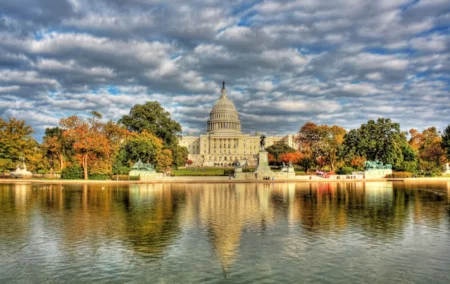
[Image: The US Capitol building in Washington DC. Daniel Mennerich, 2011, used under CC BY-NC-ND 2.0 licence]
The views of the writer are not necessarily the views of the Daily Friend or the IRR.
If you like what you have just read, support the Daily Friend