

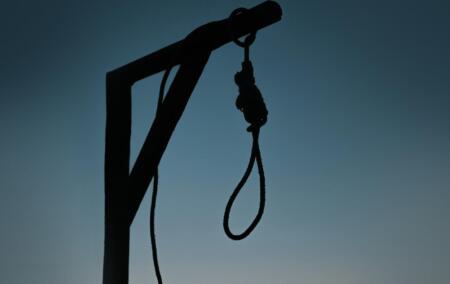
“Death penalty: Let’s not aspire to being a bloodthirsty, barbaric nation”, read a headline last week over a Daily Maverick piece by veteran journalist Mondli Makhanya. As Ekurhuleni (and the rest of the country) reels under the fear that a serial killer may be at large, the ANC Women’s League had been been circulating the idea of reintroducing capital punishment.
The impression created was that calling for the death penalty wasn’t just impulsive politicking, but represented an emergent institutional position.
League Secretary General Nokuthula Nqaba said that the matter had been discussed with its executive, and there was consensus on the need to initiate a public discussion on it. Capital punishment having been ruled unconstitutional in one of the Constitutional Court’s seminal early rulings – the first case it heard, actually – she said that it would not be possible to simply bring it back.
Instead, the League wanted to “open up the debate and let the people discuss and decide”.
As the headline to his piece makes clear, Makhanya received this with consternation. So too, no doubt, would most “enlightened” opinion in South Africa, the South Africa of editorial offices, lecture halls and legal practices. “Bloodthirsty” and “barbaric” would be standard vocabulary in these circles, and taken together with the constitutional pronouncement, that would settle the matter. Case closed.
But the death penalty is an issue that refuses to settle. At the time of its formal abolition, South Africa is believed to have had some 400 people awaiting execution.
Even abolitionists acknowledged that public opinion was strongly in favour of retaining the death penalty. Present-day proponents of reintroduction – now evidently including the ANC Women’s League – can point to survey evidence that shows a robust majority remains so inclined. Afrobarometer’s 2025 report found that just over 60% of South Africans felt that death was “fair punishment” for the most serious crimes, against 36% who said it was never justified. Interestingly, a higher proportion of women than men were in favour of capital punishment.
Given the scale and brutality of crime in South Africa, there’s no mystery in the attractiveness of the death penalty, still less any moral indictment. South Africa spawns an appalling criminal culture. Back in 2007, a review of the country undertaken by the continental African Peer Review Mechanism pointed out that “the distinctive feature of crime in South Africa is not its volume, but its level of violence”.
“Normal”
According to the World Bank’s global database, in 2019 – a useful year because that was before the Covid disruptions, and thus, after a fashion, “normal” – South Africa’s murder rate was 35.8 per 100 000. (This was roughly in the ballpark that had been established over the 2000s; in 2023, the rate had climbed to 43.7.) By any standards, this is extreme. The global rate hovers just above 5 per 100 000 (5.4 in 2019, to be precise). The rate for Eastern and Southern Africa is around 12. Wild, medicated and gun-crazy America comes in at a little above 5.
Violent crime in South Africa is a compound of callous casualness and wilful, gratuitous cruelty.
This is what kills children in the crossfire of gangland shootouts, sees vulnerable families on farms tortured during attacks, has revellers gunned down in taverns, or murder as the conclusion to robbery and rape. These are pathologies that shock observers from elsewhere on the continent: their home countries share many of South Africa’s social and economic problems, but not its violent afflictions.
And resonating with the Ekurhuleni murders is South Africa’s history with serial killers.
The first known case was Pierre Basson, who killed at least nine people in Cape Town between 1903 and 1909, to profit from their life insurance.
It started a long list. Stewart Wilken, “Boetie Boer”, murdered at least ten people between 1990 and 1997. Jacques Coetzee and John Frank Brown, the Cross-Dressing Killers, murdered at least five people between 1993 and 1995. Sipho Thwala, the Phoenix Strangler, murdered at least 16 people in 1996 and 1997. Cedric Maake, the Wemmer Pan Serial Killer, murdered at least 27 people in 1996 and 1997 (not that far off, in fact, from the 30 victims that Ted Bundy confessed to).
Jack Mogale, the West End Serial Killer, murdered 16 people in 2008 and 2009. Bulelani Mabhayi, the Monster of Tholeni, murdered 20 people between 2007 and 2012. (Notice the frequent qualification “at least”; the true numbers may never be known.)
There are also those whose crimes are known, but whose identities are not. The Cape Town Strangler murdered at least 19 people between 1992 and 1996, the Sleepy Hollow Killer in the KwaZulu-Natal midlands murdered over a dozen people from the 1990s until 2007, or the Station Strangler who murdered at least 22 between 1986 and 1994 (Norman Afzal Simons was convicted on one count linked to the Strangler, though not on others. His parole in 2023 sent shockwaves through the community into which he was released.
Most extreme
These are hardly people for whom sympathy is easy or, for that matter, should be expected. Most of them seem to have preyed particularly on women and children. And these are only a sample of the most extreme examples. Given South Africa’s law enforcement deficiencies, there have been and are probably many others whose acts have not been connected to one another, and it’s not unlikely that a number of unrecognised serial killers are active right now.
Indeed, as the headline of another piece recently flighted on the Daily Maverick put it, “Violence is South Africa’s unofficial 13th language”.
This is why capital punishment is an issue that will not die. It’s why not only the ANC Women’s League, but a good number of parties represented in Parliament and in the Government of National Unity either demand its reinstatement or at least a referendum on the matter. Moralistic admonitions or reminders that the Constitutional Court has spoken mean very little to a traumatised and fearful population. Quite understandably, there is a visceral appetite for paying back society’s predators in their own coin.
This is not an endorsement of capital punishment as a policy choice – which is a complicated matter – and even less of the manner in which the calls are being framed. But it is to recognise that this is the sort of politics that looks for easy and emotionally satisfying solutions to difficult problems, and comes with a steep cost.
Attempting to reintroduce capital punishment would mean upsetting a large part of South Africa’s constitutional order. Beware of this, since it would set a precedent that might prove difficult to control, especially with any number of bad actors waiting in the wings to strip society of the restraints and protections (imperfect though they are) that constitutional governance affords.
Crippled and often corrupt state
Sending reprehensible people to the gallows may well be justice, and would no doubt be gratifying, including to many who might have principled objections to capital punishment. But in South Africa, this would also be to hand greater power and discretion to a crippled and often corrupt state.
Authority is exercised by the powerbrokers and through the institutions that exist, as they exist, and not those that one might wish existed. Note too that shifting the constitutional Overton Window to empower the state to execute criminals is likely to bring in its wake many other powers that would shift the relationship between the citizen and the state. South Africa would come to regret that.
It was, incidentally, partly for this reason that the Institute of Race Relations fiercely opposed the amendment to the Constitution to expand the state’s ability to seize property. There was less a danger of abuse than a certainty of it, and it would have fortified and encouraged the scapegoating of constitutionalism for the failures of policy and governance.
In respect of crime too, failures of policy and governance need to be addressed. South Africa’s efforts against crime have been compromised by misaligned priorities, political meddling, a dearth of skills, deficient leadership and outright criminal penetration of its law enforcement systems.
Ian Cameron, chair of the parliamentary portfolio committee on police, pointed out earlier this year that across 35 police stations, only 7.3% of murderers were detected. Detection means that the police were able bring investigations to a point where a suspect could be identified, making prosecution a possibility. In 92.7% of murder cases, it never got to this point.
Until this can be dealt with, and criminals can actually be brought before courts and successfully prosecuted, and until this is broadly understood among the country’s criminal class, no threat of enhanced sanction stands to be an effective deterrent (if that is the intention), nor, indeed, to provide more than a sense of palliative satisfaction.
Long, hard and uncertain
The problem is that building effective law enforcement institutions and responsible national leadership (and even more so, a culture that abjures and restrains violence) is a long, hard and uncertain course of action. It is far easier to call for something like the death penalty.
Forget about scolding South Africa for “aspiring” to be a “bloodthirsty, barbaric nation”. For most of its people, that’s a description of South Africa’s everyday reality. And as long as South Africans experience this as a way of life, the death penalty is an offer that presents at least the shadow of a response.
[Image: Alireza Jalilian on Unsplash]
If you like what you have just read, support the Daily Friend