

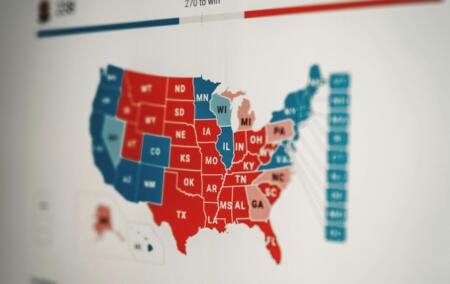
There are three ways to sow distrust in an electoral system that purports to be a democracy.
You can sow distrust in the mechanics of vote-counting (this, of course, usually requires you to produce hard evidence). You can sow distrust by appealing to voters’ belief systems (“It’s rigged because they’re crooks and bad people!”). Or you, a losing candidate, can simply say – impossible, I couldn’t have lost, everybody loves me.
With the US midterm elections bearing down upon the world, and weighty matters like wars, tariffs, health policy and immigration at stake, trust in the electoral system seems to be near an all-time low, a good state of affairs for someone with election rigging on their mind.
Having lived in the US through four presidencies during the late 20th century, I can report that there was no serious distrust in the system during that period.
Even Al Gore’s razor-thin loss to Bush didn’t leave any lasting harm beyond transient disappointment. There have been a couple of malcontents in other small local contests over time, but they were quickly snuffed out by the weight of evidence, auditable processes and the belief of citizens of both parties in the integrity of the system.
All that changed with Trump.
He sowed distrust in the counting mechanism (none of the evidence presented passed legal muster). He and his acolytes whipped his base into a disbelieving frenzy simply by repeating the claim. And he was personally outraged by his loss in 2020 – surely I must have been cheated, because everyone loves me.
(I assume at this point I will be accused of taking sides, but one needs to be reminded of this alarming quote from the president in an interview with Dan Borgino on 26 February – “The Republicans should say, we want to take over. We should take over the voting… The Republicans ought to nationalize the voting”. That is a clear statement of intent).
In any event, the consequence is that trust in American elections now rises and falls with the fortunes of whichever party is winning.
In 2004, 87% of Republicans trusted the system against 59% of Democrats. By 2024 the gap had swung to a record 56 points the other way – 84% of Democrats against 28% of Republicans. Today the gap has all but vanished, and not in a good way – Republicans regained their faith when Trump won, while Democrats lost theirs.
Electoral trust
Interestingly, this is not the pattern in most of the world, where electoral trust in democracies has held steady. The US is one of the few places where it has not.
Here are the numbers. Since 2006 Gallup has asked people in around 140 countries the same question: do you have confidence in the honesty of your elections? Contrary to the prevailing gloom, the global median has crept up, from 42% in 2006 to 49% in 2025. In liberal democracies it sits at a comfortable 64%.
The Electoral Integrity Project, which surveys political scientists after every national election, scored America’s 2024 election 54 out of 100. That puts it level with Bolivia, a point ahead of Mexico, behind Ghana (76) and South Africa (68), and a long way behind Canada (86) and Sweden (89).
Heading into November, Pew finds 55% of Americans confident the midterms will be run fairly and accurately, down from 64% before the 2022 midterms. A UC San Diego survey of 11,000 voters puts confidence in an accurate count at 60%, down 17 points since the 2024 election, with Republicans, Democrats and independents all sliding by double digits. Fewer than half expect the midterms to be free and fair.
Two facts I heard on the NYT Interesting Times podcast this week set me thinking about this.
The first is that Texas ran its voters’ roll of more than 18 million names through a federal citizenship database, looking for fraud (as requested by the administration). In the end, 117 cases were referred to the state attorney general, and seven people have been charged. Seven, out of 18 million.
The second has to do with Trump’s voluble support for proof of citizenship to vote. A sound idea in principle. Except that the US has no national ID card that proves citizenship, so a passport would be the primary evidence required.
How many US citizens hold a current passport? About half. The alternative, a birth certificate plus ID, is even worse, because women who changed their surnames on marriage also need a marriage certificate. In short, a proof-of-citizenship requirement could shut out tens of millions of eligible voters. (On the other hand, a photo ID that matches the voters’ roll is obviously a good idea.)
Mostly rebuffed
In any event, none of this will be in place by November, and Trump’s attempt to restrict mail-in voting has been mostly rebuffed by the Supreme Court.
Does this mean there will be a tsunami of fraudulent voters? No – there hasn’t been in the past, and there won’t be now. Falsifying a voter registration is a federal offence, and if you are not a citizen, well, the US now deports people to such lovely places as Equatorial Guinea to be beaten and imprisoned. I can’t imagine many would-be illegal voters risking that.
Which leads us here – should we trust the results of the midterm elections?
There are indeed many ways to sway elections. Redistricting (both parties are guilty). Outspending your opponent on messaging (both parties again). Unfair coverage (both parties trying to out-algorithm each other, skirting the edge of misinformation). Everyone is cage-fighting right up to the boundaries of the law in the run-up to an election. Nothing new here, folks.
So, can Trump or his apparatchiks actually rig the election, if they wanted to?
I don’t believe so, even though most of my friends on the left are convinced that is exactly what is unravelling before their eyes. He could, I suppose, declare an “emergency” in this city or that state – highly unlikely, given the risk of political backlash within his own party. He could send in ICE or the FBI to “monitor” polling stations (as has been demanded by MAGA operative Steve Bannon). That won’t play well either and Trump probably knows it.
There are also other scenarios, mostly floated by alarmed Democratic commentators, like post-election interference (having the House refuse to certify close or contested results, for instance). There may be an attempt to coerce malleable election officials to do something illegal. There is a long-shot danger of confiscation of voting machines for “analysis”, something Trump has said he regrets not doing previously. Then again, hypotheticals are exactly that. Making the jump from hypothetical to high-probability threat is a stance without firm evidence.
Polling poorly
Trump is polling poorly, and that will rub off on GOP candidates for the House and Senate. He probably knows he is going to lose control of at least one chamber, most likely the House. Relatively few competitive Senate seats are in play, so the Senate is probably safer. I have no doubt he will do everything he can to prevent what seems inevitable, but on the ground, in the fishbowl watched by suspicious voters on both sides (to say nothing of the eyes of the world), his options are limited.
So here is my prediction. As the losses come in, Trump will cry fraud, again without evidence. His core base will be outraged, and X will explode. But that base is smaller than it was two years ago. He will not notice, because given what he still insists happened in 2020, he will be certain, beyond a shadow of a doubt, that his team has been robbed.
What everyone else will know, with equal certainty, is that the midterms will mark the beginning of the end of the Trump era.
[Image: Clay Banks on Unsplash]
The views of the writer are not necessarily the views of the Daily Friend or the IRR.
If you like what you have just read, support the Daily Friend