

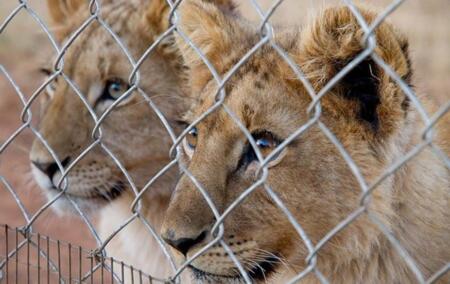
A new study has found that commercial business practices compromise the welfare conditions of captive big cats across multiple aspects of their physical, environmental and behavioural conditions.
Peer-reviewed research conducted by welfare and wildlife specialists from Blood Lions and World Animal Protection demonstrates that consistent animal welfare concerns across all the 34 assessed venues cannot be explained by isolated cases of poor animal husbandry.
The findings contribute further empirical knowledge to existing concerns about South Africa’s commercial captive predator industry, which is already contentious based on welfare concerns and potential reputational damage.
The research team undertook a systematic assessment of lion welfare conditions and husbandry practices at 34 tourism venues across four of South Africa’s provinces, namely Gauteng, Limpopo, Free State and the North West.
These venues aim to attract both local and international paying visitors for activities such as predator viewing, cub petting, and walking with lions. The methodology allowed the researchers to enter the venues as paying guests to observe what visitors would ordinarily see and experience.
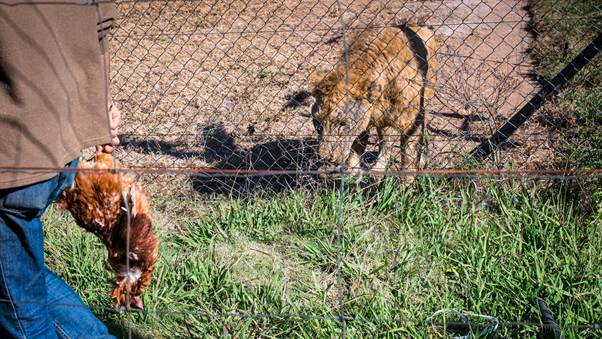
A lion with severe mange is fed a chicken carcass during a guided tour of the predator park. [Image: Blood Lions]
The big cats’ welfare conditions that were observed indicate systemic welfare challenges deeply embedded in the wider commercial captive predator industry. Given that all the venues are open to the public, the findings raise further concerns that conditions in off-grid facilities that breed and keep lions and other big cats for hunting, live export, and trade in their body parts, are likely to be similar or even worse than the welfare conditions observed in the study.
Interestingly, the statistical analysis highlighted that venues offering animal-visitor interactions (offered by at least two thirds of the venues assessed) showed poorer welfare conditions than those that did not permit direct contact with their big cats.
Activities such as bottle feeding and cub petting, and walking with lions consistently showed concerns across all welfare indicators compromising well-being of the animals in their care. However, this does not mean that simply avoiding cub petting or walking with lions, and choosing a venue where lions are exhibited for viewing only is a guarantee of good welfare conditions.
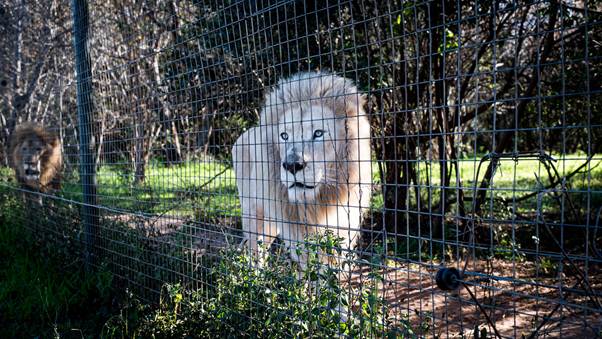
White lions are specifically bred for the commercial captive lion industry as a rarity, often fetching higher prices as hunting trophies. [Image: Blood Lions]
This new research fills a knowledge gap illustrating a consistent and systematic picture of the welfare conditions experienced by captive lions and other big cats across South Africa’s captive predator tourism industry.
These compromised welfare conditions must remain central to ongoing efforts to bring the commercial captive predator industry to an end.
“When animals are kept within a system designed primarily around their commercial use, their management tends to be shaped by the needs of business and profit, rather than by what is best for the welfare of the animals under their control”, says Dr Louise de Waal, Managing Director of Blood Lions.
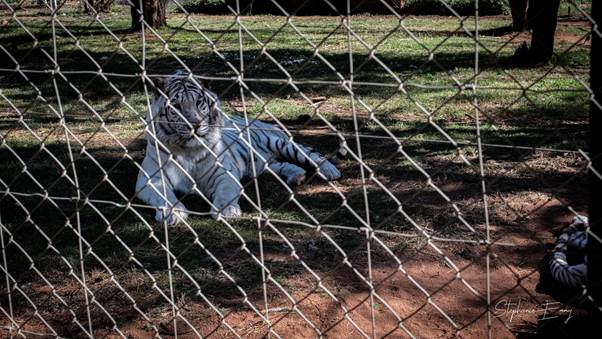
Tigers receive less legislative protection in South Africa and experience poorer welfare conditions, such as more restricted enclosure space. [Image: Blood Lions]
South Africa has one of the world’s largest commercial captive lion industries. Nearly 8,000 lions exist across 350 facilities to be used in a variety of commercial practices not limited to breeding, captive trophy hunting, live trade, interactive tourist activities, and trade in their body parts. Lions are not the only predators utilised by this industry.
Thousands of other indigenous and exotic cats, like tigers, jaguars, caracals and servals, form part of the commercialisation of predators. The result is a highly interconnected commercial system that exploits big cats for profit across their lifespans, while jeopardising their well-being and welfare.
South Africa has been on a trajectory to phase this industry out, but this was halted under former Minister Aucamp.
“We sincerely hope that the findings of this research help Minister David Maynier to continue the process of phase out, which has been through years of rigorous democratic processes and is based on solid scientific evidence”, says Dr de Waal.
[Image: Pippa Hankinson, founder of Blood Lions]
The views of the writer are not necessarily the views of the Daily Friend or the IRR.
If you like what you have just read, support the Daily Friend