

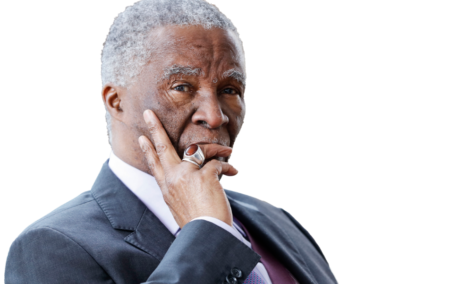
According to Thabo Mbeki – or technically, the document put out by the Thabo Mbeki Foundation – for South Africa to abandon its policy trajectory would not merely be a political defeat but would push the country to the edge of collapse.
In the distinctively dry prose, first-person-plural expression and liberal use of exclamation marks that characterise Mbeki’s writing, the document restates many of the arguments that are by now familiar to those who have followed the confrontation between the US and South African governments, and the angry public debate around the status of Afrikaners.
That is, it restates the arguments being made by government, by most of the commentariat and of course by the ANC, that concerns for Afrikaners are made in maliciously bad faith. Let them prevail, and the consequences will be – as an Afrikaner once memorably put it – too ghastly to contemplate.
“Were South Africa to abandon a determined programme to eradicate the legacy of colonialism and apartheid, it would lead to a social explosion much worse than the 1960s riots in the US! As AfriSol [the AfriForum-Solidarity movement] celebrates whatever it might consider to be its victory, if such victory serves to perpetuate any element of the apartheid system, they should know that not only will that victory be short-lived, but also that it will provoke a level of violence which will cost many lives, including those of Afrikaners.”
Apocalyptic predictions indeed.
At issue here are a raft of discriminatory policies. Let’s be clear on that phrase; clarity, I think, being important to understand this entire issue. To discriminate means to make a distinction between things and to choose one over another. This is not pejorative, and discrimination is an established and uncontroversial part of human behaviour. (The late Walter Williams once quipped that he had often considered being less discriminatory in female companionship, but that Mrs Williams might object.) Laws routinely discriminate, which is why adults can hold steady employment, but children can’t.
While South Africa’s constitutional dispensation is founded on a commitment to non-racism, discrimination on the basis of race has been a fairly common feature of South African policy and law since 1994. The Institute’s Index of Race Law records 145 laws that in some way make “race, skin colour or ethnicity” relevant to their operation.
As I have previously stated, this is not to say that they all have comparable consequences, and it is also incorrect to assert – as some have done – that these are all “anti-white” laws. The reality is more complex. It is equally disingenuous to argue that there is “no discrimination”, because this regime is aimed at redress. All that such an argument can achieve is to justify discrimination. Hence the term that appears, typically, in foreign jurisdictions, “positive discrimination”.
It’s this understanding that serves as the legitimation of South African policy. It is – in the view of its proponents – discrimination (even if there is some skirting around the word), but good, necessary discrimination. Sometimes, as in labour and staffing demands, this bills itself as ensuring a suitable racial composition among firms’ workforces, so-called “representivity”. In others, as in empowerment and procurement policy, it has a more partisan aspect, favouring firms with more explicitly “black” identities. From time to time, racial criteria can constitute an absolute barrier, as was the case when the Youth Employment Service was launched in 2018, pointedly excluding white applicants.
This is the transformation agenda that has been central to the African National Congress, government policy, and President Mbeki’s own record. Going back to the 1990s, the economic trajectory that was pursued was unmistakably one defined by, fronted by and bounded by race. The first Director General of Labour after the transition, Dr Sipho Pityana, for example declared: “The long and hard struggle for a non-racial South Africa was not a struggle for a raceless South Africa. In this world there will always be different races, and the sexes will always be different. This is the way God made the world and it cannot be changed.”
Imprint of apartheid
As deputy president, and then later as president, Mbeki frequently returned to a variation of this theme. He argued, with justification, that the imprint of apartheid was evident in patterns of wealth and poverty, and promoted racially directed remedies that were manifested in such measures as the transformation of the public service and public sector (which involved making substantial payouts to get rid of incumbents); the Employment Equity Act; and the Broad-Based Black Economic Empowerment Act. These were buttressed by a large number of legislation and policy demands that saw greater state intrusion into business activities, invariably in pursuit of transformatory objectives, with racially based redistribution at their centre, such as the Mineral and Petroleum Resources Development Act and the various industry charters.
President Mbeki was unapologetic about this; indeed, he was given to dismissing arguments against racially based programmes as a mere expression of racial prejudice.
Thus, in June 1997, he told Parliament: “During our debates in this house, the issue of affirmative action arises repeatedly. As with other matters on which we all assume there is national consensus, comments on this issue are normally prefaced with professions of support for the objective of creating a non-racial society, as well as understanding for the need to employ affirmative action as one of the means to pursue this objective. Argument then follows, which effectively rules out such affirmative action in the name of nonracialism, buttressed by further argument about experience and efficiency. In reality, I believe that we are not far from the day when the diplomatic language will slip and the point will be made openly that ‘The Bantus are not yet ready to govern’.”
Nor was he averse at that time to calamitous visions for South Africa, if the prescribed course was not followed.
In a memorable contribution in 1998, he quoted the African-American poet Langston Hughes, asking “What happens to a dream deferred?”
“His conclusion,” the then Deputy President stated, “was that it explodes”, a dark warning of the disaster that loomed, should the transformation programme fail.
The symmetry between the vocabulary employed back then, and that employed in the recent paper draws a line between the two arguments, suggesting that for President Mbeki, the moment of the apocalypse may be approaching.
There is not much to suggest this, at least not in the sense of an uprising of the dispossessed and downtrodden against their racial oppressors. One of the more remarkable features of post-apartheid South Africa has been just how relaxed, generally pragmatic and even positive everyday race relations are.
But the point remains that the country is surprisingly at ease with its racial diversity, and race per se is not a source of major tension.
The IRR’s polling typically shows that eight out of ten South Africans respect and recognise mutual dependence on one another. Last year’s poll recorded 93% of respondents saying that the different races needed one another for progress.
Stats SA found in its 2021/22 Governance, Public Safety and Justice Survey that less than 5% of respondents reported having experienced racial discrimination over the past year (down, in fact, from the 6.8% who reported this in 2018/19). Indeed, across a range of polling over decades, racism and what President Mbeki terms “the National Question” have seldom been shown to be significant concerns.
This doesn’t take away from instances of racial confrontation and racially inflected crime, or incitement or simply from interpersonal nastiness. Nor does it detract from the fact that political parties may tend disproportionately to draw support from particular racial communities or that South Africa has more than a few political leaders who are not shy about attempting to stoke and capitalise animosities.
The podium and the editorial
Race and racism are typically the concerns of South Africa’s elites, the stuff of the podium and the editorial. It is no surprise that Stats SA found that those with the highest educational attainment were most likely to report having experienced racial discrimination.
What “ordinary” people are focused on is the matter of their material existence. They want opportunities, security, competent governance and, above all, employment. There is a long trail of polling to demonstrate this. IRR polling in 2025 found that 29.4% of registered voters identified unemployment and job creation as among their top two concerns, 9.1% identified illegal immigration, 8.5% crime or safety and security, 7.8% corruption, and 7.4% the abuse of women and children. Esteem issues – racism, inequality and land reform, for example – received support in the low single figures.
This holds, with some variation, across race and party affiliation.
Moreover, there is strong endorsement of the potential of education and employment opportunities to erode cross-racial disparities. Some 73% agreed that “With better education and more jobs, the present inequality between the races will steadily disappear.” Similarly, most South Africans endorsed merit in employment (though with strong support for additional input measures, such as training, for the disadvantaged in society) and value for money in procurement, over race-based prescriptions.
Again, this held across party affiliation. The ANC’s own supporters recorded substantial majorities favouring merit in hiring (73%) and in value-for-money (65%).
All of this is entirely in line with what other organisations’ polling – such as that of Afrobarometer and the Social Research Foundation – has found.
Indeed, not only does this suggest that the weight of public opinion is not invested in race-based policy, but there is also good reason to suggest that it would welcome a change. Polling by the Social Research Foundation over the past two years reveals a willingness to loosen labour laws, to shed red tape and to fundamentally reform Employment Equity and BEE. It showed that some 74% of South Africans rejected government dictates on the employment of staff, while some 67% wanted reform to empowerment policy that focused on real-time disadvantage rather than race.
Polling also shows considerable pessimism about South Africa’s current circumstances. Afrobarometer’s 2025 omnibus poll recorded 82.5% of South African respondents believing that the country was going in the wrong direction: a complete turnaround from the heady days of transition, where around two thirds would say things were going in the right direction. There are also indications that the country’s grinding failure to extricate itself from its morass, and to actually satisfy those material needs, is eating into support for constitutional democracy itself.
President Mbeki articulated precisely this as far back as 1990, when he told a London business conference: “It is also clear that any political settlement in South Africa cannot survive unless it is underwritten by a similar transformation of the quality of the material life of especially the black majority.”
This is a process for which there are numerous corresponding cases worldwide. A substantial volume of research and analysis has delved into the regression or failure of democratic regimes, both newly democratised ones and those with venerable traditions. It comes as no surprise that democratic failures frequently track inabilities to tackle pressing societal crises, typically by opening up the electorate to the promises of political usurpers. In South Africa, there is no shortage of these, and for a population hungry for socio-economic upliftment, this is a clear danger.
Costs to economies
The policy agenda that had been pursued has been complicit in this. Racially and ethnically preferential policies the world over have seldom had the impact that their authors might have hoped for. They invariably come with costs to economies in terms of premiums paid and opportunities forgone, in what has not materialised rather than what has visibly been lost, while their benefits are disproportionately directed at those best positioned to claim them: those, inevitably, who are least in need.
It is on these grounds that preferential policies in the US, referred to at length in President Mbeki’s paper, have been much criticised. Where such policies are closely aligned to political power brokers, the damage is much greater and the benefits more limited.
The ANC should take note of this. Another poll by the Social Research Foundation concluded that 70% of South Africans said that affirmative action had benefited primarily the politically connected and “elites”. The ANC is also most strongly identified with the phrase “anti-poor”. These are the fruits of its own behaviour and the policy agenda it pursued.
It is not a change of direction from South Africa’s existing “transformational” trajectory that poses a threat, but a refusal to do so, and in that refusal, denying the country’s economy the growth impetus it needs to achieve the momentum that will deliver societal upliftment at scale.
And so we come to the real potential for an explosion, though it is worthwhile turning again to Hughes’ words.
What happens to a dream deferred?
Does it dry up
Like a raisin in the sun?
Or fester like a sore–
And then run?
Does it stink like rotten meat?
Or crust and sugar over–
like a syrupy sweet?
Maybe it just sags
like a heavy load.
Or does it explode?
Note that this is framed not as an assertion, but as an interrogative. He muses over the various scenarios but does not emphatically claim any as inevitable. Certainly, the verse presents the sudden, possible violent rupture as a possibility. That is a warning, and an enticing one for a politician hoping to make a point.
But the record of democratic decline internationally is invariably not accomplished by riots and bloodshed, but by something slower, perhaps even deadlier. It is the denuding of the moral authority and ideational attractiveness of an order of sovereign citizens to manage their own affairs, to pursue their aspirations and to seek a worthwhile future for their children. It is less explosion than drying up, rotting and lying like a burden upon society.
This is not apocalypse, but decay and despair. It is this that we should fear.
Dogged adherence
Likewise, the dogged adherence to an ideological framework that is visibly failing the country’s people and does not even command their enthusiasm is itself dangerous. South Africa’s people are pragmatists, prioritising the quality of outcomes over the justifications behind policy.
And it is for this reason that South Africa must change course.
[Image: https://mbeki.org/thabo-mbeki-presidential-centre/]
If you like what you have just read, support the Daily Friend