

Israel today marks the third anniversary of the brutal cross-border surprise attack by Hamas, which left 1,200 people dead, 250 abducted and taken into the horrific and unhealthy conditions of Gaza’s tunnels as hostages, and property burned and destroyed.
The media described it as a surprise attack because the Israeli authorities did not see it coming. This terror attack sent shockwaves around the globe.
While Israelis wanted to see those responsible for failing to protect the country and its people held accountable, there was a consensus first to prioritise the return of all hostages alive and to hold Hamas accountable through a massive military response. For a country reeling from such a devastating loss, what other options did it have to restore its people’s faith that, despite this huge security blunder, it would be prepared in the future to secure its borders and protect its people?
The war between the Israel Defense Forces (IDF) and Hamas was largely sparked by the October 7 attacks. Against this backdrop, the Israeli authorities decided to disarm Hamas, firmly believing that doing so would create a safer living environment not only for Israelis but also for Palestinians, who are equally yearning for peace and stability, but whose aspirations have, in Israel’s view, been derailed by Hamas for narrow political ends.
The tragedy took place a day before I was supposed to board a flight from Johannesburg to Tel Aviv to further my postgraduate studies at Ben-Gurion University of the Negev (BGU).
The trip had to be delayed until the beginning of December 2023. Although I considered abandoning the once-in-a-lifetime opportunity to study, education has always been important to me. I also felt that it was important to witness these events as a journalist and researcher.
It was very tense when I arrived in Israel, with fewer people in the streets, which reminded me of the lockdown days in South Africa during the height of the Covid-19 pandemic. There were posters of abducted persons with messages of hope.
Abducted
Ten members of the university community at BGU were among the abducted. Noa Argamani, who was rescued after more than 200 days, became the face of the abducted BGU community members. There were ululations and celebrations following Argamani’s safe rescue from tunnels in Gaza, bringing renewed hope that those who were still being held captive would also be saved.
There is no doubt that this tragedy changed the political, diplomatic, and security outlook in the Middle East, America, Europe, and Africa as well. For example, the collapse of Bashar al-Assad’s rule in December 2024 was a result of the October 7 tragedy and the conflict that followed in the wider region.
We started to see Iran coming out in defence of Hamas and Hezbollah, which culminated in direct military confrontation between two of the biggest military powers in the Middle East. It was frightening because no one knew how these attacks and counterattacks would affect the people and their countries. There was fear in the streets of Israel and Iran alike.
I was born a few months after the release of Nelson Mandela. I grew up in a democratic South Africa where I never witnessed war or scenes of large-scale political violence. I was scared, everybody was, but this was a war zone, and there was little I could do about it.
It was around April 2024 when both countries exchanged massive missile strikes. We spent most of our nights in the safe rooms (bomb shelters), taking cover. The confrontation between Israel and Iran made it increasingly clear to me that there was not going to be any diplomatic or political solution to what I viewed as the longest conflict in human history.
Faced hostility
Israel has previously faced hostility from its neighbours since the country was established in 1948, following the end of the British Mandate of Palestine and the adoption of United Nations General Assembly Resolution 181, which proposed the establishment of two separate states, one Arab and the other Jewish.
There has always been a need for Israel to strengthen its security and secure its borders. Several countries that directly fought with Israel, such as Egypt and Jordan, have since normalised relations with Israel, including through the Abraham Accords. However, this appears to be more difficult with Iran, which has confronted Israel through proxies such as Hamas, Hezbollah and the Houthis.
Peace is unlikely to be achieved in the Israel-Palestine conflict while Hamas remains armed, because we have seen it repeatedly engage in hostilities when opportunities arise.
Firing missiles at Israel will not achieve a two-state solution; instead, it makes the other side suspicious and makes it almost impossible to have a neighbour that is perceived as continually plotting to annihilate the other.
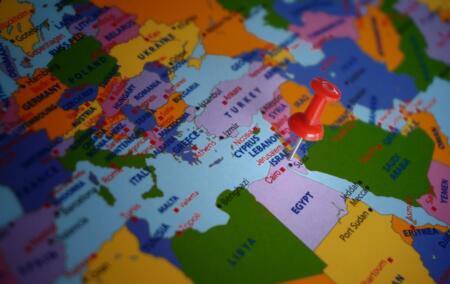
[Image: by mohdizzuanbinroslan]
The views of the writer are not necessarily the views of the Daily Friend or the IRR.
If you like what you have just read, support the Daily Friend