

South Africa is 20% Wakanda and 80% Flea Bottom.
That is the impression I got from the paper, Racial Inequality and Redistribution in Post-Apartheid South Africa, which examines income, taxes and government transfers between 1993 and 2019, using a database that combines household surveys, tax data, national accounts and government budget information.
The headline numbers are extraordinary.
In 2019, average per-capita factor income among white South Africans was comparable to the average national income of Denmark, while average income among black South Africans was comparable to Bangladesh. Yet the average income of the top 10% of black South Africans was comparable to that in Italy, while the average income of the bottom 90% was similar to that in Zimbabwe.
That is an astonishing distribution within a single racial group.
And it is why I think South Africa’s inequality debate often misses half the story.
We talk about the enormous economic gap between black and white South Africans, and that gap does remain extreme by international standards. But an enormous amount of inequality also exists within racial groups, particularly within the black population.
This is probably the most interesting finding in the paper, and it is something that is often under-reported in traditional media.
The authors show that the white-to-black per-capita factor-income ratio fell from 17 in the mid-2000s to about 9 in 2019; or put another way, the average or mean income for white people fell from 17 times that of black people to 9 times that of black people. That sounds like a dramatic narrowing of racial inequality — and it is. But the authors estimate that almost half of this reduction came from the exceptional growth of incomes among the top 10% of black South Africans, relative to lower black income groups.
In other words, part of the story of declining racial inequality is not that the black population as a whole suddenly became substantially richer. It is that a rapidly growing black upper-income group pulled up the black average. (Most of this growth is concentrated in Gauteng).
This becomes even more striking when one looks at who occupies the top of the income distribution.
Under apartheid, whites overwhelmingly dominated the upper reaches of the income distribution. Earlier work by the same researchers and their collaborator Aroop Chatterjee found that whites represented more than 90% of the top 10% of earners under apartheid. However, by 2019, Black Africans accounted for roughly 45% of the top 10%.
To put all of this another way in stark numbers; 5.052 million Coloured people’s income is analogous to their being like Tunisia or El Salvador, 5.049 million Black people in the top 10%, like Italy, 4.504 million White people, like Denmark, 1.684 million Indian/Asian-descent people, like Poland, and a large 45.548 million black people in the bottom 90% whose incomes are like those in Zimbabwe.
The South African economy has, over the past three decades, created a substantial black professional, managerial, entrepreneurial and high-income class who have benefited from the enormous skills(wage) premium South Africa has experienced since opening up its economy in 1994. The racial composition of the upper end of the income distribution has changed enormously, even though the country remains extraordinarily unequal.
And there is another important point here.
We are talking about millions of black South Africans who have entered the higher-income parts of the economy, alongside a much larger population that remains poor, unemployed or dependent on social transfers.
This is where the tax-and-transfer findings become particularly interesting because it is reasonable that someone might assume that if racial inequality has fallen, it is primarily because the government has redistributed income from whites to blacks.
That is not what the paper finds.
The tax-and-transfer system has become considerably more progressive since the mid-2000s and has substantially reduced overall post-tax inequality. But the white-to-black income ratio has declined at roughly the same rate before and after taxes and transfers. The reason is that redistribution increasingly takes place within the black population itself. As more black South Africans enter high-income groups, they become taxpayers and cease to qualify for many social transfers, while poorer black South Africans receive an increasing share of those transfers.
That is an extremely important finding.
The welfare state can redistribute money. It can reduce poverty. It can reduce overall inequality. And South Africa’s transfer system clearly does some of that, but redistribution is not the same thing as economic transformation through productive employment.
The paper does not prove that “jobs are better than welfare” in some absolute sense. What it does show is that the narrowing of the racial income gap since the mid-2000s was driven to a very substantial degree by the growth of high black incomes, rather than by an increasingly powerful redistribution of income from one racial group to another.
That should tell us something about what economic policy needs to prioritize.
South Africa needs far more people entering productive, formal employment and far more people moving from low-productivity work into better-paid occupations, and that is the obvious part which everyone and their uncle know. But the part that is often under-stressed or not even given any true airtime is that a country does not meaningfully eliminate racial inequality simply by moving money around. It does so by creating millions of opportunities for people to acquire skills, enter productive firms, earn higher incomes, accumulate assets and eventually become taxpayers rather than transfer recipients.
There is an absolute dearth of high-quality blue-collar and grey-collar work opportunities in this country, which is no doubt a byproduct of the Tripartite Alliance (especially the unions) and the unspeakably dumb labour and industrial policy the ANC has taken on, This has both prioritized capital intensive investment over labour-intensive investment and prioritized relatively highly-paid union workers, even to the detriment of expanding our industrial base and work opportunities for low-skilled people, who are the majority, or 90% of our population.
South Africa’s political debaters spend an enormous amount of time discussing redistribution, and considerably less time asking a much harder question: where are the productive jobs going to come from?
Our unemployment crisis remains enormous, and the answer cannot simply be to expand the welfare state indefinitely.
South Africa needs a much larger productive economy, capable of absorbing people with different levels of education and skill, including people who are not university graduates.
This is why I continue to believe Nelson Mandela Bay has exceptional long-term potential.
Johannesburg is unquestionably the country’s most important economic centre. Gauteng is a different economic universe from much of the rest of South Africa, but Nelson Mandela Bay has something that gives it an enormous strategic advantage: an existing industrial base, a major automotive cluster, a deep-water port and one of the country’s largest special economic zones.
Coega is South Africa’s largest SEZ, covering 9,003 hectares and located next to the deep-water Port of Ngqura. The zone has been built around industrial clusters, including automotive manufacturing, metals, logistics, energy, agro-processing, maritime industries and business-process outsourcing.
Take something as ordinary as an electric bicycle.
The question should not simply be whether South Africa can assemble an e-bike (there are already companies that do this). It should be whether a company could be attracted to Coega to manufacture more of the value-chain locally: frames, batteries, motors, controllers, electronics, assembly and logistics, and then export those products into African markets, using the African Continental Free Trade Agreement.
This is the difference between an economy that endlessly debates redistribution and one that expands the number of people with productive incomes.
Yes, industrial policy can fail. State incentives can be captured. Infrastructure can decay. Electricity and logistics problems can destroy otherwise viable investments. Crime and weak institutions can make operating costs uncompetitive.
But those are arguments for doing industrial policy better, not arguments for avoiding productive economic activity altogether.
The lesson I take from the Czajka-Gethin paper is therefore fairly simple.
South Africa has made real progress in breaking open the racial composition of its upper-income economy. The emergence of a substantial black high-income group is not a trivial development. It is one of the most important economic transformations of the post-apartheid period.
But we have not yet created anything like the broad middle- and working-class industrial economy required to pull the bottom 90% of black South Africans upward with the top 10%.
That is the next battle.
And it will not be won by pretending that redistribution can be a substitute for economic growth.
It will be won by creating an investment environment where firms, factories, supply chains, ports, logistics networks, technical occupations and export industries give millions of South Africans a reason to wake up in the morning and go to work.
That is why I keep returning to Nelson Mandela Bay.
Johannesburg is South Africa’s economic capital.
But if we are looking for a place with the potential to combine manufacturing, logistics, automotive production, the Coega SEZ, the Port of Ngqura and access to a rapidly integrating African market, Nelson Mandela Bay has an argument for being the country’s biggest under-appreciated economic opportunity.
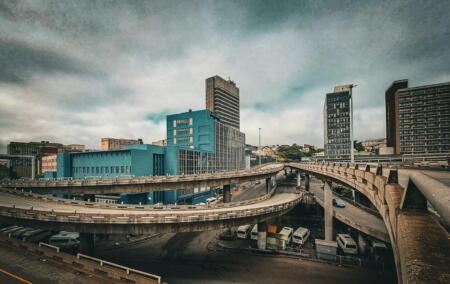
[Image: William Veitch on Unsplash]
The views of the writer are not necessarily the views of the Daily Friend or the IRR.
If you like what you have just read, support the Daily Friend