

President Cyril Ramaphosa has promised black farmers title deeds to 2.5 million hectares of state land. It sounds like a good land reform idea, but it is hobbled from the start.
In his weekly newsletter on Monday 12 October 2026 (archive link because that link will be invalid next week), President Cyril Ramaphosa wrote an unusual sentence for an ANC president: “The first step in building a new generation of South African farmers is providing them with titled access to land.”
He followed it with a promise. “Through the Proactive Land Acquisition Strategy, we are releasing approximately 2.5 million hectares of state-owned land in various parts of the country to black farmers and providing them with title deeds.”
He also praised the Land Bank’s Blended Finance Scheme, which combines government grants with loan finance, and invited more commercial banks and agribusinesses to join it. And he commended commodity organisations such as Grain SA and the Milk Producers’ Organisation for mentoring and training new farmers.
I have been arguing that the state should look at its own holdings for land reform purposes for many years. See this column about Julius Malema’s land reform demands from 2011, and this one about the importance of private property rights to land reform from 2018.
It would be churlish not to welcome this gesture. So, Mr President: well done. This is a step in the right direction.
Tenants of the state
To get an idea of what this announcement really means, consider what it remedies.
The 2.5 million hectares are not ancient Crown land. The state bought most of it, farm by farm, under the Proactive Land Acquisition Strategy (PLAS), which grew out of a land summit in 2005.
Instead of giving beneficiaries grants to buy land for themselves, the state bought farms and kept them. As the department explained to Parliament in 2018, PLAS was “meant to acquire strategically located land and transfer to the state under the leasehold system”. Leases ran for 30 years, renewable for another 20.
The effect was to turn black farmers into tenants of the state. A tenant cannot mortgage the land to raise working capital. A farmer with an uncertain lease has little reason to sink money into boreholes, orchards or soil that the state may take back.
Wandile Sihlobo, chief economist of the Agricultural Business Chamber and Ramaphosa’s Presidential Envoy for Agriculture and Land, has written about the many black farmers he has met who cannot expand or commercialise because they have no secure hold on the land they work.
(This is one of the reasons the mining sector has taken such a nosedive since mineral rights were nationalised in 2002, making miners lessees of rights owned by a “custodian” state.)
Trusteeship
The High-Level Panel chaired by former president Kgalema Motlanthe was blunt. Its 2017 report found that the state’s land leasing policy fell back on the model of “conditional use rights” state trusteeship, taken straight from the apartheid-era Development Trust and Land Act of 1936, which governed how land in the former homelands was held.
The case of David Rakgase, described in these pages by attorney Gary Moore, shows how this worked in practice. Rakgase farmed state land as a lessee from 1991. In 2003, officials approved the sale of the farm to him, at a Land Bank valuation of R621,000. In 2010, an official reversed that decision. In 2011, the state offered him a five-year lease with no option to buy, on pain of eviction. In 2019 the Pretoria High Court ordered the minister to sell him the farm at the 2003 price. The department reportedly responded by offering it to him for R5.5 million.
If this sounds broken, that’s because it is.
Reversing it is welcome. So is blended finance. A commercial bank that lends its own money to a farmer has every reason to check whether the farmer can repay, which is more than can be said for an official spending other people’s money.
Picking farmers
The newsletter leaves many questions unanswered, however.
For a start, who gets the farms? In his budget vote speech in June, Ramaphosa said the government would release the land “with title deeds to deserving beneficiaries”.
“Deserving” is a moral judgment, not an economic one. Someone has to decide who deserves what, and that someone is the Department of Land Reform and Rural Development.
According to a 2022 reply to Parliament, it uses a Beneficiary Selection and Land Allocation Policy, with selection panels, an application register, and an online system with “automated qualifying criteria”.
Ordinarily, we have a better way to decide who should own a farm. We sell it to the highest bidder.
That isn’t greed. A bid is information. What a buyer is willing to pay reflects his own estimate of what he can earn from the land. That estimate draws on everything he knows about its soil, water, crops, markets and labour, and about his own abilities. It is backed by his own money, or by a lender who has reason to believe he is the most qualified person to make the land pay. The highest bidder is usually the person who expects to use the farm most productively, and who bears the loss if he is wrong.
A selection panel has none of that information, and cannot get it. Again, we run into Friedrich Hayek’s 1945 essay, The Use of Knowledge in Society. The knowledge that economic decisions depend upon is scattered among millions of people, in bits that are often local, tacit and fleeting. Prices gather it up. Officials cannot. A panel can tick boxes for age, gender and a business plan, but it cannot know who will make a farm pay – nor does it have an answer when the farm fails.
“Trapped”
The record bears this out. The High-Level Panel found that where agriculture was the main aim of restitution, 83% of projects underperformed. It also found that the business plans on which project approval rested “correlate negatively with project success”.
Ramaphosa’s own Presidential Advisory Panel on Land Reform and Agriculture found in 2019 that beneficiary selection lacked transparency, and that business people and the politically connected were getting land ahead of experienced farm dwellers.
Even the left-leaning Institute for Poverty, Land and Agrarian Studies (PLAAS) at the University of the Western Cape agrees, from the opposite direction. Its study of 62 land reform farms under the state’s leasing policy found that selection favoured the well-off, and that policy bias, corruption and rent-seeking reinforced one another. PLAAS wants land reform aimed at the poor. I want land to end up with whoever will farm it best. In the interest of redress for apartheid, I’ll settle for someome who will farm it well.
I disagree with the left about the cure. We agree that officials choosing who gets land do it badly.
Ramaphosa himself concedes that: emerging farmers are “kept trapped at subsistence level,” he says. He blames a shortage of finance. Blaming poor selection would be an admission that the state cannot pick winners.
The obvious objection
Redress for apartheid is a fair objection to the highest-bidder rule. If the state simply auctioned these farms, many would go to established commercial farmers and agribusinesses with deep pockets, most of them white. That would defeat the purpose of land reform.
It does not, however, let bureaucratic selection off the hook, for three reasons.
First, most of this land already has occupants. Farmers who have worked PLAS land for years, and kept it productive, have revealed more about their ability than any business plan could. They should have the first claim on title.
Second, where there is no sitting tenant, the state can still let price do the selecting among eligible buyers. Blended finance helps here. If a bank has to lend part of the purchase price, its credit committee, with its own money at risk, does the screening that a selection panel cannot.
Third, and most important, full ownership lets the market correct the state’s mistakes. If officials hand a farm to the wrong person, that person can sell or let it to someone who will farm it better – and walk away with the capital.
The land finds its most productive user, and the beneficiary keeps the value. A bad selection becomes a windfall, instead of a ruined farm.
But that only works if the new owners are free to sell.
Strings attached
They aren’t. In April, the department told Parliament that title deeds now being issued carry a condition that bars the sale of the land for ten years, “and thereafter the Department will have a right of first refusal if beneficiaries want to sell the land”.
The MP who asked the question complained that some beneficiaries sell land “below market value” to former owners or “private strategic partners”, and wanted to know whether a 20-year ban was being considered.
So, the bureaucrat’s choice of owner is locked in for a decade, mistakes and all. The farmer who would rather run a transport business cannot sell up and start one. The farmer who is struggling cannot sell to a neighbour who would pay him well. And the state, having given away the farm, keeps an effective claim on it forever.
The restriction also undermines the president’s own finance plan. A title deed that cannot be sold is collateral a bank cannot easily realise. Unless the condition exempts a bank’s sale in execution – and the department has not said that it does – lenders will price that risk into every loan, or decline to lend at all.
As for sales “below market value”: an adult who sells his own property at a price he accepts is exercising the very ownership the president claims to be granting. If beneficiaries sell cheaply, the likely reason is that a farm with a hobbled title attracts few buyers. Tightening the restrictions would make that worse, not better.
A title deed you cannot sell, mortgage freely or let out is not ownership. It is a lease camouflaged behind a false pro-market name. The new farmers might have “title deeds”, but they’re not freehold title deeds.
If the state is serious about making black farmers owners, the transfer must come with full freehold rights, and no restrictions on whether the new owners may sell, let, subdivide or bequeath their property.
Dead capital
There is a further question. If title deeds are good for black farmers, why have they been so scarce for black homeowners?
When I argued in 2011 that the state should hand its land to the people who live on it, I drew on the work of the Peruvian economist Hernando de Soto, who calls such assets “dead capital”.
A family that lives in a house it does not legally own cannot borrow against it to start a business. They cannot sell it to move closer to work. They cannot let it out. I wrote then that the beneficiaries of state housing were “no better than medieval serfs, tied to their cottages and beholden to their masters”.
Fifteen years later, the minister of human settlements, Thembi Simelane, told Parliament that the backlog of unissued title deeds stands at 1,229,164.
The government’s plan, with Operation Vulindlela, is to eradicate what it calls a backlog of 80,000 title deeds during the current five-year Medium-Term Development Plan. If that were the pace for the whole lot, clearing 1.2 million deeds would take about 77 years. (The Institute of Race Relations, which publishes The Daily Friend, has asked the Human Rights Commission to declare the backlog a human rights violation.)
Apartheid-era leaseholds
Those lucky enough to receive a deed then run into section 10A of the Housing Act. It forbids the “owner” of a subsidised house to sell it within eight years, unless it is first offered to the provincial housing department. If the “owner” then moves out, the department becomes the owner, and “no purchase price or other remuneration shall be paid”. The former “owner” may join the waiting list for another subsidised house.
The minister now intends to amend section 10A – not to free the supposed owners, but to curb what she calls the “premature and illegal sale” of such houses.
Beyond the townships, the state holds a great deal more. A 2013 state land audit, as summarised by Moore, found that government at all levels owned about 21% of South Africa’s land. Millions of people also live on communal land held by traditional authorities, such as the 2.8 million hectares registered to the Ingonyama Trust in KwaZulu-Natal. They own nothing they can sell or mortgage. This is feudalism, not a market economy.
In 1983, the National Party government offered to sell about half a million township houses to their occupants, on 99-year leasehold. In 1986, it introduced freehold rights in black urban townships. In 1991, the Upgrading of Land Tenure Rights Act converted apartheid-era leaseholds and deeds of grant into ownership.
The motives were not pure. Critics at the time suspected the house sale was partly a way to fund unpopular township councils. Yet three decades into democracy, the ANC has shown less urgency about making black South Africans full owners of the land they live on than the dying apartheid state did.
Ramaphosa and his predecessors ought to be ashamed of themselves.
Privatise it
The arguments I made in 2011 and 2018 still stand.
The state is the country’s largest landowner, and most of what it holds is dead capital.
Privatising it on a large scale would be the most radical land reform South Africa could undertake, and the most effective. It would create a vast new class of property owners and transfer billions of rands in assets to poor black households, without expropriating a single private owner.
Convert every PLAS lease into freehold title for the sitting tenant who has farmed the land. Sell vacant state farms to the highest eligible bidder, with blended finance where it is needed.
Scrap the ten-year sale ban and the state’s right of first refusal. Repeal section 10A of the Housing Act. Pay private conveyancers per registered deed, and clear the township backlog in years rather than generations. Record the land rights of people on communal land as family property, as the High-Level Panel recommended, and give them title.
If you are going to put constraints on who can buy the land once it has been privatised (which wouldn’t be good, but would be understandable), then limit resale to the same class of people who qualified for the original privatisation, for 10 years. At least the land would then be subject to a market of sorts.
None of this is simple. Land records are a mess, competing claims are real, and some transfers will go wrong. But a mistake made by a free owner can be corrected by a sale. A mistake made by the state stays made.
A cursory nod
Ramaphosa’s nod to the market is welcome. It is also cursory, and very limited.
His newsletter frames everything as “transformation”, measured by the race of farm owners, to be achieved through partnerships between government, lenders, traditional leaders and communities.
Ownership appears as a gift to the deserving, dispensed by the state on its own terms, rather than as the right of people who live on and work the land. Can it be a coincidence that this announcement comes three weeks before local elections at which the ANC faces a possible rout?
And while Ramaphosa’s government hands out title deeds with one hand, it is defending in court an Expropriation Act that permits “nil compensation” for property in certain circumstances.
The president laments what he calls South Africa’s “two agricultures”. But they are not divided only by race.
One farms on freehold land it can borrow against, sell and bequeath. The other farms on land it holds at the pleasure of the state or a chief. No amount of blended finance will close that gap until ownership does. No amount of deceptive “title deed” labelling will turn neo-feudal leaseholds into freehold ownership.
If the ANC, and the government it leads, wants to settle the land question and build a new middle class of productive landed property owners, it has a very long way to go.
In 2011, I wrote that it would be smarter to reclaim dead capital from the dead hand of the state. Fifteen years later, that hand has loosened one finger.
It is progress, of a sort, but not very much of it.
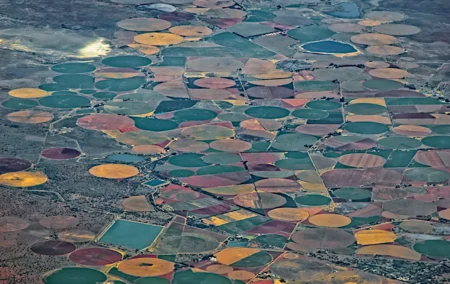
[Image: Farmland.webp]
[Caption: An aerial view of circular crop fields watered by centre-pivot irrigation systems near the small farming town of Jacobsdal in the eastern Free State, near the Northern Cape border. (Photo: Jean Boris Hamon, CC BY-NC-ND)]
The views of the writer are not necessarily the views of the Daily Friend or the IRR.
If you like what you have just read, support the Daily Friend