

‘If it’s sunny in Prague, it’s like wearing a loud shirt to a funeral.’
The cobbled streets, Renaissance fascias, Art Nouveau architecture and myriad Gothic spires best emerge from the cloak of clouded darkness as luminous beacons in Europe’s fairy-tale capital.
Centuries of history live on through its intimate, winding pathways and architectural layers. Its charismatic, worn paths have been shaped by centuries of footsteps, some of which have, however, been made by the jackboots of various 20th century occupiers.
The Cathedral of Saints Cyril and Methodius is a place of worship, but also a site of recent historical significance: the final refuge of the Czechoslovak paratroopers who carried out Operation Anthropoid, the assassination of Reinhard Heydrich, one of the most senior figures of Nazi Germany. Heydrich had chaired the Wannsee Conference earlier that year, where Nazi officials coordinated the implementation of the so-called Final Solution.
The attack would take place on Heydrich’s daily commute from his residence at Panenské Břežany to his headquarters at Prague Castle.
On 27 May 1942, Jozef Gabčík and Jan Kubiš attacked Heydrich as his car navigated a tight bend in the Prague suburb of Liben. A nearby tram stop provided the assassins with the perfect cover to wait for the tram until Heydrich’s car passed by.
Gabčík stepped out in front of the black Mercedes convertible to open fire, but his Sten gun jammed. With the car stopped for Heydrich to return fire, Kubiš tossed a modified anti-tank grenade. The shrapnel injuries caused the septicaemia which killed the Reich’s third-ranking official eight days later. The Butcher of Prague was dead. But the cost of this action was still to be paid.
For three weeks, the paratroopers and other resistance fighters hid in the cathedral and its underground crypt. The group was betrayed by Karel Čurda, a fellow British-trained Czechoslovak parachutist, who tipped off the Gestapo about his comrades in exchange for a new identity and one million Reichsmarks. Not for the first – or the last – time would trust play a part in the fortunes of battle.
On 18 June, 700 German troops surrounded the church. After a fierce battle, the remaining fighters died in the siege or took their own lives rather than be captured.
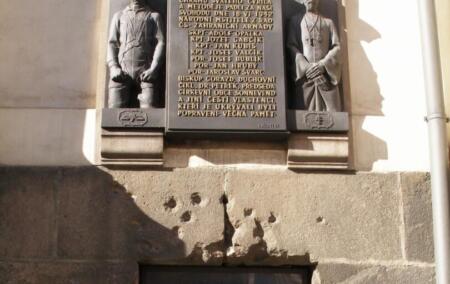
You can still see the bullet and shrapnel marks on the outside of the church walls. Operation Anthropoid is commemorated in the museum and crypt below, with bronze busts of the seven resistance fighters. The Nazis had resorted to flooding the basement with fire hoses. Low on ammunition, and struggling to stay above the rising water, the remaining four Czechs, including Gabčík, chose to end their lives rather than be captured.
At the spot of the roadside assassination, there is another memorial. Operation Anthropoid was the only successful assassination of a top-ranking Nazi official.
The Nazi response was savage and didn’t stop at the crypt with the deaths of the SOE agents. What became known as the Heydrichiáda—Heydrich’s reign of terror—brought mass arrests, imprisonment and executions. Thousands of Czechs paid with their lives, two villages of Lidice and Ležáky being razed to the ground. The men were killed, the women were sent to concentration camps, and the children were either sent to the camps or, if they were deemed suitably ‘Aryan’, adopted by German families.
History is not simply a record of what happened. It is a warning about what happens when power is left unchecked, when appeasement replaces principle, and when the price of resistance becomes almost unbearably high. Politics involves a finely woven tapestry of trust, capacity and citizenry.
It is also a reminder that history offers choices.
Czechoslovakia had already experienced the consequences of appeasement.
On 30 September 1938, Britain, France, Germany and Italy signed the Munich Agreement, compelling Czechoslovakia to surrender the Sudetenland to Nazi Germany. The region contained important industrial resources and heavily fortified border defences. Yet the Czechoslovak government was excluded from the negotiations that determined its fate.
It’s supposed allies had abandoned it in the hope of preserving peace.
The hope proved disastrously misplaced. Hitler occupied the remaining Czech lands in March 1939. Six months later, Germany invaded Poland, and Europe descended into war.
The lesson was not that diplomacy is futile, or that compromise is always wrong. It was that compromise without principle, and diplomacy without a credible strategy, can invite the very catastrophe they are intended to prevent.
Churchill captured the danger in a speech in January 1940: “Each one hopes that if he feeds the crocodile enough, the crocodile will eat him last.”
He warned that the storm would not pass. It would rage and roar, ever more loudly and ever more widely.
Almost 30 years exactly after Munich came the Prague Spring of 1968, when Alexander Dubček championed ‘socialism with a human face’ in an effort to democratise the state including greater media and personal freedoms while maintaining socialist principles. The Soviet leader Leonid Brezhnev viewed the reforms as a dangerous threat to Warsaw Pact unity and communist control.
On 20 August 1968, around half a million Warsaw Pact troops invaded Czechoslovakia to crush the reform movement. Dubček was ousted and replaced by Gustáv Husák. A harsh period of ‘normalisation’ followed that reversed the reforms imposing rigid Soviet-style control.
Milan Kundera’s account of this ‘Prague Spring’, the crushing of hope and the suffocating conformity that followed, resonates deeply with South Africa’s experience of resistance and repression.
In both our countries, people discovered the terrible distance between the promise of freedom and the reality of political power.
And yet, history did not end there. Kundera once wrote that a small nation does not make history, but is always the object of history. Small nations can however make history. So can citizens who confront apparently immovable political systems. So can opposition movements which organise themselves against formidable odds.
South Africa had Nelson Mandela. Czechoslovakia had Václav Havel. These were leaders who demonstrated that political change requires more than opposition to injustice. It requires the courage to imagine something better, the discipline to organise for it, and the moral authority to persuade others to join the struggle.
They both wore loud shirts for democracy on behalf of their people in dark times.
Their societies endured the violence of apartheid, Sharpeville and Soweto, and the repression that followed the Prague Spring. They eventually moved beyond those dark periods, not because history automatically bends towards justice, but because people worked, sacrificed and led to make change possible.
This brought rapid benefits. The Czech Republic transformed from a centrally planned economy in 1990 into a market-based, export-driven European Union member. Its nominal GDP expanded from $41 billion in 1990 to an estimated $391 billion 35 years later.
This generation of leadership had a strategy in place to achieve their goals of a different world. In the same way, though the Czech people paid a very high price, Operation Anthropoid also had the desired strategic effect in leading to the immediate dissolution of the Munich Agreement. As a result, the annexed Sudeten territory was restored to Czechoslovakia after the war.
But democracy does not defend itself. Freedom does not sustain itself. And history does not guarantee a happy ending.
The outcome depends on leadership, institutions and strategy.
The lesson of Munich is that appeasement without strategy invites disaster. The lesson of Prague is that courage and leadership can eventually overcome repression. The lesson of South Africa is that even deeply entrenched political systems can change when people organise, endure and refuse to abandon the possibility of a different future. The lesson of Ukraine is that agency is essential.
And the lesson of Africa today is that democracy must be defended not only as a principle, but as a practical political project.
The echo of these brutal times still rings in Central Europe even if we live in an age in which digital technology has democratised debate, giving millions of people a voice. Yet political and economic power remains disproportionately concentrated in the hands of a few powerful personalities, while the algorithms that shape our receipt of news and information have unseen and largely unscrutinised power. And the international system that has, however imperfectly, helped preserve security for much of the world since 1945 is now being challenged not only by its traditional adversaries, but by some of its own architects.
Democracy requires living in truth, and challenging those who say one thing and do another.
This year would have been Havel’s 90th birthday. As one of the Czech icon’s close associates Michael Zantovsky puts it in this regard, ‘We need to keep our authorities’ feet to the fire. We need to challenge the hypocrisy and Orwellian behaviour … that is not in keeping with the ideals of freedom and human rights.’
This demands, topically, not only building institutions or displaying leadership, however, but tackling malign external influences. The scale and reach of Russia’s bot networks, and their influence on Western politics, may be glimpsed in the aftermath of Ukraine’s attack on a major Yandex data centre in Russia on 11 October 2026. The immediate plunge in traffic promoting the German right-wing Alliance for Democracy (AfD) and Trump’s Make America Great Again (MAGA) movement appeared to reveal an unusually direct connection between Russian digital infrastructure and these pro-Russian political movements.
The question before us is not simply whether democracy is in retreat. It is whether those who believe in democracy have the strategy, the leadership and the determination to defend it.
Dr Mills is a custodian of the Platform for African Democrats, and attended the Forum 2000 event in Prague.
[Image: https://upload.wikimedia.org/wikipedia/commons/8/88/CM_pomn%C3%ADk.JPG]

The views of the writer are not necessarily the views of the Daily Friend or the IRR.
If you like what you have just read, support the Daily Friend