

On Friday, 9 October 2026, the Portfolio Committee on Defence and Military Veterans received the Annual Report presentations of Denel SOC Ltd and Armscor SOC Ltd as part of the Budgetary Review and Recommendation Report (BRRR) process. What emerged was not the rigorous examination these entities require. It was another compressed exercise in which two organisations charged with equipping the South African National Defence Force were permitted to place selective narratives before members inside a sitting of roughly three hours.
I have raised the inadequacy of the BRRR process in the Portfolio Committee on Defence and Military Veterans before, and on Friday I placed it on the record again. Members of Parliament are handed documents of substantial length, annual reports that contain the detailed financial and operational record of entities in serious difficulty, and are expected to analyse them, test them, and respond to them under constant pressure to speed up because of time constraints. That is not a reasonable expectation. It compresses oversight into a short presentation and a short response. It turns Parliament into a rubber stamp. If the BRRRs are reduced to that, the process is a farce. The same rushed treatment is applied to the annual reports of the SANDF, the Department of Military Veterans and, more broadly, the reports of other departments and entities. The entire manner in which Parliament deals with these reports is highly unsatisfactory. It is urgently necessary that the time allocated, the depth of prior research required, and the willingness of committees to insist on complete information rather than polished PowerPoint slides be addressed. The hardware needed to equip the SANDF, and the sovereignty that hardware is meant to protect, cannot be treated as a box-ticking exercise.
Denel’s presentation contained some facts that should be acknowledged. Revenue rose to R1.473 billion and gross profit to R361 million. Group executive posts have been filled. The company returned to the Department of Defence on 1 April 2025. On 10 July 2025 the Armaments Acquisition Council confirmed that the infantry combat vehicle remains necessary and that Project Hoefyster should continue. Those are facts. They are not a turnaround. The Corporate Plan had budgeted revenue of R1.956 billion and an operating loss of R168 million. Actual revenue missed that target by almost half a billion rand. The operating loss was R364 million — more than double what Denel itself had budgeted. The entity remains significantly loss-making. Any figure that rests on associate accounting, particularly dividends received from Rheinmetall Denel Munition, rather than cash generated from operations, cannot be allowed to dress up that result. Denel’s own PowerPoint presentation indicated that cash in September 2026 was negative. Liquidity ratios sit below benchmark. Legacy debt is not fully paid. Hoefyster advances are not supported by cash on hand. The escrow balance is a meagre R169 million.
Of the roughly R3.297 billion drawn under the turnaround framework, more than 80 per cent — about R2.757 billion — went to legacy obligations. Only about R178 million reached the growth allocation. The R1.8 billion expected from non-core asset disposals has not materialised. Public money has continued to fund the past. It has not funded a future. The audit remains the central and most serious fact: a ninth consecutive disclaimer. The Auditor-General could not obtain sufficient appropriate audit evidence across 34 areas of the financial statements. Prior-period errors were still open at 31 March 2026. Material irregularities included misuse of a public resource, statements that were not credible, data loss, customer advances used for other purposes, R14.7 million in tax penalties and interest, and R2.5 million paid for services not received. Denel has also lost significant numbers of engineers, technologists, scientists and technicians. Recruitment has resumed in some areas, but the skills base required for a sovereign defence industry has been hollowed out. The interim board chair offered a somewhat more realistic assessment than the Group CEO, whose presentation struck me as a forced and outdated recovery narrative that did not match the reality before the Committee. Members of Parliament should not be asked to applaud a recovery that the numbers do not support.
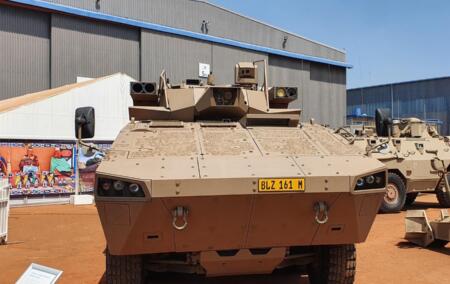
Project Hoefyster remains the wound that will not close. It was meant to replace the Ratel, which has been in service since 1976. It is more than ten years late because of capacity constraints at Denel. The revised Phase 1 baselines required the Section variant at Denel by 31 May 2025 and the Fire Support variant by 31 July 2025. The Annual Report gives no performance against those dates. Armscor indicated that Denel has gone out on a Request for Information to find a partner for Phase 2. An entity that must advertise for a partner to finish a project it has held for more than a decade has not demonstrated that it can deliver. There is consistent procrastination, and no delivery dates that can be held to. Increasingly ageing and outdated equipment sits stored away in warehouses — some of it was seen during oversight visits — while the Ratel remains in the field. Nobody has told Parliament whether the technology already paid for is obsolete. The question Denel must answer is when it will bite the bullet and take a decision on Hoefyster. That decision may be to close the project, with all the financial losses that follow. Hard as it may be, a decision must be taken. No decision, and simply allowing the disaster to drag on, is the worst possible situation. The dragging-on is itself the damage. Because Hoefyster is a gaping wound that keeps bleeding, it is also a major reason Denel cannot address its liquidity problems and cannot obtain finance or credit. It drains cash, it sits on the balance sheet as an unresolved obligation, and it scares away possible financiers. No lender will fund an entity that will not decide whether this project continues or stops.
Armscor is not Denel and should not be treated as if it were. It again received an unqualified audit opinion, which is better than a disclaimer and should be recorded. Some work is moving. Inshore patrol vessel support is described as near finalisation. The Dockyard remains a strategic facility, though it is poorly managed. These are limited positives. They do not excuse what sits underneath the opinion. The financial statements submitted for audit were not fully prepared under section 55 of the Public Finance Management Act. Material misstatements were corrected before the opinion was signed. Irregular expenditure rose by a further R19.15 million to a cumulative R51.4 million. Fruitless and wasteful expenditure rose by R1.614 million to R7.4 million. Subsistence and travel rose from R35 million to R64.2 million. Non-executive fees rose from R8.1 million to R15.2 million, with about 70 per cent of that classified as ad hoc. These are red flags that cannot be waved away.
The same pattern of delay and incomplete accountability is visible in Project Hotel, the acquisition of a new hydrographic survey vessel — the SAS Nelson Mandela — intended to replace the ageing SAS Protea and restore the South African Navy’s ability to chart its waters, meet international maritime obligations, and support safe navigation and naval operations. The contract became effective in December 2017, with delivery first promised for May 2021. Repeated extensions followed. By April 2026, when the Portfolio Committee conducted an oversight visit to the Sandock Austral shipyard in Durban, there was still no firm handover date, earlier completion percentages had become unreliable, and more than R2 billion had already been spent. The hull remains unfinished. The same yard is also late on the SAS Isandlwana refit. Armscor’s slides list Hoefyster among the projects where Denel’s failures are hitting prime-mission equipment, but Project Hotel is an Armscor-managed acquisition whose slippage cannot be blamed solely on others. Oryx and Rooivalk continue to be kept alive by cannibalisation. A decade of such slippage is also a failure of contract management.
What makes Project Hotel particularly troubling is the manner in which the tender was handled. The previous Chief of Materiel of the SANDF, Dr Mthobisi Clyde Zondi, played a central role in the adjudication process that awarded the contract to Southern African Shipyards, which later became Sandock Austral. Shortly afterwards, in an extraordinary revolving-door move, he joined the successful bidder as an executive. This sequence raises the clearest possible appearance of a conflict of interest: an official responsible for awarding a major public contract moves directly into senior employment with the company that received it. The irregularities in the tender process, the subsequent delays, the absence of a credible completion date, and this post-award transition have never been properly accounted for to Parliament. During the April oversight visit the unfinished vessel stood as a concrete reminder of what happens when procurement decisions are not subjected to rigorous, independent scrutiny.
Two further procurement matters illustrate the same problem of incomplete information. Tender ELWS/2024/71 for 462 border-patrol vehicles — 210 section, 144 command and 108 ambulance — was issued on 23 July 2024 to replace the Land Cruiser troop packs used on Operation Corona. A field evaluation set for March 2025 was cancelled after compliant bidders had mobilised. Milkor did not take part in that process. In October 2025 Milkor was confirmed as the winning bidder. On 18 March 2026 the matter was taken to court, with the Minister and Armscor as respondents. Both the award and the litigation fall inside the 2025/26 financial year. Yet the Annual Report does not account for the cancelled evaluation, the award or the case. Silence in an annual report on a tender already before the courts is itself a reporting failure. The R500 million figure cited in Parliament is an allocation, not a contract value. Armscor has still not placed the value or the full evaluation record on the table.
The second matter is the soldier’s rifle. Armscor issued Request for Information 02061-900-013 for self-loading automatic rifle systems. It closed on 30 September 2026. Officially it is not a bid. Officially it is a study into a possible replacement of the Vektor R4 and R5. It was issued after year-end, so it is not a line in these accounts. It is, however, the live test of the same procurement culture. The study is being read, reasonably, against a Kalashnikov-pattern pitch, the AK201 in 5.56 mm. Questions have been put to the Minister about information indicating that 300 such rifles were already bought for trials and have not been delivered, and that local content would be assembly rather than manufacture. These claims require confirmation or denial. A study that looks like a corridor is not oversight. The R4 and R5 are a locally designed and supported family. They can be improved. They are not to be replaced in a side room without Parliament being told whether a decision to leave that family has already been taken.
During the Committee meeting I put five questions to each entity for answer that afternoon. For Denel they concerned the concrete corrective actions taken after a ninth disclaimer, the status of every Hoefyster variant against the stated baselines and whether a binding go or no-go decision has actually been taken, the cash versus accounting nature of any bottom-line improvement given the negative cash position, the status of the non-core disposal programme, and the basis for a Corporate Plan revenue path toward R3 billion when the entity missed its own target by R483 million. For Armscor they concerned progress on the instruction arising from the April oversight visit on the future of Project Hotel, the absence of Hoefyster delivery figures and any consequence applied to Denel, the full story of tender ELWS/2024/71 including why the March evaluation was cancelled and why the Annual Report is silent, the rifle Request for Information and any prior orders of AK201 rifles, and the named control that will stop further material misstatements and rising irregular expenditure.
It was critical that the committee should not be left with another undertaking. It should receive dates with names and with decisions. What the committee must insist on is that Denel must be required to produce a time-bound plan to exit the disclaimer, reported quarterly to the committee and to SCOPA, the independent turnaround review on the table, a decision on Project Hoefyster within sixty days — either a ring-fenced, performance-bonded delivery schedule or closure with the losses quantified, because no decision is the worst possible situation — and a cash-flow statement before any further recapitalisation is entertained.
What Armscor must be required to produce is a joint accountability matrix with Denel on the shared projects so the two entities can no longer point at each other; monthly reporting on flagship projects with dates, spend and a responsible official; a full report on ELWS/2024/71 including the pleadings; a written answer on the rifle Request for Information; and Budgetary Review and Recommendation Reports that tie the next allocation to delivery milestones and the closing of audit findings, not to the repetition of an unqualified opinion with findings. Project Hotel requires the same treatment: a clear statement of the revised cost, the revised date, the capacity of Sandock Austral to finish both the hydrographic vessel and the Isandlwana refit, and a full accounting of the tender process and the revolving-door transition of the former Chief of Materiel.
What we learned on 9 October is that both entities remain in serious difficulty and that the soldier is still waiting for the vehicle Hoefyster was meant to provide, while the Navy is still waiting for the hydrographic vessel that was supposed to restore its ability to chart its own waters. What we did not learn is equally important, and more alarming. We did not learn the true cash position of Denel in a form that can sustain a going-concern claim without associate income. We did not learn whether a binding decision on Hoefyster has been taken or what the cost of cancellation versus continued obsolescence would be. We did not learn the full evaluation record or contract value of the border-patrol vehicle tender now before the courts. We did not learn whether a decision to replace the R4 and R5 has already been taken, whether any Kalashnikov-pattern rifles have been ordered and paid for, or what local content is actually proposed. We did not learn a credible completion date or full cost for the SAS Nelson Mandela, nor a proper explanation of the circumstances in which the tender was awarded and the former Chief of Materiel moved into the successful bidder. Presentations that omit these facts raise legitimate questions about whether they reflect the true reality inside Denel and Armscor.
Denel’s disclaimer is now a governance failure, not a bookkeeping failure. Armscor’s unqualified opinion is being asked to carry a capital programme it is not delivering, a border-vehicle tender that is in court, a rifle process that Parliament was not told about, and a hydrographic vessel whose tender process and revolving-door transition have never been properly scrutinised. Project Hoefyster is where the failures of the two entities meet. The SANDF cannot defend the sovereignty of the nation with ageing equipment, cannibalised aircraft, delayed ships, an unfinished hydrographic vessel, and an unresolved infantry combat vehicle project. The BRRR process itself must cease to be a rushed rubber stamp and become the rigorous oversight the Constitution requires. Anything less is a failure of Parliament’s duty to the soldiers and sailors who are expected to defend this country, and to the sovereignty they are meant to protect.
[Image: Badger IFV Missile Variant, Ricardo Teixeira]
The views of the writer are not necessarily the views of the Daily Friend or the IRR.
If you like what you have just read, support the Daily Friend