

BEE is a barrier to growth, and finding a genuinely empowering alternative is vital.
This is the thrust of the latest report from the Institute of Race Relations (IRR), Breaking the BEE Barrier to Growth.
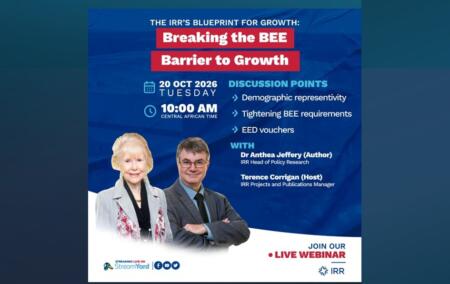
At tomorrow’s 10am online launch, IRR Head of Policy Research and author of the report Dr Anthea Jeffery will discuss the ramifications of BEE’s failures with IRR Projects and Publications Manager Terence Corrigan.
The IRR points out that criticisms of BEE have persisted in 2026, “spurred on by evidence that some 60% of the net value redistributed by pre-2014 ownership deals in mining had gone to around 46 ‘BEE entrepreneurs’ – each of whom had probably gained between R2bn and R3.7bn”.
“By contrast, most black South Africans continue to be hurt by BEE rules in mining and elsewhere, which curtail investment, growth and employment – and have helped raise the joblessness rate to 33% against a global average of 5% in 2026.
“Opinion polling by the IRR and the Social Research Foundation (SRF) shows that most South Africans see little value in BEE and would like its key requirements to be scrapped. By contrast, the ANC wants to further ratchet up the rules. As in the past, it keeps emphasising the good BEE is supposed to achieve, while ignoring the damage it does in practice.”
For this reason, the IRR argues, an alternative “is vital”.
In Breaking the BEE Barrier to Growth, the latest paper in the IRR’s Blueprint for Growth series, Jeffery highlights the failures of BEE and presents Economic Empowerment for the Disadvantaged (EED) as a sound solution that would stimulate growth and help empower the poor in meaningful ways.
Join tomorrow’s webinar at: https://streamyard.com/watch/5v6F2AKdFFrf