

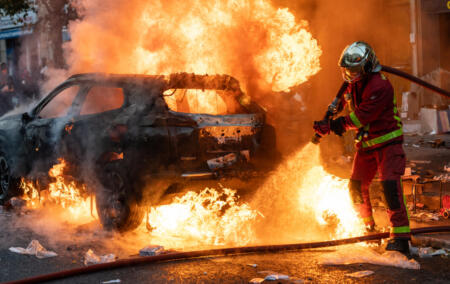
Paris could become the spark that gives further fuel to clashes with police across Europe and what the right sees as the battle for the West.
In the battle between the broad left – pro-Palestinians, defenders of mass immigration and the political establishment – France last weekend shows how bad things might yet turn out in many countries.
How all this will all end is murky. But there is bound to be a backlash to the violence with growing support for the right. And support for the hard left is likely to grow in the wake of a cost-of-living crisis and from the groups that see themselves as trampled on. But that will not sort out the problem of finding a way out of Europe’s economic growth problem.
All of this is a big defeat for the political centre, which has not been able to sufficiently restrict immigration and deal with and reverse the decline of the welfare state.
Over the weekend, after weeks of protests by schoolchildren across France, a broad coalition and hangers-on out to cause real trouble took to the streets. Schoolchildren have been protesting over problems of absent teachers and the poor state of schools. Some 3000 temporary teachers are being brought in, but the education system is bound up in bureaucracy and burdened by the pension system for retired teachers. There is no immediate solution to the economic or the education problems.
This is a Europe-wide problem and there have been demonstrations and, in many cases, violence across much of Europe. In Brussels, demonstrators have clashed with police. Troops are to be deployed in Milan, after clashes between police and demonstrators in other Italian cities. There have also been demonstrations in Spain and Portugal as well as Greece and Albania.
And there could be large copy-cat demonstrations in the major UK cities. Pro-Palestine and hard-left groups have put out a call for a “youth strike” and student walkouts for a demonstration in London next month. Clashes between far-right groups and pro-Palestinian and “anti-racist” groups are increasingly frequent on British streets.
In France, there were those out to use violence and clash with the police, but the demonstrators on Saturday, by most accounts, came heavily from a broad alliance of groups who are facing extreme cost-of-living crises. Demonstrations by schoolchildren protesting against the poor state of the education system began last month. And have since been joined by unions, the hard-left, pro-Palestinian and Islamist groups, and members of the middle class who face a sharp rise in their cost of living.
The cost-of-living crisis, in part due to the higher fuel price with the intermittent closure of the Strait of Hormuz due to the US–Israel war against Iran, is exacting a heavy toll throughout Europe. In Spain and Portugal, the main cause of the protestors is the high cost of housing. But across the continent, there is anxiety about the decline in the benefits of the welfare state and what will happen in the future.
Demonstrations often provide a big opportunity for groups with their own agendas. And mixed in were those who wanted to burn and loot and cause as much trouble as possible.
In Marseille, there were credible reports that Jewish-owned businesses were targeted by mobs.
The streets of Paris became another frontline in the battle by a broad coalition, which has a similar make-up to others elsewhere in the world. In New York City last year, a similar coalition of the left made up of those suffering a cost-of-living crisis, pro-Palestinian groups and anti-Trump groups, elected Zohran Mamdani as Mayor.
The US and European right are thrilled at the gift that France has given their cause. The extreme violence and the extensive property damage have given Marine Le Pen, leader of the far-right National Rally party, a strong boost in her bid in next year’s Presidential election.
And the demonstrations have given a definitive boost to the far-left’s Jean-Luc Mélenchon, who leads La France Insoumise, a party he founded in 2016. The demonstrations may have brought together the broad coalition that could support Mélenchon.
But for the centre, Saturday was a disaster. A centrist, President Emmanuel Macron, is not coming up with answers and is being eclipsed by the extremes.
The day after the violence, US Vice President JD Vance appears to have been gloating with his X remark that, “Western liberals imported the Third World into France and other countries in the name of diversity and compassion.”
“They ignored fundamental questions of assimilation and compatibility. They were told it would lead to this and they didn’t listen,” Vance said on X.
“I hope Americans are paying attention. This is the future Democrats seek.”
What he neglects is that left- or right-leaning governments are now far tougher on immigration. The politicians know they are following the path of the parties on the right to try and undercut them.
While decades of insufficiently controlled immigration and difficulties of assimilation play their role in Europe’s problems, there is also the problem of low levels of economic growth. That means governments just cannot spend a great deal more on health care, education and welfare. Low growth restricts tax revenue and borrowing is now a lot more expensive because of high debt levels, currently at 120 per cent of GDP, which is high by international standards. Then, with Russia’s war in Ukraine, there is the need to spend a lot more on defence to deter Moscow from further ambitions.
There is the larger issue that the welfare state, which greatly benefited post-war Europe, is in need of re-imagination. The state can no longer play such a large role and cushion economic shocks such as Covid, and continue to back down in the face of protests against raising the age at which public servants go on pension.
The French government is only expecting growth of 0,5 percent after 0.9 per cent last year. Unemployment is eight per cent and the youth unemployment rate is 20 per cent.
Any government that comes to power in France, right or left, will have to cut spending and lower, and eliminate excessive red tape, rigid labour laws and burdensome taxes.
Europe’s “China Shock 2.0” fuelled by a Chinese price war and attempt at dominance of cutting-edge technology sectors like batteries, solar panels, robotics, artificial intelligence and green energy, makes a Eurozone recovery hard. And Europe has largely been defeated by China 1.0 industries like steel and cars.
Deep European political divisions and economic problems play right into the hands of Russian President Vladimir Putin, who is endlessly attempting to test European resolve. The right want to be Russia’s friend and the extreme left want to withdraw from NATO.
And neither has an economic plan which admits to the deep pain that will be needed for an economic recovery.
[Image: by Jorge Jaramillo]

The views of the writer are not necessarily the views of the Daily Friend or the IRR.
If you like what you have just read, support the Daily Friend