

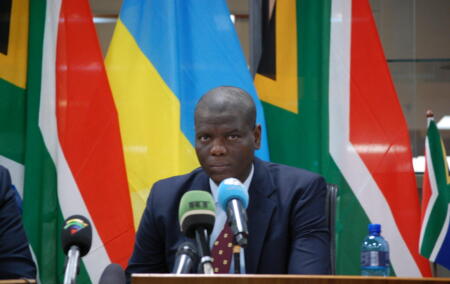
Writing in the Daily Maverick in September 2025, International Relations Minister Ronald Lamola set out the clearest official statement of what non-alignment is meant to be. It is “not anti-West or anti anyone,” but “an expression of sovereignty anchored in our Constitution and in international law.” It is “strategic independence: we engage all partners, make case-by-case decisions using constitutional values and international law, and refuse bloc allegiance.” Engagement, he wrote, “is not endorsement; it is leverage.”
That is a completely coherent doctrine. A middle power with South Africa’s trade profile and regional obligations has good reason to refuse bloc capture. Automatic alignment does narrow room to manoeuvre.
Lamola then did something unusual for a sitting minister. He named the tests by which he wanted to be judged: “Are we consistent on international law? Do we protect civilians and humanitarian access in every theatre? Are we honest with partners even when we disagree?”
And if we take him at his word, on Russia, the answer to each is no.
Consistency on international law
South Africa’s Gaza record is the strongest evidence for the doctrine. Pretoria instituted proceedings against Israel at the International Court of Justice (ICJ) in 2024, filed its Memorial there that October, the main written pleading setting out a state’s case, and co-chairs the Hague Group, which Lamola himself describes as “non-alignment in practice.” Whether you like the move or not and whatever one thinks of the merits, that is a government spending diplomatic capital on a legal principle.
That is what makes the Ukraine position indefensible. The same government that mobilised the machinery of international law over Gaza has, across four years of Russian strikes on residential areas and the documented deportation of Ukrainian children, produced abstentions and calls for dialogue. No legal theory binds the prohibition on aggression to one belligerent and not another.
The objection that Gaza and Ukraine are not comparable is weak because the standard Lamola named was never “treat every conflict identically.” It was consistency on international law and the protection of civilians “in every theatre.” A doctrine that generates a Memorial in one theatre and an abstention in another is instead choosing where the standard applies.
Engagement as leverage
Now let us test the “engagement is not endorsement; it is leverage” claim by examining what the engagement has bought?
In early 2026, young South Africans were lured into combat in Ukraine through recruitment networks tied to the Zuma faction, in breach of the Prohibition of Mercenary Activities Act, the law barring South Africans from fighting in foreign wars. Securing the return of 17 trapped citizens required President Ramaphosa to lobby Vladimir Putin personally. A state that must ask a foreign head of state, as a favour, for the return of its own nationals taken in violation of its own statute has no leverage worth the name.
India’s Narendra Modi told Putin to his face that now is not an era for war, and India’s relationships with both Moscow and Washington survived the candour. New Delhi engages Russia and says what it thinks. That is Lamola’s third test exactly: being “honest with partners even when we disagree.” Pretoria has kept the engagement and dropped the honesty, and now has neither.
Message discipline
Lamola identified this weakness himself. Foreign policy, he wrote, “is set by the Presidency and executed through the Department of International Relations and Cooperation,” a structure that “ensures coherence and prevents freelancing from being mistaken for South Africa’s position.”
On 24 February 2022, the day Russian forces crossed into Ukraine, the Department of International Relations and Cooperation (DIRCO) called for a troop withdrawal. That same day, the Minister of Defence, her department’s special adviser and the Chief of the South African National Defence Force attended a function at the Russian ambassador’s residence in Pretoria honouring the Russian armed forces. In January 2026, Pretoria hosted the “Will for Peace” naval exercises alongside Russian, Chinese and Iranian warships, and the backlash over Iran’s inclusion was sharp enough that Ramaphosa took the inquiry out of Defence Minister Angie Motshekga’s hands.
The ambassadorial metric
Lamola set a performance standard for his own diplomats. Ambassadors, he wrote, will be measured on “market access, investment pipelines, sector partnerships.”
Bilateral trade with Russia in 2025 came to $907.8 million, 0.4% of South Africa’s global trade. The Reserve Bank’s September 2026 trade-weighted index, which weights trading partners by their share of South African trade, gives China 28.6% and the Eurozone 26.0%; Russia does not appear among the top 23 partners. South African assets in Russia total R724 million, against hundreds of billions deployed across Europe. No market access, no investment pipeline, no sector partnership. By the minister’s own yardstick, Moscow is the weakest-performing relationship in the diplomatic network, and the one receiving the most expensive political cover.
The lobby objection
Lamola anticipated criticism of this kind and placed it with “a strong narrative and a seemingly strident lobby” whose “thesis is simple: do what they (we) say, they (we) know better.”
But that describes a different argument. Nothing here asks South Africa to affiliate with Washington, adopt Western positions as a bloc, or step back from the Hague Group. It asks that the doctrine be applied as its author defined it. Non-alignment that applies international law consistently is a serious foreign policy. Non-alignment that produces a Memorial on Gaza and an abstention on Ukraine is bloc allegiance by another name, with the allegiance running to Moscow.
The constitutional standard
South Africa’s constitutional order rests on individual rights, the rule of law and limits on state violence. Carried into foreign policy, those commitments require defending the territorial integrity of sovereign states without reference to the identity of the violator. The Constitution contains no liberation clause exempting former benefactors.
The “liberation debt” does accumulated from the support by the Soviet Union, which ceased to exist in 1991, is transferred to a state now prosecuting a war of territorial conquest in Europe. Treating ANC party history as a standing obligation of the Republic confuses a party’s memory with a country’s interest, and it has produced a foreign policy in which a 20th-century debt outranks a 21st-century statute.
Non-alignment as Lamola defines it is defensible, but what is being practised towards Moscow is not non-alignment. Correcting it requires no new doctrine and no Western turn. It requires applying to Vladimir Putin the standard South Africa has already proved willing to apply elsewhere. Until it does, the minister’s own questions will keep answering themselves.
[Image: Ricardo Teixeira]
The views of the writer are not necessarily the views of the Daily Friend or the IRR.
If you like what you have just read, support the Daily Friend