

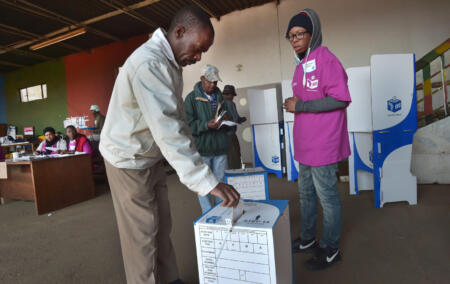
Do you think voting makes a difference? When the #PledgeToVote campaign, an initiative of the Institute of Race Relations (IRR), funded by the Konrad Adenauer Foundation (KAS), put that question to people in an informal online survey, the most common reason given for answering yes, from more than a quarter of respondents, was that not voting lets others decide on their behalf. The next most popular answers were that voting is how citizens hold politicians accountable and that voting affects who makes important decisions.
The survey is not representative, but it does make clear that many South African voters understand why voting matters. Some might just need a little push to get to the polls.
Why this matters now
Voter turnout in South Africa is declining. In the 2024 National and Provincial Elections, fewer than 60% of registered voters cast a ballot and in the 2021 Local Government Elections turnout was only about 46%, the lowest for any nationwide democratic election in our history.
Voter participation is a measure of a democracy’s health. It is the most valuable non-violent way to take part in politics and hold leaders accountable for their decisions. In local government elections, we choose who makes decisions about the services we interact with every day: our roads, water, electricity, and refuse collection.
Despite the decline in voter participation and the importance of voting, the Independent Electoral Commission (IEC) has experienced budget cuts, which affects its ability to carry out its mandate of non-partisan voter education and awareness. Civil society organisations and campaigns like #PledgeToVote have to step in to fill the gaps.
The stakes are also rising. Many local governments, including metros like Johannesburg, have become battlegrounds, with parties fighting harder than ever to gain or hang on to mayorships and seats in local councils. In these contests, individual votes carry real weight.
What really keeps people from voting
If we want to reverse the decline in voter turnout, we must understand what keeps people away from the ballot box. The obstacles to voting fall into two main groups.
The first is practical. If you are not registered correctly, you cannot vote. If you cannot travel to your voting station, you cannot vote. If you have too many work or family responsibilities, you may not have the time to vote.
The second is social and psychological. Some voters feel no party is appealing enough to earn their vote. Although many local governments have been led by coalitions for years, others may still feel like foregone conclusions, with the same party winning every time. Some voters have lost faith in the process after having voted before and not seen any change. Many are not surrounded by enthusiasm or awareness of the elections.
On the other hand, there are some things that do get people to the polls. A strong voting habit helps, especially when you’re surrounded by friends, family, or organisations that talk about voting. If your entire household is already heading to the polls, it takes little effort to hop in the car or take the walk to the voting station with them. If you know your friends will glance at your thumb on 5 November, ready to shame you if they don’t see the mark, standing in the queue doesn’t seem so bad.
And finally — and this is the principle upon which #PledgeToVote is built — we believe people will vote because they said they would.
The power of a pledge
The central action of the #PledgeToVote campaign is a Voter Pledge. It asks less of people than voting does: you don’t need to stand in a queue, you don’t need to find your ID, and you don’t need to choose a party or candidate. All you need to do is add your name and email address and click a button.
After pledging their vote, signatories receive emails designed to help them overcome the obstacles to voting. Some deal with the practicalities: a prompt to check your registration status, answers to basic questions such as what to bring and how to find your voting station, and reminders about deadlines like special vote applications. Other emails address the emotional side. We ask signatories to think about their own reasons for voting, and throughout the emails we remind them that they have made a commitment.
The results so far
This is not the first time we’ve run #PledgeToVote. Leading up to the 2024 elections, we gained over 54,000 signatories, sent over a million emails and reached more than 1.2 million people on Facebook.
This year’s campaign focuses on the most effective parts of the 2024 campaign: the Pledge and our email community. So far, we have over 58,000 signatories, over 5,000 of them from the 2026 campaign. Each of those is a voter who is ready to make their voice heard on 4 November.
Make your promise
Voting is one of the simplest and most powerful things a citizen of a democracy can do. It connects even the most diverse people, which is especially important in a country like South Africa.
However, it is a right that we cannot take for granted. Increasing voter abstention places South Africa’s hard-won democracy in danger, and it is crucial to restore faith in the vote. That is the mission of Pledge to Vote: to bring South Africans back to the polls through messaging about what really matters to them, practical voter education, and a clear and simple call-to-action: commit to using your voice in the next election.
Don’t just plan to vote. #PledgeToVote.
[Image: https://www.flickr.com/photos/governmentza/28145143644]
The views of the writer are not necessarily the views of the Daily Friend or the IRR.
If you like what you have just read, support the Daily Friend