

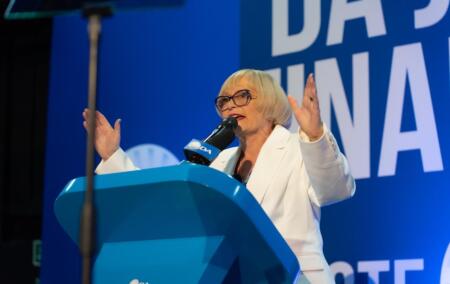
Helen Zille has fought a municipal election campaign unlike anything South Africa has seen in recent years. In its tenacity, physical effort, inventiveness, and sheer refusal to accept the dilapidation of Johannesburg as an unavoidable fact of urban life, her campaign has broken with many of the conventions of South African electioneering.
The latest eNCA/MarkData polling puts Zille’s party comfortably ahead of the ANC in the crucial metro and South Africa’s economic hub, by 35% to 22%. Remarkably, the poll even suggests that the ANC could fare worse in its former Johannesburg heartland than in the DA’s fortress of Cape Town, where the same poll places ANC support at 24%. The difference is small enough to fall within the surveys’ margins of error, but the mere possibility is extraordinary.
Of course, coming first in Johannesburg guarantees neither a governing majority nor the mayoralty. In a city accustomed to unstable coalitions, Zille could finish comfortably ahead of her opponents and still find herself denied the opportunity to govern. However, the hidden reality is, at least to my mind, the most consequential Zille effect might only be felt in 2029, when South Africans next vote in national and provincial elections.
How? In the shifts in the political choice market of Johannesburg not seen in the results. Zille’s campaign has evidently made the DA the first-choice party of many Johannesburg voters, yet the greater outcome will prove invisible for now: that Zille has made the DA an acceptable consideration for even more. The available headline polling does not establish this, nor will the results this November.
Most voters have a relatively small collection of parties they would seriously consider supporting, even when their immediate voting intentions change within that collection. Researchers call these ‘electoral consideration sets’, and studies suggest these are considerably more durable and difficult to break into than the voting intentions ordinarily captured in opinion polls.
In a 2019 study, political scientists Roderik Rekker and Martin Rosema surveyed voters in Sweden and the Netherlands on two occasions, approximately a year apart, to establish how their political preferences had changed. They found that, although voters frequently changed which party they intended to support, 81% of the parties they had initially been willing to consider remained among their options a year later.
In a study published in June this year, Stellenbosch University researchers Edward Keenan Jacobs and Collette Schulz-Herzenberg examined what had happened to ANC supporters between the 2014 and 2019 national elections. They found that 68% remained loyal to the ANC, while 25% did not vote and only 7% switched to another party. Whether dissatisfied voters switched depended substantially on their perceptions of those alternatives, particularly whether they trusted them and regarded them as inclusive.
By making the DA visible in communities where it has struggled to establish trust, demonstrating practical concern and solution-based interventions for local problems, and placing its people in direct contact with residents, the Zille campaign has created opportunities to challenge perceptions that have long limited the party’s electoral appeal. The Blue Brigade, with its volunteers tackling practical service-delivery problems in Johannesburg communities, is perhaps the campaign’s most interesting organisational innovation. It has been, as it were, a “free sample” of DA governance.
If the Blue Brigade disappears from Johannesburg’s streets once the election is over, the DA risks confirming one of the electorate’s most corrosive suspicions about politicians and political parties: that their concern for ordinary people’s problems lasts precisely as long as they need ordinary people’s votes. A pavement cleaned in October might attract considerable attention. The volunteers who return in February, when there are no election posters to be seen, may do considerably more to establish trust in a civic setting of no little cynicism.
And Zille’s own involvement after voting day could be of inestimable importance. A straightforward return to Cape Town and retirement might be received almost as badly as the Blue Brigade packing up and going home. Yet what becomes a truly tantalising notion is a permanent Blue Brigade, led on a strategic and national level by Zille herself. It would amount almost to the DA establishing its own service-delivery arm, with a national footprint and agenda, treating the symptoms of municipal failure through civic activism while its political operations remained squarely aimed at treating the disease.
Now, the resources this effort of a permanent Blue Brigade will require are immense. In theory, voters ought not to expect municipal services from a political party to which they have denied the authority, budgets, and administrative machinery necessary to provide those services. However, the party has considerably less reason to expect voters to care. The DA may therefore find that the most promising route to winning their support is to reverse the usual order of political business: deliver whatever practical results are possible first, and ask for votes afterwards.
The future of Zille’s Blue Brigade therefore also brings into play what the sociologist Alvin Gouldner described as the norm of reciprocity, a widely recognised moral expectation that kindness or assistance ought, in some measure, to be returned. In the DA’s case, that return would be considering to vote DA at first, and deciding to vote DA down the line.
Now, this indebtedness of reciprocity does not necessarily translate into votes, and people may resent assistance that appears calculated to secure their political loyalty. The goodwill generated by genuine and sustained assistance may endure, while the suspicion that every good deed carries an electoral invoice could destroy it. But not pursuing this next crucial phase of the psychological development of the voter’s relationship with the DA, would be very damaging to the party.
On 4 November, the DA will learn how many voters Zille persuaded to support it. It will learn far less about those she persuaded, perhaps for the first time, to consider doing so. If the party has entered electoral consideration sets from which it was previously excluded, dismantling the Blue Brigade would risk squandering precisely the achievement the results cannot reveal in the short term. Under Zille’s leadership, a permanent national Blue Brigade operation could spend the next few years turning that new willingness to consider the DA into trust earned through repeated, useful work.
Should the Johannesburg mayoralty elude her in 2026, the formidable campaign machine she has built may yet have a greater purpose in anticipation of the national and provincial elections of 2029. She won’t be on the ballot then, but, knowing Zille, she will be on the ground. And the full impact of what she has spent 2025 and 2026 doing for her party, might only then reveal its full extent.
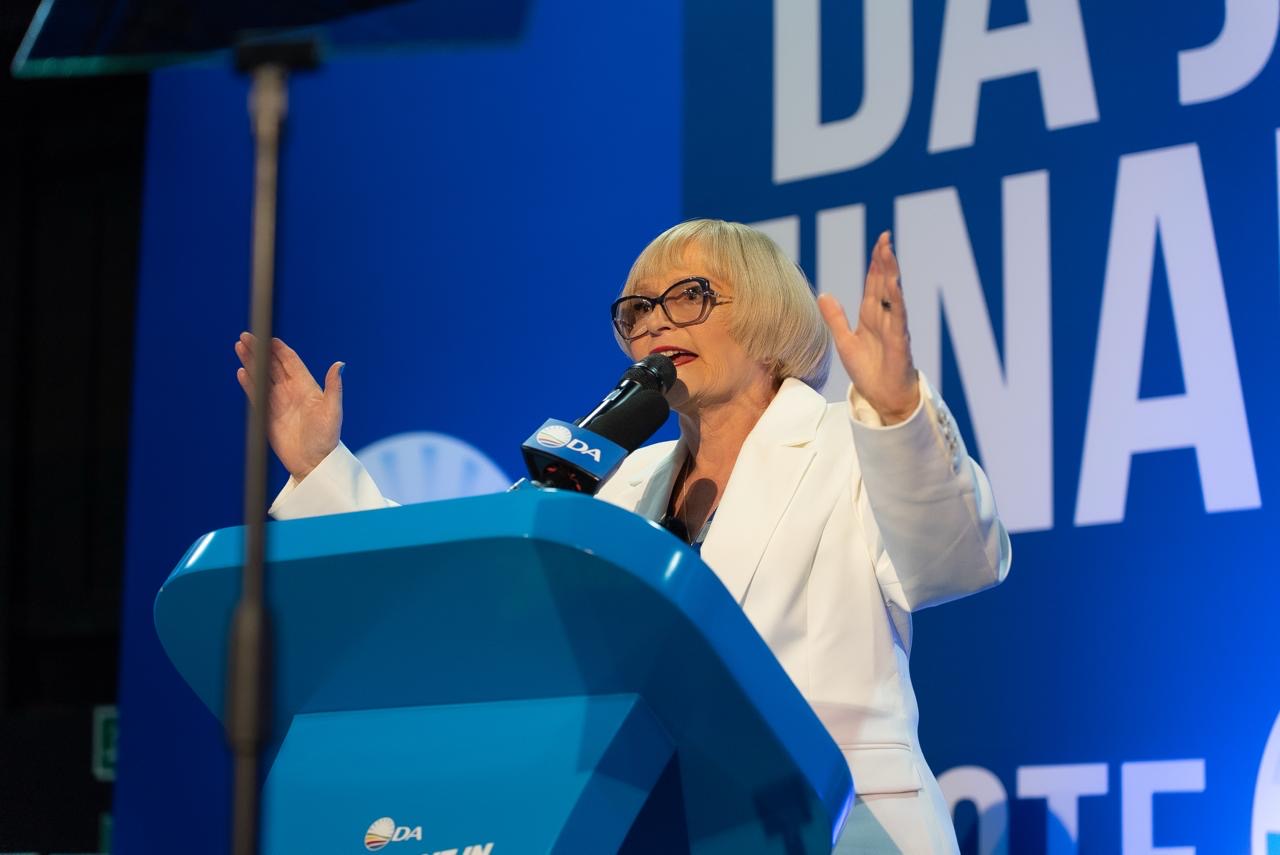
[Image: Helen Zille]
If you like what you have just read, support the Daily Friend