

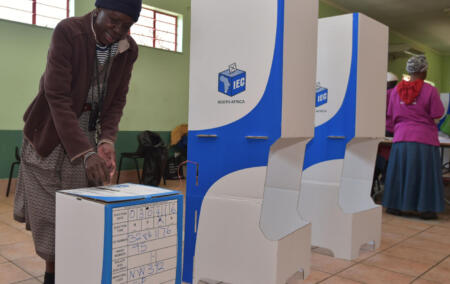
There are two kinds of people in South Africa right now: those who believe that if you don’t vote, you can’t complain, and those who believe that if you do vote, you can’t complain because you voted for it. Both are convinced they have the moral high ground, and neither is prepared to stop complaining. Next to soccer and rugby, it is our most popular national sport.
Which is perfectly fine. Democracy is in part a sophisticated form of complaining. Let’s be honest: getting out of bed, running toward a Bastille with a pitchfork, and setting things on fire is a lot of work. Plus, the people with guns on the other side of the moat don’t like it. Even less effort, of course, is staying in bed, not voting, and then proclaiming it loudly on social media as if you were Mel Gibson in Braveheart baring your naked pimply ass at the ‘establishment.” It should come as quite a surprise and a fair amount of embarrassment to this group of rebels that they are now the majority. 65% of eligible South Africans won’t vote this election. The contrarians now form part of a block that includes the great swathe of unemployed township socialists, disenchanted youthful communists, and people who want to stay home and wash their hair. Simunye, you are one. Oh, the horror. The “No Vote Party” has achieved such mainstream status that they are the topic of a Zaprio cartoon. Sorry, fellas, but does this mean you are now the ‘sheeple’ you so despise? Good luck with your identity crisis!
As a committed democrat, I now find myself in the minority. Luckily for me, minority groups receive some protection in our largely liberal constitution. I shall thus continue to vote and wave my moaning license around like a moral sceptre. It is nice to point fingers when one of them is inked. Voting is the least one can do, which is why one does it. But why must the minority in this country always have to take responsibility for everything? Not only are we expected to be the adults in the room, but we also have to double up as the resistance because the majority are sitting at home dikbek. Vive la resistance!
All of this counts, by the way. It means we are not killing each other; that part is good! It matters that you voice your discontent, which you must if you want yourself to be seen and heard by other people, including the government, who are also just other people. We are social creatures, very aware of status and hierarchy. Over time, we have developed complicated feedback loops, which could be as crude as farm implements pointed at a castle, as elegant as drafting a bill of rights, as adventurous as trekking in ox wagons to the north, or as dirty, messy and tricky as voting, but still more peaceful than war. You might not see the difference in one iteration. Yet, over time, guillotines drop, dictatorships are ended, slavery is abolished, and great liberal democracies take over the world, resulting in the freest, most prosperous generation to have ever lived. World hunger is a thing of the past. More people have access to primary health care, wifi, private property, water and electricity than ever before. So, we can choose to take up arms against the slings and arrows of outrageous good fortune or simply show up to vote now and again.
In general, most people prefer stability to anarchy, and a voting populace is a sign to investors that a country has chosen that route consciously and won’t be manipulated as easily. Most of us will tolerate a degree of tolerance for our fellow countrymen rather than bloodshed. None of this means we do not have the right to grumble and whine. We absolutely must. It is in the dark mutterings on Facebook, the clever slogans on posters, and the V for victory signs sprayed on subway walls in which the murmuration’s of change are spawned.
It would be a mistake to think voting is a perfect transaction. But it is a fair swap for the pandemonium. Moreover, it often leads to free markets and prosperity for many. Not perfect. Not terrible. Elections, by their nature, are trade-offs in sub-optimalities. Let’s go. Let’s play “it’s not a solution, it’s a trade-off.”
Democratic existential survival tips for 4 November
For voters
- Accept that you are responsible, but not in control.
You have a voice, not a steering wheel. Vote for the people you think will do the least damage, then accept that democracy is a group project with several million strangers.
- Vote responsibly, blame creatively.
Existential lesson: Take responsibility for your choices without imagining you control the universe or deserve a halo.
For non-voters
- Don’t confuse detachment with freedom.
- Abstaining is a choice, too. You may refuse to participate in the system, but the system won’t necessarily return the favour. Other people will still make decisions that affect your life.
Existential lesson: You can opt out of the process, but not the consequences.
For everyone
Lower your expectations, not your standards.
Learn to live with the gap between the world as it is and the world as you think it ought to be.
Whether you voted, boycotted, spoiled your ballot or stayed home to watch a rerun of Braveheart – remember that politicians are human beings. So are you. Nobody has a monopoly on stupidity, and nobody gets everything right.
I vote, not because democracy guarantees I’ll get what I want. I vote because it gives me a say in what happens next. And if it all goes wrong, at least I’ll have earned the right to complain.
Viva!
Vivienne Vermaak is an award-winning journalist and keynote speaker.
[Image: https://www.flickr.com/photos/governmentza/28478617660/in/photostream/]
The views of the writer are not necessarily the views of the Daily Friend or the IRR.
If you like what you have just read, support the Daily Friend