

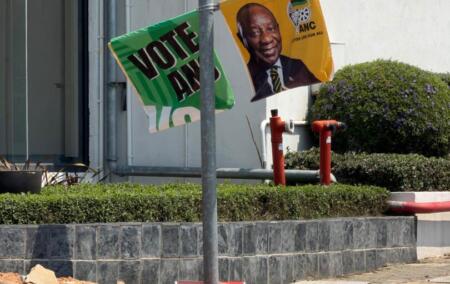
It is a measure of how things have changed that during the early years of democracy, South Africa’s decisive election was always seen as somewhere over the horizon – “It’ll be the one after the upcoming one” – while now there is a sense of nervous expectation that the moment will arrive on Wednesday.
Perhaps that plays into a fondness for political theatre; there is something beguiling about the singular moment of destiny. In reality, these are rare, and what we are witnessing now is less a revolution than a continuation of South Africa’s post-apartheid political evolution. The coming election will, nonetheless, be significant.
All indications are that South Africa is going through two intrinsically linked experiences. The first is the decline of the African National Congress; the second, the accumulated consequences of poor policy choices and misgovernance.
In common with other liberation movements, the ANC fell victim to a sense of its own rectitude and infallibility. Its plans for the country were, by definition, correct, and its unity a sacrosanct principle. This has made it incapable of serious course correction as a party – despite having been speaking since the 2000s about the need for “renewal”.
What started with ideological bombast rapidly metastasised. The South African state is now severely incapacitated and penetrated by criminality, often functioning as a mechanism for extraction rather than for governance. Nowhere has this become more apparent than in South Africa’s municipalities. Where once the provision of water had been a marker of progress and a visible signifier of the ANC’s commitment to its people, the failure of water systems has become a defining issue – and one exploited by criminal syndicates.
President Ramaphosa, ironically enough, gave a concise rundown of what had played out when addressing the launch of the revised White Paper on local government: “We assigned municipalities extensive powers and responsibilities that in some cases outstripped their capability and funding. We underestimated the importance of training up a new generation of engineers, town planners and municipal managers. We underestimated how politicised appointments would open the door to corruption, malfeasance and a lack of accountability. Today our people live with these consequences.”
The ANC’s campaign has been lacking in energy and direction and reduced at times to utter farce. An inability to name mayoral candidates and submit candidate lists is directly connected to the water outages and potholes it has presided over. Promises that it will do better in future lack all credibility. (The ANC promised in its manifesto to address potholes within 100 days – why it couldn’t tackle them in the period before the election is a mystery.)
This campaign may also be recalled as the graveyard of the Tripartite Alliance. Receiving surprisingly little media attention, the ANC’s longtime ally and sometime brains trust, the South African Communist Party, finally put its brand on the ballot. Their trade union allies, meanwhile, are stuck between their historical loyalty to the ANC, and ideological affinity with the SACP. Claiming to support both is untenable. Expect recriminations about this going forward, and ongoing ructions as the conjoined triplets endure a prolonged separation.
The Democratic Alliance, by contrast, has put up a slick, organised and media-savvy electoral offensive. It looks set to do well, particularly in the country’s cities.
The DA has put itself forward as the true representative of South Africa’s constitutional promise: the party that can provide sensible policies, non-racial politics and competent governance. There is much to recommend it on these grounds. Its record in government has been far better than that of its peers, if far from perfect. And in Johannesburg it actually started fixing things.
It has managed the remarkable feat of putting together a support base that cuts across racial cleavages. This is unusual for a society with deep ascriptive, historical divides, and it should be credited with doing so. That it is not, is an indictment on much of the country’s commentariat.
The DA campaigned under a unique set of circumstances for itself. Its electoral posture has invariably been one of opposition (even as its governance footprint expanded at local level). This year, it has had to tread a fine line between its role as a partner in government to the ANC, and as the latter’s inveterate opponent. It’s debatable how convincingly it carried this off, but at the same time, it doesn’t really seem to have mattered.
It has been striking that so much of the election has pivoted around the DA, and particularly about its mayoral candidate for Johannesburg, Helen Zille. Public commentary has been focused on the party, and the campaigns of rival parties have been geared towards combating it – somewhat reminiscent of the manner in which opposition parties in the early years of democracy were oriented towards the ANC.
For the DA, the big question is whether it will make the breakthroughs that will give it an unencumbered majorities in the cities it has been pursuing. For the big prize, Johannesburg, polling suggests that this may be out of reach, although it’s been said before that the only poll that really counts is the one conducted in voting booths on election day.
This leads to the obvious issue of what comes after the votes are tallied.
By now, coalitions are a well-entrenched part of South Africa’s political calculus. In the 2021 elections, 71 municipalities returned results that gave no party a majority. It’s quite possible that this will be even more pronounced in the coming term. How well this turns out will depend on how the constituent parties approach them.
The point needs to be made that half or more of these arrangements are functioning adequately and have not been wracked by leadership instability. Others – here again, Johannesburg is a prime exhibit – have not been encouraging.
Coalitions have been formed as a means of taking power, only to be destabilised by those determined to secure a larger share of the spoils. The extractive opportunities in a dysfunctional system should not be underestimated here. Equally importantly, the participants may have coalesced to exclude a rival. Where parties treat municipal office as a prize to be carved up, not as a responsibility to be discharged, instability is inevitable. More than that, it is advantageous. Coalitions become arrangements of toxic collusion and internecine contestation.
Interestingly, survey evidence suggests that most South Africans are inclined towards coalitions that bring in the weight of the country’s political support, in other words, between the ANC and DA. Here again, there is some logic to this, as both represent important constituencies (the corrosion of the ANC’s brand notwithstanding) and can lay claim to standing broadly in the country’s political centre.
Judging by their respective campaigns, neither party would be enthusiastic about such an arrangement. Particularly in Gauteng, local ANC sentiment against the DA rides high, and the party in the province would be far more amenable to an arrangement with the uMkhonto we Sizwe Party and the Economic Freedom Fighters. Altogether, this sounds like a coalition of South Africa’s worst impulses, in an environment that simply cannot endure them. (Gayton McKenzie has predicted a coalition involving the ANC, MKP, EFF and his Patriotic Alliance; Action SA, which may perform creditably in Gauteng, seems so set against the DA that it might be inclined to such a relationship itself.)
That being said, MKP is expected to perform well, particularly in KwaZulu-Natal. This is not an encouraging prospect. It represents a politics conceived in grievance, personal loyalty and a rejection of constitutionalism. More directly, it has mauled the ANC’s support base, and this may be a greater concern for its current leadership than the DA. The ANC leadership has indicated it will take charge of coalition agreements. This makes an approach to the DA a possibility, though if – and it’s a big if – an agreement can be concluded, it will face hard opposition from within the ANC in the province. It is hard to see in that the makings of productive governance.
Then there are the darker dimensions of this election. Something in excess of 40 leaders have been assassinated over the course of the year. This is not a new phenomenon, but it has accelerated in recent years. It is also a reminder of what is at stake – not only in the resources to be plundered through patronage and crooked contracts, but in the capacity for governance, and in matters of life and death. This is about the integrity of the shopworn fabric of South African society.
Finally, there is the question of those who will choose not to go to the polls. Just under 64% of eligible voters are registered – meaning that over a third are excluded or have excluded themselves. And among those registered, declining proportions are turning up to vote. Close to 87% did so in 1994 (admittedly, an atypical poll); this had fallen to around 46% in the 2021 local elections and 59% in the 2024 national elections. The Daily Maverick ran an interesting piece pointing out that participation in elections in South Africa was among the lowest of comparator countries. For reasons of choice, apathy or frustration, South Africa’s electorate are turning away from electoral politics. This has potentially dire implications for South Africa’s future constitutional order.
The election will not produce a neat verdict on the future of South African politics, still less on the governance malaise within whose context it is taking place. Once-established certainties are gone, and new assumptions have yet to take shape. Those with memories of the 1990s will understand just what a significant change in the country’s circumstances this represents – an incomplete change, and one laced with both peril and opportunity. That, at least, remains a constant.
[Image: John Endres]
If you like what you have just read, support the Daily Friend