

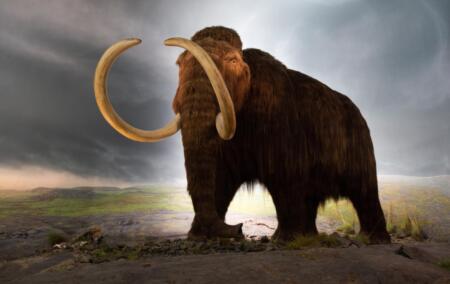
The woolly mammoth roamed the Earth until about 4,000 years ago. It may be coming back. No, let me be more accurate – it is certainly coming back, although precisely what comes back, and when, is another matter. The original target date was 2028; now it seems that it may be a few years later. Re-animating the dead is hard.
Wait! What? Is this a good idea for the poor mammoth (which will be born bewildered and herdless), or for us, or for the eager investors in the company doing this? Did the founders not see Jurassic Park? Isn’t the whole thing a bit icky, part of the torrent of billionaire techbro hubris?
This is a story with many strands – commercial, ethical, scientific and financial. None of it is in the realm of science fiction because there is an American company doing this. De-extinction is its game.
The company is called Colossal Biosciences, and it has already brought back the dire wolf (or reasonable facsimile), extinct for some 13,000 years. The company, with little revenue and no established record of profitability, was recently reported to be seeking a second round of investment at a valuation of $25 billion.
But let’s not knee-jerk. There is a bigger story here.
Colossal was founded in 2021 by technology entrepreneur Ben Lamm and Harvard geneticist George Church, one of the pioneers of modern genomic engineering. Its ambitions extend beyond mammoths to the dodo, the Tasmanian tiger and other animals that disappeared from the evolutionary stage, some quite recently and others long before humans began keeping records.
That’s the sales pitch, and the mammoth is the star. Company communications talk about the role that the ancient beasts played in ecological protection, especially in cold, snowy and icy locales where their galumphing around helped keep the permafrost frozen and its carbon locked away, and that it could help with this problem now. I’m not really buying this, and I suspect neither are others.
Woolly mammoths
To bring back enough woolly mammoths to populate the permafrost of Siberia and elsewhere and do their part for the environment would take many decades, even centuries. It is not realistic, probably not even meant to be taken that seriously.
So what is?
Colossal is not digging up frozen and extinct animals, extracting cells and cloning them.
Instead, scientists recover fragments of ancient DNA, reconstruct the extinct animal’s genetic instructions and compare them with those of its nearest living relative. So the much-hyped dire wolf is not really a dire wolf. It is a normal grey wolf that has been genetically engineered with some strands of dire wolf DNA, changing its phenotype, making it a sort of hybrid.
In the case of the coming woolly mammoth, Colossal started with a mouse, engineered some woolly mammoth genes into its DNA and ended up with a shaggy-haired mouse. While the world does not need a shaggy-haired mouse, the really big deal was the genetic engineering mountain they were required to climb to get there. They had to invent new science, invent new techniques, dream up new protocols, try and fail and regroup and try again. That’s the real value of the company – not the wolf, not the hairy mouse, not the mammoth.
A great analogy here would be the original space programme, particularly during the 1960s. The broadsheets screamed – a man on the moon by the end of the decade! The public’s enthusiasm was endless; it was geopolitical gold, a major driver of American exceptionalism and pride. The number of technologies invented to get Apollo 11 to the moon was broad and deep, and they make our lives easier even to this day (freeze-dried food!).
A cute baby mammoth will launch an entire universe of jpg images serving our need for wonder and awe, but underneath it all will be a cornucopia of new genetic engineering techniques that will serve humanity far more profoundly than a conservation park of exotic animals once lost to time.
Ick factor
But even in the face of this fairly rational explanation of the real scientific and market value of Colossal Biosciences, there remains an ick factor. This is worth unpacking.
Extinction is supposed to be final. It is one of the few truly irreversible things in nature, and there is something unsettling about a start-up treating it as a bug to be patched. Remember what Ian Malcolm, the scientist played by Jeff Goldblum in Jurassic Park had to say – “Yeah, yeah, but your scientists were so preoccupied with whether or not they could, that they didn’t stop to think if they should.”
Elephants are intelligent, social, long-lived and endangered. Using them as surrogates for experimental pregnancies – with the miscarriages and failures that implies – is ethically fraught. And the first mammoth-ish calf will be born into a world with no other mammoths: no herd, no matriarch, no inherited knowledge of how to be what it is. The dire wolves live on a 2,000-acre reserve in an undisclosed location, under constant observation. These animals are being exhibited rather than rewilded.
And then there is this. Months after the dire wolf announcement, Representative Lauren Boebert, arguing to strip grey wolves of federal protection, asked a congressional hearing: “Didn’t we just bring a wolf back that was here 10,000 years ago?” Her argument being that if extinction is reversible, why spend political capital preventing it? This leads to the legal battle now underway in US courts over whether protected habitats are even necessary (a challenge to the Endangered Species Act).
Underneath this sits something harder to articulate – a sense that a line between the living and the dead is being trespassed, and that the trespass is being monetised. It is the feeling of the uncanny – a creature that should not exist, built from instructions recovered from a corpse, owned by a company with expectant investors.
Unease
Let me end with this, because I suspect that the unease many of us feel needs to be tamped down.
Consider the world we are in. The tools that Colossal (and others) are developing – advanced gene editing, synthetic biology and a deep understanding of genomes – are precisely the tools we will need for the conservation of the future.
We may need to edit coral to survive warmer oceans. We may need to engineer disease resistance into wild populations (and ourselves). We may need to use the very techniques being developed for the mammoth to save its surrogate mother, the Asian elephant, from its own extinction.
We have proven, beyond a shadow of a doubt, that we possess the god-like ability to degrade our inherited natural world, from bombs to forever chemicals, from polluted air to urban sprawl.
All things considered, it might not be such a bad idea to invent the tools to resurrect it or even improve it.
[Image: By Thomas Quine – https://www.flickr.com/photos/quinet/44598416660/, CC BY 2.0, https://commons.wikimedia.org/w/index.php?curid=80400437]
The views of the writer are not necessarily the views of the Daily Friend or the IRR.
If you like what you have just read, support the Daily Friend