

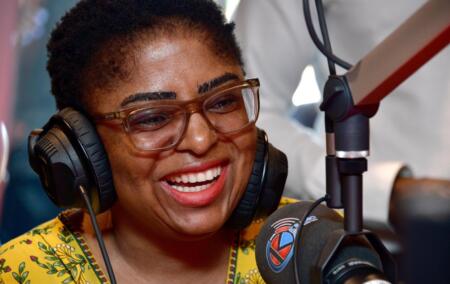
I was elated recently to hear Minister in the Presidency Khumbudzo Ntshavheni describing South Africa as “a country of minorities”.
Speaking in the Ronnie Mamoepa Press Room at Tshedimosetso House, the GCIS – government information service – headquarters in Hatfield, Pretoria, she was responding to questions during a post-Cabinet-meeting briefing which included one about foreign political rhetoric, specifically from the United States, characterising Afrikaners as a targeted or persecuted minority in South Africa.
She displayed remarkable wisdom when she said: “We are a country of minorities … [and SA] should invite President Donald Trump to protect us all”, adding that “we do not count minority in terms of the race or tribe that people are. We count through languages spoken.” Her own home language, she said, “is spoken by only 2.5% ….”
My first reaction was: “Minister, now you are talking! Please push hard for that brilliant idea of yours to become official government policy. Then we can all have renewed confidence in the future of South Africa.”
The South African legal state is fundamentally hardcoded around four primary apartheid-era racial categories: Black (African), Coloured, Indian, and White. Framework legislation like the Employment Equity Act (EEA), the Broad-Based Black Economic Empowerment (B-BBEE) Act, and the Preferential Procurement Policy Framework Act (PPPFA) all rely on these racial definitions to measure compliance, allocate points, and set demographic targets.
We know that “race” is an inherited holy cow from the apartheid era, which has now become a sacred cow for the ANC-in-Government. Thus, “racial classification” can never be abandoned.
“Language classification”
But with the minister’s idea of language classification we can reconcile “racial classification” with “language classification.”
This is how it could be done:
Instead of evaluating a company on whether its board is “representative” on racial terms, regulations would require a matrix – X% isiZulu-speaking Black, Y% Afrikaans-speaking Coloured, Z% English-speaking Indian, and so on.In this way, we can turn corporate HR departments into linguistic/genealogical research labs.
The ANC-in-Government might also then argue that certain language groups (for example, Tshivenda, Xitsonga, isiNdebele) represent historically peripheral regional populations requiring unique linguistic-equity scoring alongside traditional racial B-BBEE points.
Imagine how much fun we would have if a language-based classification system was strictly enforced in corporate or civil service life.
Imagine a state tender process where points were awarded based on the primary language spoken by a company’s directors. Bidders would have an incentive to conduct internal meetings or board resolutions in minority languages like Xitsonga or Tshivenda to claim higher “linguistic equity” points. Tender compliance officers would need to act as language proficiency testers, conducting oral fluency exams to ensure a director isn’t just reciting a memorized script in a minority tongue.
Since Afrikaans is spoken by a majority of the Coloured population in the Western and Northern Cape alongside a White minority, treating “Afrikaans speakers” as a single administrative unit would lead to surreal outcomes. A White executive and a farmworker from Springbok would end up in the exact same demographic category for employment equity reporting, completely neutralising the race-based target metrics currently mandated by the Department of Employment and Labour.
Language is fluid
Under race-based laws, changing your statutory category is legally restricted. But language is fluid.
If the state incentivised or penalised people based on home language, citizens would simply declare whichever language offered the best economic or educational advantage on official forms. A family might speak English at home but officially register as isiXhosa speakers on state portals to qualify for linguistic representation targets in government employment.
In millions of South African households, family members switch fluidly between code-mixed languages (like Tsotsitaal or Sepitori) or speak three different languages fluently.
How would the state classify a child raised by a Sesotho-speaking mother and an isiZulu-speaking father who attends an English-medium school?
The state would have to institute arbitrary rules – such as declaring a person’s “true category” based strictly on their father’s birth language – effectively reinventing apartheid-era population registration boards under the guise of linguistic preservation.
Honourable Minister, South Africa and the world can’t wait…
[Image: https://www.flickr.com/photos/governmentza/53457284865/in/photostream/]
The views of the writer are not necessarily the views of the Daily Friend or the IRR.
If you like what you have just read, support the Daily Friend