
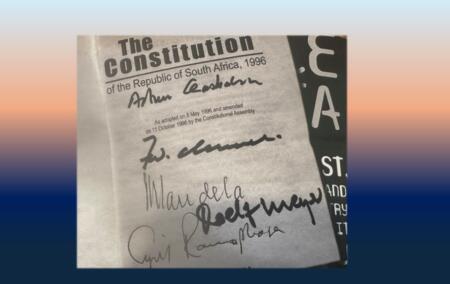
The following is the text of my FW de Klerk Memorial Lecture 2026, which I delivered at an event co-hosted in Cape Town last evening by the FW de Klerk Foundation and the Konrad Adenauer Stiftung to mark the 30th anniversary of the signing of the South African Constitution in Sharpeville/Vereeniging on 10 December 1996
It is a privilege to address you today as we reflect on the legacy of former President FW de Klerk, the journey of our constitutional democracy, and, importantly, the future of our beloved South Africa.
I speak to you not merely as a former political leader, but as a South African who participated in the struggle for freedom, witnessed the difficult negotiations that gave birth to our democracy, and continues to believe passionately in the extraordinary potential of our nation.
I have always maintained that leadership is ultimately measured not by the power we acquire, but by the difference we make in the lives of those we are privileged to serve.
Today, as we reflect on our past, we must also have the courage to confront our present and take responsibility for our future.
The courage to change – the lessons of 1990
On 2 February 1990, President FW de Klerk stood before Parliament and made an announcement that would fundamentally change the course of South African history.
He announced the unbanning of the African National Congress and other liberation movements, and paved the way for the release of Nelson Mandela.
It was a defining moment.
For those of us in the liberation movement, who had dedicated our lives to the struggle against apartheid, the announcement was momentous.
Although some of us were aware of the confidential discussions taking place between representatives of the National Party government and the ANC, the magnitude of that announcement was nevertheless extraordinary.
What followed was neither simple nor inevitable.
The negotiations that ultimately produced our democracy were difficult, frequently tense and, at times, threatened by violence and profound mistrust.
I know this because I was part of that process. We came from opposing political traditions. We carried the wounds of our history. We held fundamentally different visions of South Africa. Yet we understood that the future of our country demanded something greater than our individual political interests.
It demanded courage. It demanded compromise. And, above all, it demanded leadership.
The assassination of Chris Hani in April 1993 brought our country dangerously close to the precipice.
But we persevered.
Under the leadership of Nelson Mandela, FW de Klerk and many other committed South Africans, we found a way forward.
In April 1994, millions of South Africans exercised their democratic right to vote for the first time.
Nelson Mandela became the first President of our democratic South Africa, with FW de Klerk and Thabo Mbeki serving as Deputy Presidents in the Government of National Unity.
It was a remarkable achievement.
It demonstrated that even a deeply divided society could find common ground when its leaders placed the interests of the nation above their own.
FW de Klerk’s decision to turn away from the political system he had served required considerable courage.
Recognising that courage does not diminish the suffering caused by apartheid, nor does it diminish the sacrifices of those who fought against it.
It acknowledges an important historical truth: that, at a decisive moment, he chose to participate in the transformation of South Africa rather than resist the inevitable demands of history.
His contribution, alongside Nelson Mandela, was recognised through the Nobel Peace Prize in 1993.
The National Party later withdrew from the Government of National Unity, with effect from 30 June 1996. That withdrawal was another reminder that the new democratic order would not guarantee any party a permanent place in power. Political legitimacy would have to be earned and continually renewed.
The lesson for us today is profound.
True leadership is not demonstrated by defending the status quo at all costs. It is demonstrated by recognising when the status quo has become indefensible and having the courage to change it.
South Africa at another crossroads
More than three decades later, South Africa once again finds itself at a defining moment in its political history.
The political landscape has changed dramatically.
In the national elections of 2024, the ANC, the party that led the struggle for liberation, received 40.18 per cent of the vote, losing its parliamentary majority for the first time since 1994.
It could now govern nationally only through cooperation with other political parties.
The result was the formation of another Government of National Unity.
The local government elections held on 4 November 2026, with results announced by the Electoral Commission on 8 November, delivered an even more sobering message.
The ANC received 30.76 per cent of the national municipal vote, down from 45.59 per cent in 2021.
It failed to secure an outright majority in any of South Africa’s eight metropolitan municipalities. Only one metro, Cape Town, saw any party achieve an outright majority, and there it was the Democratic Alliance.
In six of those metropolitan areas, another party finished ahead of the ANC.
The results in Johannesburg, Cape Town and eThekwini are particularly significant, given their importance to our national economy.
These electoral outcomes cannot simply be dismissed as temporary political fluctuations.
They represent a profound shift in the relationship between political parties and the people they are elected to serve.
And they demand serious reflection.
The ANC was once regarded by millions as the embodiment of liberation, hope, dignity and opportunity.
How, then, has a movement that enjoyed such extraordinary public confidence experienced such a dramatic decline?
I believe the answers are painfully evident.
We have witnessed corruption and the abuse of public resources. We have seen unemployment reach unacceptable levels, particularly among our young people. We have watched critical infrastructure deteriorate through neglect and inadequate maintenance.
We have experienced the consequences of failing municipalities, unreliable water supplies, electricity disruptions and declining public services. We have seen political appointments too often influenced by loyalty rather than competence.
And we have witnessed a growing disconnect between the privileges enjoyed by political office-bearers and the daily hardships experienced by ordinary South Africans.
There is something deeply troubling about the spectacle of flashing blue lights and expensive official vehicles moving through communities where families struggle to put food on the table.
It sends the wrong message. It suggests that public office has become a position of privilege rather than an obligation to serve.
Political leadership must never become a refuge for personal entitlement. It must remain a responsibility entrusted to us by the people.
There is a further lesson we must confront. Too often we have changed the faces of leadership without changing the templates through which government operates and delivers. A new Minister, Mayor or official cannot succeed merely by inheriting the same ineffective machinery and expecting a different result.
We must change not only who leads, but how government works: how decisions are made, how responsibility is assigned, how public resources are protected, and how results are measured.
Our citizens do not expect miracles. They expect honesty. They expect competence. They expect accountability and respect. And they expect the government they elect to deliver the basic services necessary for a dignified life.
The people of South Africa are not asking for the impossible. They are asking us to honour the promises of our democracy.
The Constitution – a living promise
As someone who participated in the constitutional negotiations that helped shape our democratic future, I remain deeply committed to the principles upon which our Constitution was founded.
Our Constitution is one of the greatest achievements of our democratic transition. It embodies the values of human dignity, equality, freedom, justice and the rule of law. It represents a solemn commitment to build a society in which every South African enjoys equal protection and opportunity.
But we must never confuse respect for the Constitution with resistance to thoughtful constitutional reform.
The Constitution is a living framework for democratic governance.
Its fundamental values must be protected, but its institutional arrangements should remain open to careful and responsible examination.
The question we must ask ourselves is whether the structures of government established more than three decades ago remain appropriate for the challenges confronting South Africa today.
I believe the time has come for a serious national conversation about constitutional reform. Not to weaken our democracy. Not to undermine our constitutional institutions. But to strengthen accountability, improve efficiency and ensure that government serves the people more effectively.
Rethinking the election of our President
Let me begin with Section 86 of the Constitution.
Under the present constitutional arrangement, the President is elected by the National Assembly following a general election.
This has historically meant that the President emerges from the political processes and leadership decisions of the governing party.
The concern I wish to raise is whether this system creates an excessive dependence on party political structures and interests.
We have seen how political loyalty can, at times, take precedence over national responsibility.
I therefore believe that we should seriously consider amending Section 86 to allow South Africans to elect their President directly, through a separate presidential ballot.
Such a reform would require careful examination of its implications for our parliamentary system, executive accountability and the separation of powers.
However, I believe it deserves serious national debate.
The President of South Africa must be accountable, first and foremost, to the Constitution and the people of South Africa.
The interests of the nation must always rise above the interests of any political party.
A smaller, more effective Cabinet
Section 91 of the Constitution also deserves our attention.
South Africa cannot continue to sustain increasingly expensive and cumbersome structures of government without asking whether they deliver value to the taxpayer.
I believe we should consider constitutional limitations on the number of Cabinet Ministers.
In my view, a Cabinet of approximately fifteen or sixteen Ministers should be sufficient for a country seeking efficient, coordinated and accountable government.
We should be asking whether every ministerial portfolio is necessary, whether responsibilities overlap, and whether our administrative arrangements encourage effective decision-making.
Government should not be measured by the number of Ministers, Deputy Ministers, departments or officials it employs.
It should be measured by its performance. A smaller government that delivers is infinitely more valuable than a large government that merely administers failure.
We need to move away from a culture in which political office is regarded as a reward.
Public office must be earned through competence, integrity and a demonstrated commitment to service.
Strengthening local government
Section 155 of the Constitution, together with the related provisions governing local government, also requires serious reconsideration.
The current system of metropolitan, district and local municipalities has created layers of administration that can, in many instances, complicate accountability and increase costs.
The overlapping responsibilities between district and local municipalities deserve particular attention.
I believe we should examine the possibility of restoring a simpler, single-tier system of wall-to-wall local government across South Africa.
Our objective should be to eliminate unnecessary duplication, clarify responsibilities and ensure that resources reach the communities they are intended to serve.
Local government is where our citizens experience democracy most directly.
It is where water must flow. Where refuse must be collected. Where roads must be maintained. Where streetlights must work. And where communities must feel that government is present, responsive and accountable.
When local government fails, democracy loses its meaning in the daily lives of our people. We cannot continue to accept administrative complexity as an excuse for poor service delivery.
Reconsidering provincial government
As the former Premier of Mpumalanga, I am particularly conscious of both the opportunities and limitations of our provincial system.
I believe the time has come to revisit Chapter Six of the Constitution and critically examine whether our existing provincial government structures remain the most efficient means of delivering services.
We should be willing to consider far-reaching reforms, including the eventual abolition of elected provincial government structures and the redistribution of their functions between national and local government.
This is not a proposal to weaken democratic accountability. On the contrary, the objective must be to strengthen it.
Such reform would require extensive constitutional consideration, appropriate safeguards and a clear assessment of how essential functions could be transferred without compromising service delivery.
As an interim measure, provincial administrations could potentially be redesigned as streamlined administrative structures while these broader reforms are considered.
The guiding principle should be simple. We need less bureaucracy, less duplication and more effective government.
Changing the people at the top is not enough if the systems beneath them remain unchanged. Our reform agenda must replace cumbersome delivery models with institutions that are answerable for real outcomes.
Our citizens deserve public institutions that are responsive, affordable, accountable and focused on delivery.
We cannot continue to build expensive structures of government while our communities remain trapped in poverty.
The message from the electorate
The voters have spoken. And we would be foolish not to listen.
Their message is not complicated. They want jobs. They want functioning schools and hospitals. They want reliable water and electricity. They want safe communities. They want their taxes used responsibly.
And they want leaders who understand that political power is not a permanent entitlement.
The results of the 2024 national elections and the 2026 municipal elections should serve as a powerful warning to every political party.
No party owns the electorate. No party has a permanent right to govern. And no political movement, regardless of its historical contribution, is entitled to unconditional loyalty.
The struggle for freedom was never intended to replace one form of political entitlement with another. It was intended to liberate our people and create opportunities for all.
The ANC, in particular, must confront this reality.
For those of us who devoted much of our lives to the liberation struggle, the decline in public confidence is painful to witness.
But loyalty to the history of a movement must never prevent us from confronting its failures.
The greatest tribute we can pay to our liberation history is not to defend every decision made in its name, but to remain faithful to the principles for which we struggled.
The courage to make difficult decisions
In 1990, FW de Klerk recognised that the political system he represented could not continue indefinitely.
The pressures for change were overwhelming. He faced a difficult choice. He could attempt to preserve a failing political order, or he could begin a process of transformation that would ultimately end his party’s exclusive hold on political power.
He chose change.
Today, the ANC faces a different but equally important test of leadership.
Will it recognise the depth of public dissatisfaction? Will it confront corruption decisively, irrespective of the positions occupied by those responsible?
Will it act against incompetence and remove those who have failed the public? Will it implement the recommendations of the many commissions and investigations established at considerable public expense? Will it restructure government to prioritise performance rather than political accommodation? Will it be prepared to learn from successful practices wherever they are found, including in municipalities governed by opposition parties?
And, most importantly, will it place the future of South Africa above the political survival of the organisation?
These are difficult questions. But they cannot be avoided.
The time for political explanations, public relations exercises and promises without implementation has passed.
What South Africa requires now is decisive, ethical and courageous leadership.
South Africa beyond 2029
We must also begin preparing for the political realities that may emerge after the 2029 general elections.
The era in which one political party could assume that it would dominate South African politics indefinitely is clearly under challenge.
Coalition politics, new political alliances and changing patterns of electoral support are becoming increasingly important features of our democracy.
This should not frighten us.
Democracy was never intended to guarantee the continued dominance of one political organisation.
It was designed to give citizens the freedom to choose their leaders and to remove them when they fail.
We must therefore begin a serious national conversation about the political and institutional arrangements that will best serve South Africa beyond 2029.
How do we build stable and accountable coalition governments?
How do we ensure that political agreements are based on shared principles and clear programmes of action rather than the distribution of positions?
How do we protect the professional public service from political instability?
And how do we ensure that our institutions continue functioning effectively, regardless of which political parties occupy government?
These questions should occupy the minds of responsible leaders across the political spectrum.
Our task is not merely to prepare for the next election. Our task is to prepare South Africa for the next generation.
Reclaiming the spirit of reconciliation
There is another lesson from our democratic transition that I believe we neglect at our peril.
It is the enduring importance of reconciliation.
Nelson Mandela, FW de Klerk, Archbishop Desmond Tutu and many other South Africans understood that a nation divided against itself could never realise its full potential.
They recognised that political freedom had to be accompanied by the difficult work of nation-building.
We cannot build a prosperous future by continually retreating into the divisions of our past.
Our diversity must remain a source of strength rather than a weapon of political convenience.
Reconciliation does not mean ignoring injustice. It does not mean abandoning the pursuit of economic transformation. And it certainly does not mean accepting inequality. It means recognising that our future is shared.
That the dignity of every South African matters. And that sustainable progress requires us to build bridges rather than deepen divisions.
The unfinished business of our democracy demands that we work together to confront poverty, inequality, unemployment and exclusion.
These challenges cannot be resolved through political slogans.
They require competent institutions, sound economic policies, meaningful opportunities and leaders who are willing to put the country first.
The South Africa we must build
I remain an optimist.
I have witnessed South Africa overcome circumstances that once appeared insurmountable. I have seen political enemies sit around the negotiating table and find common ground. I have seen a nation emerge from decades of division to embrace a constitutional democracy founded on dignity, equality and freedom.
I therefore refuse to believe that the challenges we face today are beyond our ability to resolve.
But optimism without action is merely wishful thinking.
Hope must be accompanied by leadership. Leadership must be accompanied by accountability. And accountability must produce results. The promise of 1994 was never simply the right to vote. It was the promise of a better life. A life of dignity. A life of opportunity. A life in which the circumstances of one’s birth would no longer determine the limits of one’s future.
That promise remains unfinished. And it is our collective responsibility to fulfil it.
We need leaders who are prepared to listen rather than dictate. Who seek solutions rather than excuses. Who understand that public service is a privilege, not an entitlement. And who recognise that the success of our democracy will ultimately be judged not by the achievements of politicians, but by the wellbeing of our people.
The responsibility to lead change
As we reflect on the legacy of FW de Klerk, I believe there is one enduring lesson that speaks directly to the challenges confronting our nation.
History remembers those leaders who had the courage to change course when the future of their country demanded it.
In 1990, South Africa needed leaders who could look beyond the fears, prejudices and political divisions of their time.
Today, South Africa once again needs leaders who are prepared to rise above narrow political interests.
Our circumstances may be different, but the responsibility is the same.
We must have the courage to confront uncomfortable truths. The wisdom to learn from our mistakes. The humility to listen to our people. And the determination to build institutions that serve future generations.
Let us not become prisoners of our political history. Let us draw strength from it. Let us not allow the failures of the present to destroy the possibilities of the future. Let us work together to restore public confidence, strengthen our constitutional democracy and renew the promise of freedom.
Our people want honesty, integrity and respect. These are not decorative virtues to be invoked at election time; they are the foundations of trust. And trust is built when leaders speak truthfully, treat people with dignity and deliver what they have promised.
If we can restore that trust through consistent action, it may prove one of the most decisive changes we make in the life of our democracy.
I believe in South Africa. I believe in the resilience of our people.
And I believe that, with the right leadership, integrity and collective determination, we can still become the prosperous, united and winning nation we envisioned in 1994.
The responsibility belongs to all of us.
The time for courageous leadership is now. Let us become the change we expect from others. Let us once again place South Africa, and her people, first. Let us use the trust of our people wisely.
[Image: Core element from archives of the Centre for the Constitutional Transformation of South Africa at the FW de Klerk Foundation]
The views of the writer are not necessarily the views of the Daily Friend or the IRR.
If you like what you have just read, support the Daily Friend