

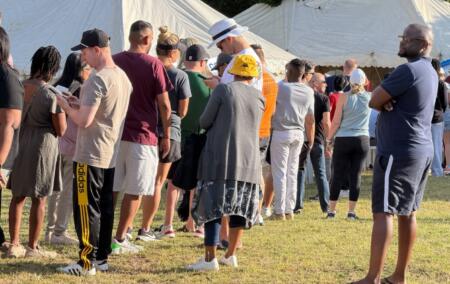
The 2026 Local Government Election results are out, and South Africans all over the country are holding their breath as the over 100 hung councils negotiate coalition agreements.
Despite the uncertainty, there are already some reasons to be optimistic. For one, I am delighted that voter turnout has increased: 52% of registered voters voted last week, up from 45.9% in the last Local Government Elections in 2021.
This is likely due to service delivery frustrations reaching boiling point, motivating voters to take their future into their own hands at the ballot box. Additionally, the 2024 National and Provincial Elections ended three decades of single-party majority government. The belief that your vote can truly make a difference in an increasingly competitive political landscape is the perfect antidote to voter apathy.
However, apathy is not the only thing that can keep voters away from the polls. The more confusing, time-consuming, or tedious voting is or is perceived to be, the more likely voters will stay at home. This is why a smooth voting process – and sharing stories of positive voting experiences – is a vital part of maintaining and increasing voter turnout.
Our work is not done
The increase in voter turnout does not mean we can relax and assume the trend is reversed. New parties in power can easily destroy voters’ faith in democracy once again by not delivering the changes they promised or not improving the lives of residents quickly enough. And although 52% is an improvement, it’s not exemplary. South Africa can do better.
This is why the work of campaigns such as #PledgeToVote, which aims to get voters to the polls, is never done. In the lead-up to 4 November, #PledgeToVote encouraged voters to show up to the polls by asking them to make an explicit commitment to vote. This commitment, made via an online voter pledge, was reinforced by a series of emails containing information about voting, messages about the importance of voting, and reminders of important dates in the electoral calendar.
The voting day experience
The day after voting day, #PledgeToVote signatories were sent a short survey on their voting day experience. When asked whether they voted, 98% of the 691 respondents said they had. Of these, 90% reported a positive experience.
Many respondents shared their positive experience with special voting specifically, with one remarking, “I had registered for a special vote and that was extremely pleasant”. Even on voting day, many had the sought-after “in-and-out” experience, ranging from “a jiffy” to “all of 5 minutes”. Some were pleasantly surprised by the short wait; one respondent and their spouse “went armed with water and hats and were delighted we didn’t need them because the queues were so short”.
Even those who had to stand in the queue for some time described a positive energy, with one reporting a “cheerful atmosphere in the hall, and everyone appeared to be ‘chuffed’ with themselves that they had made the effort to cast their vote”. IEC officials were described as not only “professional” and “helpful”, but also as “smiling”, “friendly”, and “welcoming”.
At my voting station, a whole family showed up in their Springbok supporter gear, complete with South African flags draped over their shoulders. While some may find it strange or even inappropriate to mix the national rugby team so explicitly with South African democracy, I argue that the Springbok team has become a symbol of what South Africans want: unity, non-racialism, and excellence. To support the Springboks is to support South Africa, so it did not surprise me to see that brand of green and gold in the queue.
Not all respondents had a good experience. Some had to wait a long time to vote; the longest reported wait was five hours. Accessibility was a problem for some, with uneven ground making it difficult for the elderly and disabled to stand in the queue. Accommodations for elderly voters were inconsistent and controversial. Some elderly respondents expressed relief that they were able to skip the queue, whereas others reported that they had to wait in the queue with everyone else because “there wasn’t a separate queue for elders”. Some younger voters were frustrated that pensioners were fast-tracked. “Old people had to go in first; mind you I woke up early to queue. Can’t they vote on the special vote days?” said one respondent.
Not all IEC officials were friendly, with some being described as “grumpy”, “lazy” or even “illiterate”. There was also some scepticism around the legitimacy of the election, saying that “boxes were not sealed” in a satisfactory way and that “another form of box should be used to hold the votes so that nobody can mess with them”. Another reported that there was only one box for both ballots, which they found suspicious. For one respondent, the lack of a queue in itself was a concern, perhaps interpreting it as a lack of voter participation in their community.
Keep telling your voting day stories
One of my favourite parts of voting day is the debrief. How long did you wait this time? Were there any interesting characters in the queue? Which political parties set up booths around your voting station? What was the atmosphere like?
Not only can conversations about the voting experience – especially the positive voting experience – encourage hesitant voters to make their mark next time, but they can also exert necessary peer pressure on non-voters, making them feel left out.
This rise in voter turnout is a hopeful sign for the health of our democracy and the future of our country. Let’s keep it up. And let’s keep talking about it.
The #PledgeToVote campaign is an initiative of the Institute of Race Relations (IRR) and is funded by the Konrad Adenauer Foundation (KAS).
[Image: John Endres]
If you like what you have just read, support the Daily Friend