

Ten years ago, I was in a hotel lift in central London when a ‘celebrity’ stepped in. Fair and jowly, of immediate recognition but no talent, he swore loudly into his phone, most likely ruining a subordinate’s day for the 8th time that morning. Unfortunately, the genius clearly did not understand the Faraday-cage attenuation, or the reflection of radio-frequency radiation, so his phone cut as we descended the shaft. Realising he’d lost signal, the man then lost it and kicked the car wall, swearing loudly. When we reached the lobby, the two other passengers in the lift and I looked at one another. I didn’t know their names or where they were from, but I’d like to think we formed an instant bond that morning, strangers committed to the idea that it was no longer acceptable to just dislike celebrities: you had to be anti-celebrity.
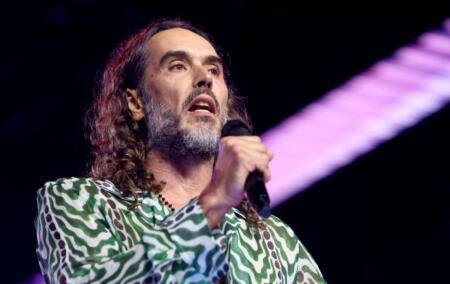
On Monday the English comedian and actor Russell Brand was sentenced to ten years in jail. Following him will most likely be David Walliams, the children’s author and former Little Britain actor, who lost his bid for anonymity relating to sexual abuse charges. Now, another British celebrity is thought to be next. Like Brand and Walliams, this person is alleged to have committed crimes of a similar sexual nature.
Russell Brand’s only real achievement to date is that he was calling people Nazis long before it became fashionable (2011). In 2008, he played a cruel prank on Fawlty Towers’ Andrew Sachs (Manuel), leaving him a voice message from a BBC studio in which he claimed to have slept with Sachs’ granddaughter, and wouldn’t be surprised that, having heard this, Sachs went and ‘hanged himself’. It prompted national revulsion, but Brand was rehabilitated by Ed Miliband’s Labour party and became that party’s most prominent ‘influencer’ for the 2015 elections (which he lost).
As far back as the early 2000s, Brand’s parasitic, depraved behaviour to women was an open secret. To do as he did, he needed an enabler, and the BBC, in its role as the country’s official concierge to pederasts, was there to guide him, as it most likely was for Walliams.
Walliams’s best skit on Little Britain was role-playing a Conservative party minister who’d been caught in various compromising positions with other men (‘inside a Rastafarian’). It acted reasonably well, but it wasn’t original.
Otherwise married
Britain’s otherwise-married Conservatives have been using and abusing rent boys for generations. In one real-life incident, a minister’s impromptu tryst went awry, and he was found naked and bound with a gag ball shoved into his mouth on Clapham Common.
Apologising for the incident, the Minister claimed that he had suffered “a momentary lapse of judgement”.
Why is this happening now? There are many explanations.
There is a sexual-violence epidemic among celebrities, but there always is, and just that alone warrants our building internment camps for them. DEI hires at Ivy League universities and Oxbridge will soon emerge with the usual stuff about white men, but these will be quickly defenestrated by responses pointing to Bill Cosby, R. Kelly or Puff Daddy.
But the one I prefer is called ‘nature healing’.
In 2020, the comedian and actor Ricky Gervais tore into celebrities gathered for annual Golden Globes awards. The insults were rapid and merciless. His monologue is still watched today, as if it had just happened. But some weren’t impressed. Writing in the Los Angeles Times, the newspaper’s culture correspondent Lorraine Ali bemoaned the effect Gervais may have had on celebrities’ mental health. ‘After all that has happened (referring to Donald Trump’s first term), they did not need this’.
Well, Ms. Ali, I beg to differ. I think they need more of it. I think it should be trapped in their ears, playing through speakers in their ablution facilities. Because if there were more ridicule and more disgust, maybe we wouldn’t have to rely on nature’s occasional purge of surplus-to-requirement, publicity-addicted jerks.
I don’t know anyone famous, but two faces once lived not far from me, and frequented our high street occasionally. One was a singer, the other a writer and actor. Both were wildly successful, shy, cursed with impostor syndrome and so reluctant. Fame was an unfortunate symptom of doing the thing that put food on the table.
Currently bricking himself
People like Brand and Walliams (and very likely the third guy currently bricking himself) did not have this foundation, just eternal pleas for attention, and an eagerness to stoop or shock beyond the acceptable when attention wasn’t forthcoming.
Think about this for a second.
In his applications to the court requesting the super-injunction concealing his identity in the press, David Walliams ̶ through his lawyer ̶ claimed if this were not issued by a judge, “he might consider suicide”.
To understand: Walliams lives in a country suffering unacceptable levels of young white suicide, but because he and his fellow ‘stars’ have enjoyed such impunity (courtesy of institutions such as the Labour party and the BBC), or have never had to endure any features of the spiritual war bureaucracy thrust into young white men’s lives, he thinks he can extort a judge with it? Just incredible.
I don’t think we can rely on nature. I don’t think it’s fair anymore. We must seize the initiative and blend our annoyance with theories, such as those of the French academic René Girard. His scapegoat mechanism suggests that in order to prevent full-blown destruction, a person or group is sacrificed, whereupon peace abruptly returns. Just as Walliams dangled his threat in front of the judge, the mechanism should be presented as a warning to every individual acting out with delusions of fame.
Watch: cases of abuse against ‘stars’ will plummet. There will be no more tantrums inside lifts. Instagram might go bankrupt. Piers Morgan might become homeless.
[Image: https://www.flickr.com/photos/gageskidmore/55018916186]
The views of the writer are not necessarily the views of the Daily Friend or the IRR.
If you like what you have just read, support the Daily Friend