

The DA is in an intense and long-term fight to prevent the party being frozen out of coalitions. With our proportional representation system and the end of ANC one-party domination, coalitions are the future.
The intention of the ANC and its spin-offs, ActionSA and others, is to see to it that the DA is frozen out of power. This is being backed up with attacks on DA personalities like Helen Zille and Cilliers Brink, but also the rhetoric of racial nationalism. The rationale of “black unity” is increasingly being called upon to keep the DA out of power.
Listen to ActionSA leader, Herman Mashaba, on why he does not want a coalition deal with the DA: “I will not take the votes entrusted to us by black South Africans and hand them over to people who look down on black voters.”
The implication is clearly that the DA is a horrible racist party. Yet he has shown that he is prepared to hand over his supporters’ votes to the ANC. His supporters voted for him as an alternative to the ANC, and here he has rolled over and given the ANC all they want.
The ANC says it will reveal its coalition partners across the country tomorrow, ahead of councils meeting on Friday to elect mayors and speakers. What is pretty certain is that the ANC and its coalition allies, ActionSA, the EFF, the Communists and possibly MK and others will be in power, for the moment in the Gauteng Metros. They are united in their goal to keep the DA out.
Earlier this week, the ANC’s bosses meeting as the party’s National Executive Committee (NEC) left decisions on coalition formation up to the local ANC regions. It is unlikely that the ANC bosses will not intervene in local decisions to try and keep the DA out. After all, the NEC has called any coalition deals with the DA “a last resort.”
ANC local deals rather than one at national level mean the DA’s “Stability Framework”, proposed as a national deal that would give parties that obtained the largest share of the vote the right to appoint mayors and council speakers, has been turned down.
The exclusion of the DA, the party with the largest share of the vote in the three Gauteng Metros – Johannesburg, Tshwane, and Ekurhuleni – is perfectly legal. But it will depress investor confidence and raise questions about the quality of SA’s democracy.
Excluding a party from coalition arrangements has occurred around the world. In SA. we are only becoming much more aware of the reality of this with the end of a one-party dominant system.
In the Gauteng provincial election in 2024, the DA obtained the second largest share of votes, over 27 per cent to the ANC’s nearly 35 per cent. Yet Panyaza Lesufi, Gauteng Premier, known to be hostile to the DA, did not invite the party into the provincial coalition. This is although the DA agreed to the Statement of Intent underlying the formation of the government of national unity, which arguably should have also applied to provincial governments.
The agreement among mainstream parties to exclude what are often undemocratic, extremist and regional independence parties from coalitions in multi-party democracies is termed a “cordon sanitaire” –
a sanitary buffer. In Germany, mainstream parties from the centre-left and right have maintained a “firewall” against forming coalitions with the right-wing Alternative for Germany. In Belgium, Flemish mainstream parties have refused to enter a governing coalition with a far-right separatist party. In Italy, mainstream parties refused until the 1990s to govern with the Communist Party.
But the DA is a mainstream moderate democratic party with the most diverse racial support base of any party in the country. And here are ActionSA and the comrades wanting to paint the DA as a racist party. EFF leader Julius Malema has tried to paint the DA as racist for opposing black empowerment and expropriation without compensation.
Their campaign will gather pace to try and paint the DA as a party justifying exclusion.
The comrades are furious at the DA success and are intent on halting the party in its tracks. In Emfuleni earlier this week, EFF councillors overthrew tables and heckled to prevent a council vote that would have seen the DA’s Kingsol Chabalala elected Mayor.
What the DA’s exclusion will mean is that coalitions will have to resort to support from multiple parties. That will make for an environment of coalition instability and continuing poor performance in service delivery.
In SA. with our politics in flux, coalition deals are inherently unstable.
But uniting parties to keep the DA out of the coalition and on grounds of racial exclusion is unlikely to provide a glue that can guarantee stability. Parties are bound to come up against each other as they tussle over how positions of power are divided up as well as perceived slights.
There are factions in the ANC that would prefer a deal with the DA to those with ActionSA and the breakaway comrade parties. They are pragmatists and want to be associated with the better chance of DA success on service delivery.
But they do not have the weight to push through their wishes. Handing decisions to local party bosses means President Cyril Ramaphosa is unable to make party decisions of this magnitude, or that he does not want to be seen to be making these.
In its dealings with other parties who want the DA frozen out, the DA can take a tough line. It could obtain good deals by linking any agreement it makes to other matters. To the ANC it can say, ‘If you want us to save your skin in certain municipalities, give us a few extra ministerial posts in the government of national unity.’
The worse for the DA is that its voters, who are despondent at the gang-up to freeze the party out of power, will lose faith and not come to the polls. Strong opposition and a continuing campaign against municipal failure could remedy that.
ActionSA thinks it can build support by being in ruling coalitions. The ANC and its allies are scared at the declining direction of their support and need to satisfy their base of cadres and patronage networks. They see their best bet as lying with parties that are similar to them or want to exclude the DA. It is what they know best and where they feel comfortable.
But the “doomsday” coalitions could backfire, ending ActionSA’s rapid rise in Gauteng, and ensuring the continued erosion in support for the ANC, EFF and MK. Poor delivery due to incompetence, corruption and infighting and vengeance on ActionSA for supporting the ANC has to be a real risk for the doomsday coalition partners come the national election in 2029.
The best vengeance of all against the parties that want to freeze the DA out is for the party to win sizeable majorities. Exclusion from power just might give voters the push to come to the polls to right an injustice.
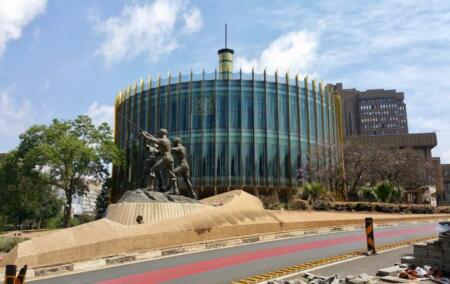
[Image: JHB city council chamber]

The views of the writer are not necessarily the views of the Daily Friend or the IRR.
If you like what you have just read, support the Daily Friend.