

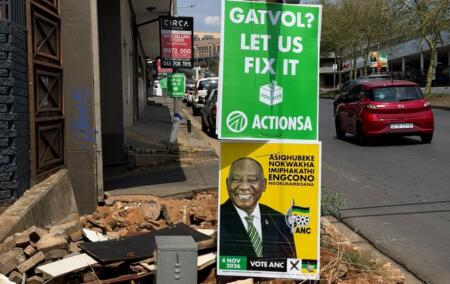
For people like me with a developmental wish for election outcomes rather than personal-enrichment outcomes, the way coalition formations have played out at municipal level is bleak indeed.
The wish that the weakening of the ANC which resulted from the election earlier this month would usher in reforms at local government level appears to have been no more than wishful thinking.
By looks of it, an incredibly important window for reform at local government level – in order to bring positive development to municipalities – has been closed on account of the continued selfishness of the newly elected councillors who seem to be intent on choosing the gravy train instead of the development train.
If readers think my pronouncement is premature, I am willing to swallow my words when we assess progress at our collapsed municipalities again in three years’ time just before the next national elections.
Unfolding tragedy
Ironically, the national political leaderships allowed the unfolding tragedy I painted above, which should tell us a lot about them. Not that one is surprised that the EFF and MKP and some other smaller wish-to-be-kingmaker parties chose the personal gain route, but the ANC’s national “leadership” miserably failed to stand firm and put the country’s development first.
But even that should not be too much of a surprise, since the ANC hasn’t shown any statesmanly leadership for many years, especially since the current weakling took over the reins of the party.
No “broad church of interests” can stay bound in the form of a unitary party, unless it has very strong leadership. It is said of China that the CCP could never but “elect” a leader who was not for all intents and purposes a tyrant. He couldn’t allow division for a minute, since that would make China ungovernable in no time.
One does not for a moment want such a leader for South Africa as a whole, but political parties need Zilles in order to enforce unity. After all, political parties are not country clubs, but rather “fight clubs”. They engage in brutal battles so must be commanded by strong generals to ensure unity of purpose.
In very exceptional cases, a charismatic leader can achieve the same in another way through soft power, like Madiba could mainly do – to mention but one example befitting the South African context.
As someone who did not even vote for the DA this time, I can somewhat objectively state that the DA, with its proposal of a nationwide “stability framework” across 137 hung councils (offering the ANC 93 mayoralties in exchange for the DA leading metros where it is the plurality party), made it again stand out as a party the larger South Africa deserves.
Clearly ignored
The argument that “the voters get the government they deserve” is nonsense in respect of the recent LGE’s outcome. Voters did switch votes, or stayed away from the ballot box, to send the ANC a message. But it is a message the party very clearly ignored on account of pathetic and spineless national leadership, thus resulting in the continued selfishness of the newly elected councillors who seem to be intent on choosing the gravy train instead of the development train.
What a tragedy, since South Africa’s economic recovery could have started with stable local government coalitions – reflecting the wishes of the voters – instead of the conditions resulting from the deliberate sidelining of the DA in which councillors are effectively encouraged to think of their own pockets rather than the desperate needs of the residents.
And that in spite of the DA’s being the only big party with a proven development track record at local government level.
[Image: John Endres]
The views of the writer are not necessarily the views of the Daily Friend or the IRR.
If you like what you have just read, support the Daily Friend