

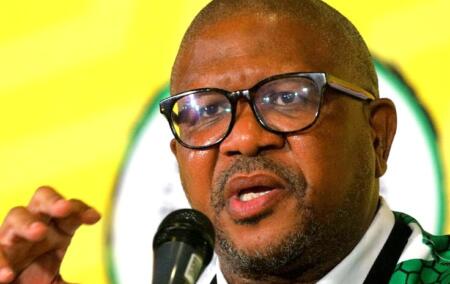
African National Congress (ANC) secretary-general Fikile Mbalula told journalists at Luthuli House this week that the party had to “read the room correctly” on March and March, the anti-immigration movement that mobilised tens of thousands of South Africans on 30 June.
His admission that the movement’s grievances were real was unusual for a party that spent months dismissing the marchers as xenophobes or proxies for foreign funders. It was also a useful data point for anyone tracking the ANC’s succession contest, ahead of the party’s elective conference in December 2027.
Mbalula’s remarks did two things at once; he conceded that March and March had tapped a genuine well of anger over unemployment, crime and failed service delivery, anger the ANC itself has generated over three decades in power. And he positioned himself as the ANC figure willing to say so out loud, while his rivals either ignored the movement or tried to discredit it.
That combination is not new for Mbalula. He has spent much of his term as secretary-general building a reputation as the party’s most visible communicator, a role that gives him command of the airwaves without the institutional weight of the deputy presidency. While Paul Mashatile, the deputy president, holds the position that has historically delivered the ANC presidency, Mbalula holds the microphone. His pitch to ANC branches ahead of 2027 depends on his using his party role and profile more effectively than Mashatile.
The events around 30 June gave him an opening. President Cyril Ramaphosa met privately with March and March co-organiser Nkosikhona Ndabandaba on the eve of the protests, seeking assurance that the marches would stay peaceful. Mbalula then used social media to highlight a separate meeting between Jacinta Ngobese-Zuma and MK Party officials, implying her organisation was compromised by Jacob Zuma’s political orbit. Ngobese-Zuma responded that Mbalula had ignored years of meetings that her movement had held with other parties, including the ANC itself, and accused him of settling old scores tied to Zuma, rather than addressing the substance of her movement’s demands.
Some political analysts have read this exchange as evidence that Mbalula was competing for relevance after being excluded from the president’s own diplomacy, and that reading definitely has merit. Mbalula has a documented habit of calling press briefings that put him ahead of government ministers and sometimes contradict positions the government has already stated.
Not mutually exclusive
But turf protection and succession positioning are not mutually exclusive. A leader building a national profile ahead of a conference vote has every reason to insert himself into the story of a protest movement that rattled his own party, and to do so in a way that makes him look like the one ANC official willing to name the problem.
The succession contest itself is no longer a secret conducted through winks and denials. Mbalula has spent the past year consolidating provincial machinery in the Eastern Cape and Johannesburg regions, placing allies in structures that will matter when delegates vote in 2027. He has simultaneously denied any presidential ambition, calling succession talk premature and warning against what he termed self-aggrandising campaigning within the party. But the public denials have not stopped the manoeuvring.
Mbalula cannot afford to be seen exploiting March and March’s grievances for personal advantage. Doing so would give his rivals an easy line of attack, and it would undercut the ANC’s official position: that the protests reflect legitimate policy failures the government is already addressing. That constraint likely explains why his framing stayed close to party talking points, even as it opened distance from his colleagues. So, while he conceded the grievances, he did not concede that the ANC had failed to act on them.
Relevant signal
For investors and analysts tracking South Africa’s political risk profile, the relevant signal is that a senior ANC official has validated the substance of a protest movement built on anger at service delivery failure, unemployment and porous immigration enforcement, at the same time as he uses that validation to build a domestic profile ahead of a leadership race.
For now, the ANC is still the biggest party in South Africa. One of the ANC’s potential next presidents is simultaneously admitting the party’s failures, and competing over who gets credit for that admission. Government of National Unity partners and citizens to whom they answer should read that combination as a sign of a party under real internal pressure, not one recovering its footing.
[Image: https://www.flickr.com/photos/governmentza/34207305944/in/photostream/]
If you like what you have just read, support the Daily Friend