


The following is based on an address I am to deliver tomorrow at the National Press Club in Washington DC, as part of the Lex Libertas White Cross Project Conference.
In January 2025, primarily due to the efforts of Elon Musk and senior officials in the United States, including the President, and the hard work done by organisations such as AfriForum, the Institute of Race Relations, the Free Market Foundation, and later Lex Libertas, the world became aware of the fact that race and skin-colour continue to play a fundamental role in South African law.
While many believed that this had come to an end in 1994, the Index of Race Law, which I edit for the Institute of Race Relations, laid bare the unfortunate reality that race law is alive and thriving. You can view the whole Index at RaceLaw.co.za.
And this graph bears it all out, clearly.
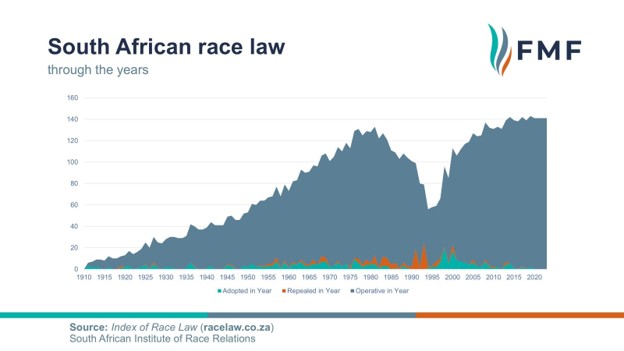
Ladies and gentlemen, as of June 2025, the Index of Race Law records that since the establishment of the Union of South Africa in 1910, Parliament had adopted 324 race laws. Of those 324, 145 remain on the books, and 136 remain racially operative. Since the end of Apartheid, Parliament has adopted 122 of these laws.
A race law, of course, is any statute that takes the common law legal subject – whose pigmentation is perfectly irrelevant – and makes of their race, skin-colour, or ethnicity a legally relevant factor.
Think about that: 38% of South Africa’s total ever race laws were adopted after Apartheid is said to have ended.
I could not lie about this even if I wanted to. Statutory law is public record, so I assure you that Secretary Rubio is not imagining it when he limits South African officials’ ability to travel to the United States for legislating racial discrimination.
It was of course not arbitrarily decided that South Africa would continue to legislate by race after the end of white minority rule in 1994.
Many in South Africa try to present this phenomenon as a perfectly natural reaction to the racial injustice of the past, saying that if people were impoverished on the basis of their race back then, they must be empowered on the basis of race today.
In other words, the race laws we have today, are well-intended. They are “redress” laws, the world is told. They are necessary and therefore good. We are told thus that we cannot count these as “race laws”. Only laws with bad intentions could qualify as race laws.
That means all the laws of the Apartheid era that have a bearing on race must be counted, but the second the African National Congress (ANC) came to power, all intentions suddenly became pure and no race-based law that the ANC crafts may be said to be race-based.
There are no race laws in South Africa today, is what the South African press and senior politicians have been telling the United States for well on two years now. And Ronald Lamola, South African foreign minister, is right here in the United States now to repeat the lie.
Well, ladies and gentlemen, I guess the PATRIOT Act is therefore not a surveillance law, because it was adopted with good intentions.
But also, with this logic, if we discover that the people who enforced Apartheid did so because in their own minds they believed they were doing the right thing, we also cannot count Apartheid as a system of racial legislation.
That cannot be. Intention and good-vibes are not a seriously recognised test in public policy or lawmaking for whether a given law is beneficial or harmful, or whether it has a certain nature. We must look to the actual text and effect of the law to determine that. Intention plays no substantive role.
Nobody today is asking whether the intentions behind the laws that entrenched slavery, Jim Crow, segregation, or Apartheid, were pure. The question does not arise, and rightly so. What the text of the laws back then and of the laws today tell us, is that the design is one of racial-social engineering, for purely academic purposes.
“Academic”, because South Africa’s race laws have no bearing on the socio-economic conditions of their intended beneficiaries and victims. They do not by design seek to uplift the poor – there is no question of wealth. There is no exemption for poor whites, or for rich blacks.
These laws are all about “representivity”; in other words, ensuring that when one looks at a spreadsheet or a ledger, each racial population group is neatly contained to the demographic quantity it represents in the country. If whites are only 7% of the population, then ideally only 7% of land may be owned by whites. And you might think this means only 7% of big companies may then be owned by whites, but no, only 7% of the shareholding in big companies may be owned by whites.
They euphemistically call these “targets”, so they do not have to call them “quotas”.
The laws do not really mind a 100% black-owned company. This is in fact celebrated openly, and officially by the state. Make with that what you will.
In New York City, something like 80% of nail salons are owned by Asian-descended people.
Is this a problem? Of course not! But academically, it might be. I mean, it is disproportionate to the 1% of the New York population that they represent. It does not make sense on the spreadsheet or the ledger. In South Africa, this would be an outrage, whereas in reality, this is the way society, markets, and freedom work.
Race law in South Africa is, therefore, a base rejection of normality, and is formally totalitarian. It touches every domain of society, from public procurement, sports, education, and of course virtually all commerce.
If you want to succeed in business in South Africa, at some point, the law compels you, whether directly or indirectly, to take someone’s race or skin-colour into account – be that your own, that of your staff, your shareholders, your suppliers, your clients, or even the people you make charitable donations to. Whether you can merge with another company, promote or demote staff, or sell shares, you will eventually need to sit down and count racial beans.
Except, these beans are flesh and blood individuals with interests and desires. What an atrocity.
This is nothing less than a repudiation of the social contract between a state apparatus and its citizens and taxpayers.
In South Africa, we are left with the question of how long we will continue to tolerate this relentless assault on our vital interests and those of our children. And, increasingly, our friends from abroad like yourselves are starting to play an important role in this determination.
Ladies and gentlemen, I inform you with some level of regret, that it is American civil rights logic that South Africa imported into its discourse in the 1970s and 1980s and into our law from the 1990s until today.
Our law is crafted as if the powerful demographic majority is extending a hand of upliftment to the disadvantaged minority, as was the case in the United States. In reality, race law in South Africa is targeted at the politically powerless racial minorities and enforced by a political elite from within the racial majority.
What do we call this, ladies and gentlemen? Not “genocide”. Of course not genocide.
“Persecution”. This is racial persecution, in its most obvious form. A powerful, entrenched political elite is using the inborn group characteristics of legal subjects to victimise them in official policy.
But surely, we are told by the South African and international progressive elite, that if there is really something going on, we must take it to court and to our human rights authorities. All too conveniently, though, the judiciary and bodies meant to protect demographically vulnerable groups all too eagerly endorse the racial-socialist ideology of the ANC, even when on a plain reading the South African Constitution is resolutely designed to be a firewall against race law and racist policy.
The courts will not save the day, because their ideological core comprises those who treat DEI and racial engineering as religious imperatives.
And of course, to their eternal shame, the fourth estate in South Africa, the so-called independent press, has with very few exceptions decided to run cover for the political elite and normalise the lie that there is no racial legislation happening in modern South Africa.
I am a libertarian, or as we say in South Africa, a classical liberal, with every fibre my being, and I am telling you: distrust as a matter of course that classical liberal institution, the press media in South Africa.
Ladies and gentlemen, the United States of America is the shining city on the hill for liberty, free enterprise, private property, and limited constitutional government. The US played a key and active role in bringing Apartheid to an end, but mistakes were made in the assumption that the new revolutionary communists who came to power would respect constitutional safeguards.
We ask, therefore, not as a matter of charity, but as a matter of American geostrategic interest and the long-term viability of Western civilisation, that the United States re-engage sustainably with the situation in South Africa.
Make your opposition to racist laws clear. Not just federal officials, but American businessmen. If every meeting with South African regulators is started with a race law condemnation, in the same way the Canadians and Australians do their weird land acknowledgements, it will be worth its weight in gold. And engage in maximum achievable non-compliance with these race laws whenever you can, as encouraged by the business groups Sakeliga and the National Employers’ Association of South Africa.
From the federal government’s side, incentivise your companies to do so. And when you engage with private South African companies or entities, make it a matter of official policy to only cooperate and engage with those South African institutions that have made a clear statement against the race totalitarianism of the present South African regime.
Secretary Rubio’s announcement last week meaningfully moves in this direction.
In conclusion, our situation in South Africa is far from hopeless. Racial minorities, with the help of their many good friends among the black majority, have been remarkably resilient in adapting to and overcoming the harm that race laws are designed to create.
Civil society in South Africa is perhaps one of the most organised in the world. Combined with decades of corruption and ineptitude by the South African political elite, this has ensured that the totalitarian ambitions of race law cannot be achieved. Much damage is done in the attempt, but any little resistance that is relentless and sustainable guarantees their failure.
We love South Africa, and most of us want to stay in South Africa. Some, of course, understandably seek to make use of the generosity of the United States and take up refuge there, and we encourage those who feel the need, to do so.
Your renewed interest in South Africa, ladies and gentlemen, has been remarkably helpful. The ANC and its ideological allies know they are being watched now, whereas before, they thought they could do as they pleased. Your interest has to a large degree normalised criticism of the ANC and racial socialism, and I can only ask that you keep it up.
We are potentially on the cusp of finishing the unfinished business of 1994, which is to finally rid South Africa of racially discriminatory law.
[Image: by SeanPavone]
The views of the writer are not necessarily the views of the Daily Friend or the IRR.
If you like what you have just read, support the Daily Friend