

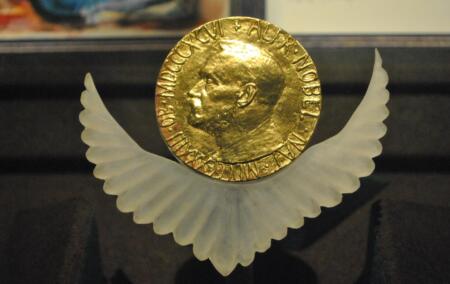
On 9 October 2026 the Norwegian Nobel Committee (“the committee”) awarded the Nobel Peace Prize to Navanethem (Navi) Pillay “for her efforts to promote peace and international law”, and announced that “Peace requires justice”.
In Nuremberg, ironically, Pillay told a crowd celebrating her award: “The last thing I did is the delivery of the report on Gaza, naming what’s happening there as genocide.” In Oslo the committee said that it was “not taking a stance” on genocide, as “it’s her report”. Perhaps the committee should have made its announcement on 7 October, the day of the worst genocide of Jews since the Second World War, rather than two days later.
On 9 October 2009, seventeen years earlier to the day, the committee awarded the Nobel Peace Prize to President Barack Obama “for his extraordinary efforts to strengthen international diplomacy and cooperation between peoples”. Obama’s response, as his memoir records, was a question: “For what?” In 2015 the committee’s secretary disclosed that the committee chose Obama because it believed the prize would help him achieve his goals.
Alfred Nobel’s will makes it quite clear what the requirements for the Peace Prize are. It is for those who, “during the preceding year”, have “conferred the greatest benefit to mankind”. It is for the person who has done “the most or the best work for fraternity between nations, for the abolition or reduction of standing armies and for the holding and promotion of peace congresses”.
The records of the favoured candidates were clear. Vanessa Nakate campaigned for the vulnerable communities affected by climate change. The volunteers of Sudan’s Emergency Response Rooms were bringing food, medical help and evacuation to civilians in Sudan’s civil war. Yulia Navalnaya became the political voice of her husband, Alexei Navalny, who died in a Russian Arctic prison colony.
Pillay’s record was not as impressive.
Having signed South African BDS petition to “Sanction Apartheid Israel” she had no qualms in chairing the singularly inappropriately named “Independent International Commission of Inquiry on the Occupied Palestinian Territory, including East Jerusalem, and Israel.” She proceeded to conduct an investigation in which Israel refused the commission entry and the commission acquired its information from second-hand sources.
Ten weeks after she tendered her resignation, the commission published its results and conclusions, finding that the State of Israel was responsible for committing genocide, for failing to prevent it and for failing to punish it. In September 2024 it had recorded that Hamas was guilty of war crimes and crimes against humanity. In its 2025 report to the General Assembly it absolved Hamas, mentioning it once, in a quotation from an Israeli minister. It declared that Israel had the intent to destroy the Palestinians of Gaza, as this was “the only reasonable inference”. It traced that intent back to “decades of unlawful occupation and unlawful settlement, with racial segregation or apartheid”.
When asked whether the states that still supplied arms to Israel were complicit in genocide, Pillay answered: “Yes.”
Her record as a judge at the International Criminal Tribunal for Rwanda (“the tribunal”) is equally chequered. When the defence in the Media case applied for Pillay’s recusal, because she had already expressly pronounced on the guilt of the radio station RTLM in an earlier case, the chamber in which she sat dismissed the application.
When a press report accused three judges of the tribunal of laughing while defence counsel cross-examined a rape survivor about how her attackers had undressed her, Pillay, as president of the tribunal, called the report “a mischaracterisation of the scene”, and in the same statement declared that it would not be appropriate for her to discuss the conduct of other judges in an ongoing trial. The survivors’ organisations Ibuka and Avega suspended their cooperation with the tribunal.
Her attitude has remained constant. When her fellow commissioner, Miloon Kothari, told an interviewer that the “Jewish lobby” largely controlled social media, Pillay stated that he had been “deliberately misquoted”, without saying how. Kothari subsequently apologised and wrote that it had been “completely wrong” for him to describe social media in that way. Pillay was not as forthcoming.
In the Rwanda tribunal, the Appeals Chamber annulled and replaced various decisions over which Pillay presided, because of her misdirection concerning conduct outside the tribunal’s temporal jurisdiction. In the Palestine commission matter it was easier. Her commission was to investigate violations “leading up to and since 13 April 2021” and was not limited by time issues.
During the investigation, Pillay stated: “The occupation is as non-ending as our mandate.” This followed earlier prejudicial remarks, when Pillay told the General Assembly that “Israel’s occupation is now unlawful”. The evidence of her bias, and her (lack of) regard for natural justice, did not prevent her from sitting on either the tribunal or the commission.
The Appeals Chamber in the Rwanda tribunal reversed Pillay’s Media case decision on the basis that a reasonable trier of fact could not find conspiracy to commit genocide to be “the only reasonable inference” from the evidence. Pillay, not a great historian, repeated her conclusion when deciding on Israel’s conduct, with a greater paucity of evidence. But then, a report to the UN General Assembly has no Appeals Chamber above it that can set aside such a legal conclusion.
In September 2022, when the United Nations Association of Germany proposed to present her with its Otto Hahn Peace Medal, Israel’s ambassador in Berlin said: “To have Navi Pillay investigate Israel is like asking Putin to chair a commission of inquiry into Ukraine.” The ceremony did not take place. In November 2025, when Sydney gave her its peace prize, the Premier of New South Wales declined to attend, and the Executive Council of Australian Jewry had said that the prize went to recipients “for having the ‘correct’ opinions, rather than for making a real contribution to peace”.
The Nobel committee wanted Obama to achieve in 2009, and it paid him in advance. In 2026 it wants Pillay’s report to achieve the definition of Gaza as genocide before any court has ruled, and it has paid her in advance as well. She is well positioned to pay it back, as she sits as an ad hoc judge in the Gambia v Myanmar genocide case and will no doubt work hard to change the definition of genocide.
The function of the Nobel Peace Prize committee was to ask what Pillay did in the preceding year for fraternity between nations, and what she did for fewer standing armies and for peace congresses. She ticks none of those boxes. She incites friction and animosity. She accused one nation of genocide and called the nations that arm it complicit. Nobody punished the committee for the Obama Peace Prize, and now the committee has taken another step further. It is no longer an award for anticipated fraternity; it is now an advance to persuade political opinion. Again, the committee goes unpunished. But this time the sin is more egregious. A political finding on genocide lets the committee ignore its own principles, and lets its members’ antipathy toward Israel translate the big lie of Israeli genocide into a Nobel medal.
So, to you, Vanessa Nakate, to you, the volunteers of Sudan’s Emergency Response Rooms, and to you, Yulia Navalnaya: speaking for the vulnerable, feeding civilians under fire or defying the Kremlin will not win you this prize. Better luck next year. President Obama asked “For what?” The committee has now answered: the correct opinion, not peace.
[Image: Nobel Peace Prize medal]

The views of the writer are not necessarily the views of the Daily Friend or the IRR.
If you like what you have just read, support the Daily Friend