

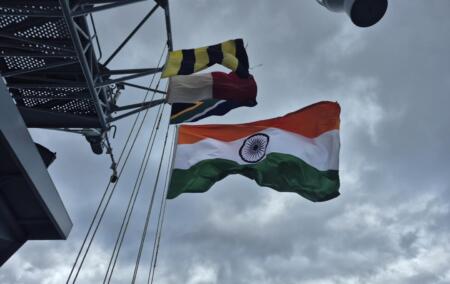
On Monday 19 October I stood on the deck of INS Tarkash in False Bay as the ship’s Chetak helicopter hovered overhead. Brazil’s BrNS Barroso steamed nearby, and South Africa’s submarine SAS Manthatisi was in the same waters – as well as SAS Amatola. The Indian crew were impressive: professional, welcoming, and friendly. They were keen to talk about all kinds of things, from their ship to naval strategy and tactics, to cricket. The weather was perfect for the exercise, and I came away thinking about a different naval exercise held in the same waters nine months earlier.
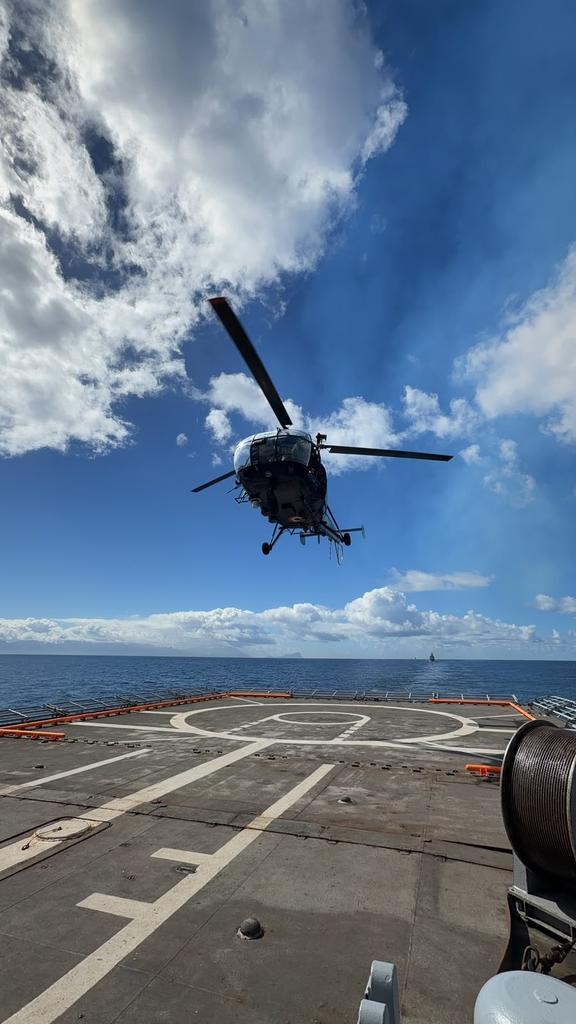
[An Indian Navy Chetak helicopter over the flight deck of INS Tarkash in False Bay. Photo: Chris Hattingh]
IBSAMAR is a maritime co-operation forum that brings together the navies of India, Brazil and South Africa. It has run every second year since 2008, with this latest edition the ninth. South Africa is an ideal host because of where it sits on the sea route between the Atlantic and Indian oceans. The lead nation changes, and this time it was India’s turn. The exercise ran from 8 to 20 October, with a harbour phase followed by a sea phase in False Bay. South Africa navy contributed the Valor Classs frigate SAS Amatola, two inshore patrol vessels of the Warrior Class, SAS King Sekhunene and SAS Adam Kok III, and the submarine SAS Manthatisi. Brazil has sent the corvette BrNS Barroso, while India has sent INS Tarkash, which carries a Chetak helicopter and a special forces team. The theme is “Stronger Together Towards a Shared Future in the Maritime Domain”.
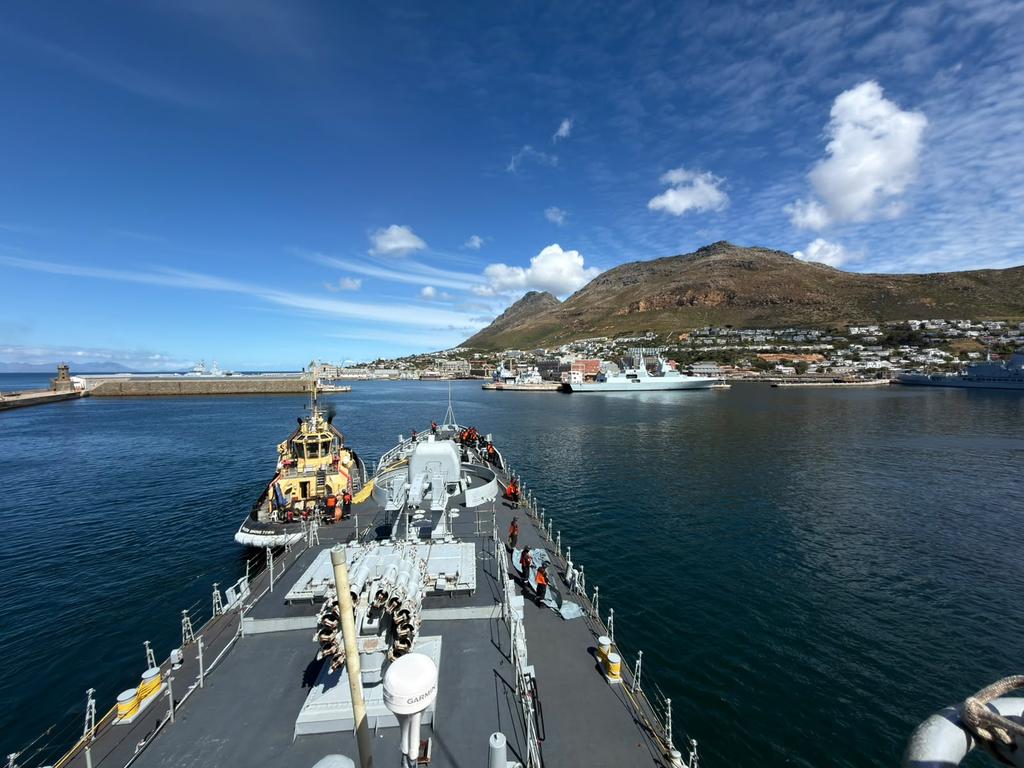
[INS Tarkash enters Simon’s Town harbour. Photo: Chris Hattingh]
Exercise Will for Peace ran from 9 to 16 January, with China being the exercise lead. Russia and Iran joined, and the United Arab Emirates sent a corvette. The exercise was first planned as Mosi III, the third in a series South Africa has held with China and Russia. By the time it started, it had morphed into something else.
Ukrainians protested outside the Simon’s Town base. The Democratic Alliance objected to the presence of Russia and Iran. On 16 January, the United States embassy called Iran a “destabilizing actor and state sponsor of terror” and said its inclusion in any capacity undermined maritime security. Reports also said the presidency had ordered Iran excluded, yet Iranian ships were anchored in False Bay. A probe was launched to investigate what happened. Brazil and India, both BRICS members, stayed away. India’s foreign ministry said the drill was a South African initiative and not a regular BRICS activity.
The two exercises can be compared on what South Africa’s navy gained, and what South Africa’s government (read: the taxpayer) paid for it.
On the first measure, they look alike. Both gave the SA Navy time at sea with foreign ships. Both offered practice in vessel boarding, escort and search-and-rescue drills. SAS Amatola, took part in both. A navy with a small fleet needs that practice from whoever will provide it.
But on deeper reading, they differ sharply. IBSAMAR is an exercise between three democracies that have worked together for eighteen years. Nobody must explain who is on the guest list or why. Will for Peace needed days of explanation. The government had to defend it to Washington, to its own coalition partners and to a public that wanted to know why Iranian warships were in South African waters. Pretoria spent diplomatic capital that IBSAMAR, by contrast, does not draw down.
The lead nation sets the tone. IBSAMAR passes the lead from one partner to the next, and every edition has the same three members. Will for Peace had China in the lead and a guest list that changed as the politics changed. A rotating lead among three fixed partners gives South Africa a predictable exercise. A single dominant lead with an open guest list leaves the host answering for other countries’ choices.
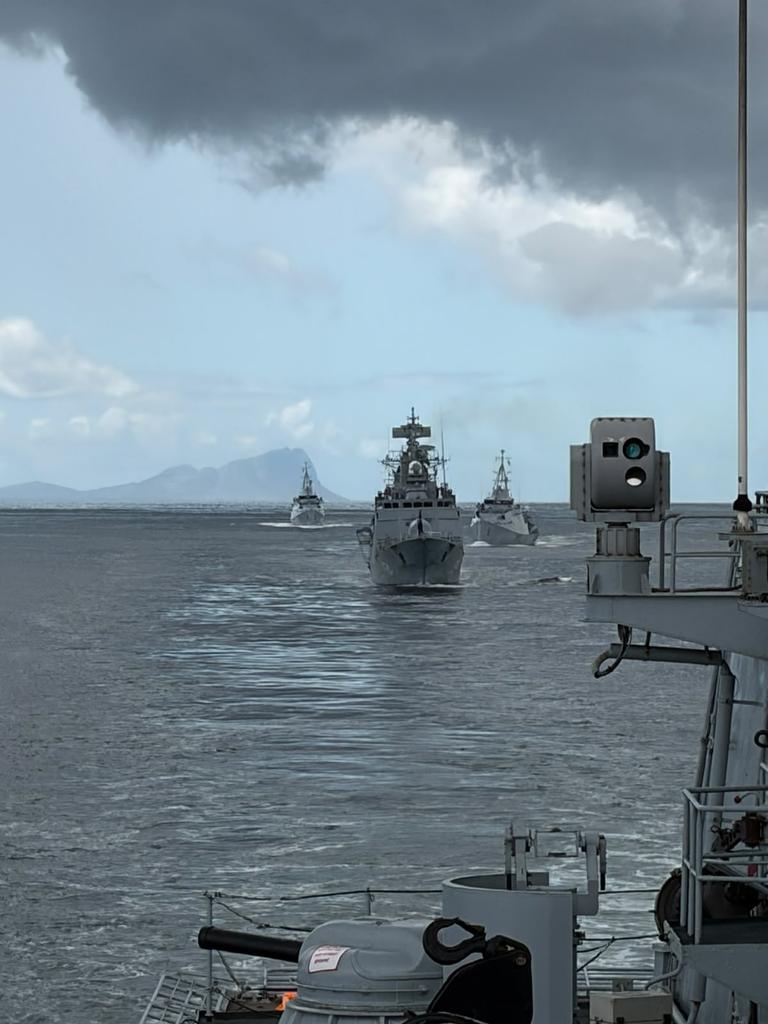
[Ships in formation in False Bay during IBSAMAR IX. Photo: Chris Hattingh]
India shows how this can be handled. Tarkash was built in Russia, and India also sent INS Sahyadri to Vladivostok for a separate exercise with the Russian navy from 13 to 18 October. On the way to South Africa, Tarkash held a passage exercise with the Kenyan navy at Mombasa, and India and Kenya held their first staff talks. In June the same ship called at Port Victoria in the Seychelles. India builds each of these partnerships separately, with its own rules and its own guest list. Nobody asks India to choose between them, because New Delhi never presents them as a bloc.
The Indian Navy is also growing rapidly, currently operatinng more than 140 ships. It commissioned 12 warships and one submarine in 2025, and its defence minister said on 29 September that the navy would commission 18 warships this year, the largest single-year addition in its history. The navy has said it will have more than 200 ships by 2035. About 45 to 50 ships are under construction, and every one is being built in an Indian yard. Tamal, a sister ship of Tarkash, was commissioned in Russia on 1 July 2025. She was the last warship the navy took from a foreign yard.
The orders create work and skills at home. The Indian government’s 70,000 crore rupee (R120 billion) shipbuilding package was meant to lift production, jobs and supply chains in steel and electronics. One recent frigate, INS Dunagiri, was reported to carry 75% indigenous content, with more than 200 small suppliers and more than 14,000 jobs behind it. India’s defence ministry reported record defence production of 1.78 trillion rupees (about R300 billion) in the 2025-26 financial year, up 15.6% on the year before, and record defence exports of 384 billion rupees (about R65 billion).
Technological innovations and progress, with benefits for other economic sectors, follow the orders. India took delivery of its own aircraft carrier, INS Vikrant, in 2022, builds Kalvari-class submarines at home, and commissioned its third nuclear-powered submarine, INS Aridhaman, on 3 April 2026. A navy that builds at home also pays wages and trains engineers at home.
Simon’s Town’s strategic location and value explain why South Africa’s choice of partners matters. The base sits on False Bay, next to the Cape Sea route that links the Atlantic and Indian oceans. Ships carrying oil, grains, containers and cars between Asia, Europe and the Americas pass it every day. Since the Red Sea became dangerous in late 2023, more of that traffic has gone round the Cape. The US, Israel-Iran war that erupted in February has forced yet more traffic around the Cape.
South Africa also carries a heavy responsibility at sea. It runs the search-and-rescue service for a very large stretch of three oceans. It has to protect its fishing grounds, its offshore resources, and its ports. No other country will do this for South Africa. The job needs ships that can stay at sea for weeks, aircraft that can see and reach a long way, and submarines, to protect undersea infrastructure and deter aggression. It needs a navy and an air force that train together and can be sent wherever they are needed. That ability to project capable forces far from home and keep them there is vital.
What I saw on the water showed how little South Africa has available to do that job. The sailors on SAS Amatola did what they could with what they have. So did the air force crews flying an Oryx helicopter and a Gripen fighter in support of the exercise. The effort is there, but the equipment is perilously little and thin.
The submarine in my photograph, SAS Manthatisi, is the only one of the navy’s three submarines that can go to sea. She returned to sea in July, nearly three years after a training accident off Kommetjie in September 2023 thatresulted in three deaths. The navy said it cleared her after safety inspections and crew certification. The other two, SAS Charlotte Maxeke and SAS Queen Modjadji I, are in the midst of an unfunded refit programme. Manthatisi’s own midlife refit, planned for 2022, has not taken place. She can sail, but she is not in the condition a modern submarine should be.
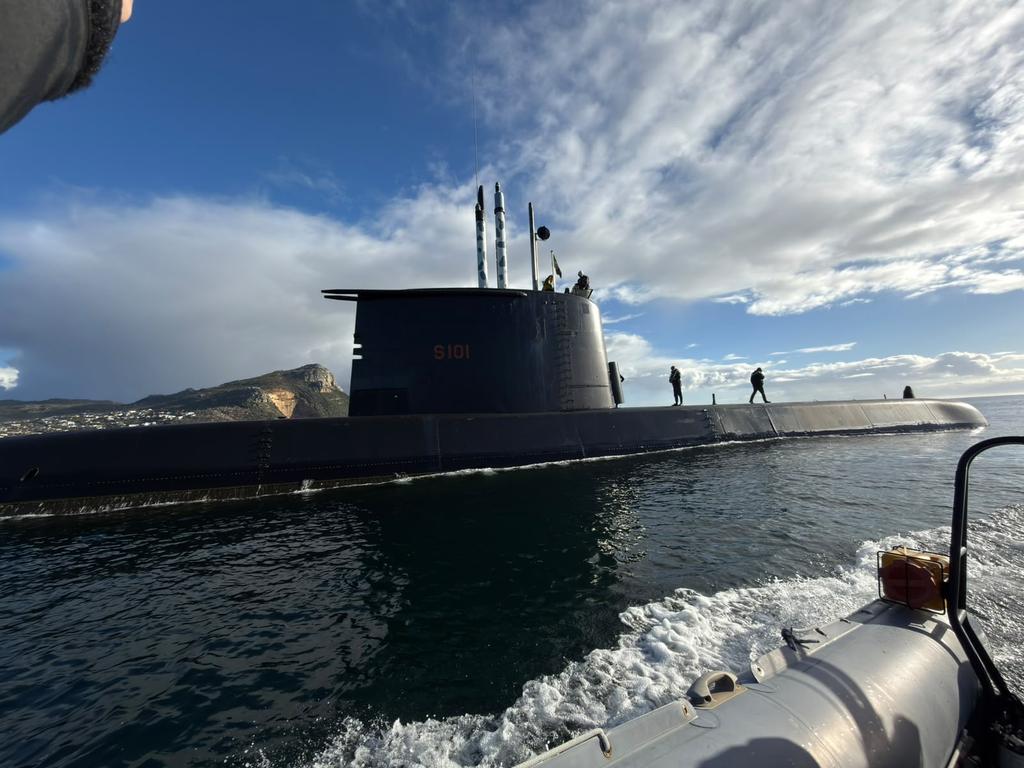
[SAS Manthatisi (S101) off Simon’s Town. Photo: Chris Hattingh]
Amatola is one of four frigates. The CRA Macro Review, Under Siege, found that she was the only one of the four that was serviceable, and able to go to sea. She spent years out of service for maintenance and returned to the fleet in 2024. In January she sailed for India, the navy’s first long-range foreign deployment in about ten years. The navy’s sea-hour record shows the strain. In the 2024/25 financial year, it spent 3,717 hours at sea, less than half its planned target.
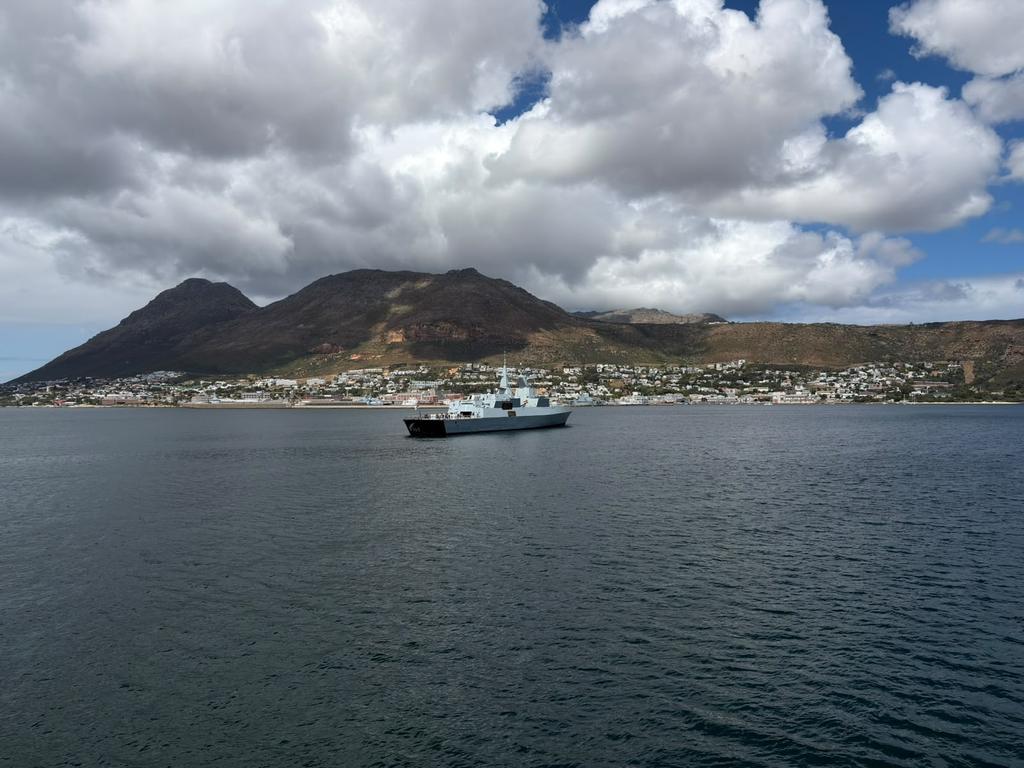
[SAS Amatola (F145) in Simon’s Town during IBSAMAR IX. Photo: Chris Hattingh]
A claim to sovereignty over the sea gets tested by other countries – and in increasing numbers, non-state actors. The claim holds only as far as the state can enforce it. A country that cannot patrol its waters, escort its trade or respond to an incident depends on others to do those things, and those others have interests of their own. The world is more uncertain than it was a decade ago. South Africa cannot treat its navy and air force as an afterthought and still call itself sovereign.
South Africa could do the same as India. Pretoria says it is not aligned. To be credible – and useable – non-alignment means that no single partner decides who comes to Simon’s Town. A sensible rule would be that South Africa publishes the participant list before any exercise it hosts and sets out the exercise’s purpose in plain terms. The navy would then train with whoever fits that purpose. IBSAMAR already follows that rule in practice.
Exercises such as IBSAMAR matter greatly. A navy, air force, or army can look great in theory and on paper, but things become harshly different when equipment and troops must be deployed – and if they haven’t had the time to actually practice, theory will only carry them so far. With one working submarine and very few working frigates, every week at sea with a capable partner builds skills that cannot be learned in harbour. Spending that time on a drill that costs goodwill with major trading partners wastes a scarce resource. Spending it with partners who bring seamanship, a clear purpose and no controversy builds the capability that sovereignty needs. IBSAMAR shows what that looks like. The harder question is whether the budget will give the navy and the air force the ships, aircraft and crews to match the coastline South Africa has to defend.
I owe thanks to Captain Rohit Mishra, the commanding officer of INS Tarkash, and to his crew. They hosted me with warmth and courtesy, and they were happy to answer questions on any subject. A visitor on a warship is an extra burden in the middle of an exercise, but they never made me feel like one.
I left Tarkash with a pleasant memory of the crew and a clear view of the contrast. Both exercises cost South Africa fuel and sailors’ time. Only one of them also cost South Africa friends.
Chris Hattingh, Executive Director of the Centre for Risk Analysis, for CRA Defence and Geopolitics
[Image: Ricardo Teixeira]
The views of the writer are not necessarily the views of the Daily Friend or the IRR.
If you like what you have just read, support the Daily Friend