

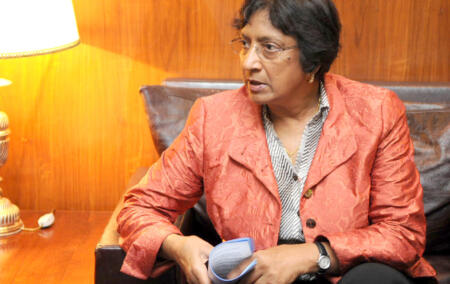
The Helen Suzman Foundation is the latest organization to congratulate Navi Pillay for her controversial Nobel Peace prize. Not entirely convinced the old dame would approve; it’s fine that there’s the whole girl-boss-power thing, but then there’s also Pillay’s performance at the 2009 Durban II convention. Not so much peace that was, more the standard blood libel you’ll find at any of London’s theatres these days, medium price.
The HSF’s call happened at the end of a victory lap celebrated by the vast majority of prestige media. Around the same time something else happened involving a dynasty of watermen and women from Fish Hoek, Cape Town.
In the late 1990s I met a guy called Dawid Mocke. Unassuming but impeccably mannered, Dawid was a devout Christian from a family of them, headed by father Godfrey, a popular fixture in the town who held over 30 jobs in his life. Dawid, naturally, was raised to keep his accomplishments to himself, one of which back then was winning the SA Surf Lifesaving championship (paddleboard) in 1997.
In 2001, Dawid started surfskiing; eight years later in 2009, he would commence a streak of four consecutive World Surfski Championship titles. In 2010, Dawid and his brother Jasper won the US double surf ski championships, followed by SA Championships in 2012 and 2014. In local and international competitions, the winners and runners all seemed to be called ‘Mocke’; Dawid or Jasper first or second, then first as doubles, followed by the women’s winner, who just so happened to be Dawid’s wife Nikki – a world champion and Olympian who competed in Beijing in 2008.
Surfskiing’s niche status does no justice as to what it demands from its competitors. South Africa already had standing in a sport adjacent – kayaking – through national treasure Oscar Chalpusky, who today braves cancer and its treatment as defiantly as he rode the channels between the Hawaiian islands.
In addition to supreme fitness, surfskiing demands a supreme ability to read the currents. One story from the 2000s involves a reasonably fit young man being blown off course whilst surfskiing near Simonstown. He got picked up by the NSRI, clinging onto the metal legs of Roman Rock lighthouse in False Bay.
In the early 2000s Dawid and Nikki established what was to become an internationally renowned surfski school – mentoring aspiring paddlers eager to test the limits of their skill and endurance. One of the results of the marriage and mentorship was son Sam, now 16-years old and a pupil at Wynberg Boys High. On the 9th of October, Sam Mocke won his third consecutive junior men’s surfski world title in Spain. But for Wynberg and to their credit, EWN, you might not have known that South Africa had just swamped the medals table in Europe. The emphasis lay on Pillay’s award.
In the second edition of Graeme Joffe’s Sport: Greed & Betrayal, which he’ll happily send you a copy of if you ask nicely, you get a sense of what many of our athletes are up against – outside the rigour of their codes. Joffers is a stand up guy, and his experiences leave no doubt: the majority of South African sports federations are run as gangsters administer back-alley betting shops on the subcontinent. For the Mockes to have triumphed beyond the parameters of a specialized sport to the point where the next generation follows fathers and uncles to the podium is some kind of a statement.
Arguably the best kind – for a family, for a country – but we’re evidently stuck in ways of seeing these things that try to reduce their wholesomeness. In our present circumstances, there are orders of people, at home and abroad, who can only see the Mockes through privilege and discrimination, despite these being – as they usually are – inappropriate and inaccurate considerations. Those same people, however, will champion Pillay, disregarding the forces challenging the concept of ‘peace’ at present.
If we are to listen to those people, then Pillay’s award is proof that Israel is committing genocide. That would be news to ICJ’s Justice Joan Donoghue, who was firm in the court’s clarification that no such thing has been proved. Admittedly it is difficult not to feel a bit sorry for Pillay, trapped in brinkmanship between countries and courts, her prize suspiciously like a pawn in the battle between civilization and destruction.
None of that happens on the sea though. There, it’s just man or woman against themselves, opponents, the currents and winds. One mark of a great country is how it takes unusual things, then shapes them into victories or ideas or even inference that others can use to find their own ways. The Mockes have been doing that for a very long time, and will continue to. If only people knew as much about them as they do now about Navi Pillay.
[Image: https://commons.wikimedia.org/wiki/File:Navanethem_Pillay.jpg]

The views of the writer are not necessarily the views of the Daily Friend or the IRR.
If you like what you have just read, support the Daily Friend