

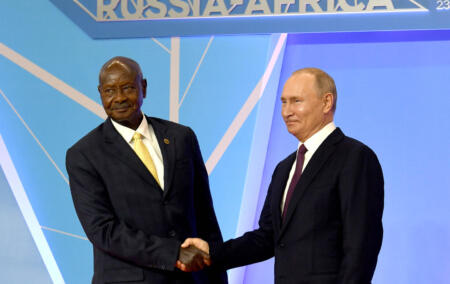
Vladimir Putin pitches Russia as Africa’s anti-colonial friend
For a man waging a war of conquest in Europe, Vladimir Putin is remarkably keen on denouncing imperialism. At the third Russia-Africa summit, held in Moscow on October 28th and 29th, he told delegations from 48 African countries, 22 of them led by heads of state or government, that the West still wanted to strip the continent of its resources and push it back into “debt bondage”. He did not say which countries he meant. He did not need to.
He framed the pitch as history and prophecy. Opening the summit, Mr Putin declared that the era in which a narrow bloc of states decided the fate of whole continents was coming to an “irreversible end”. He reminded his guests that the Soviet Union had backed Africa’s anti-colonial struggles, and called Russia and Africa “natural allies” against “diktat and double standards”. Western lenders, he said, offer Africa money on predatory terms that stunt its development.
Russia’s offer, as Mr Putin described it, is the opposite. Russian firms, he claimed, reinvest their profits locally, share technology and build factories rather than simply carting off raw materials. He promised digital know-how and joint transport and farm-infrastructure projects. Russia already sends grain and fertiliser to more than 40 African countries. Mr Putin said grain shipments reached 18m tonnes last year and 13m tonnes in the first nine months of this one, and that fertiliser exports had risen from about 1.5m tonnes to more than 2.2m.
He also offered diplomatic flattery, promising to push for a bigger African say at the IMF and World Bank. When Kenya’s president, William Ruto, said the world order should reflect today’s world rather than that of 1945, and demanded a permanent African seat on the UN Security Council, Mr Putin promptly agreed. Egypt’s president, Abdel Fattah al-Sisi, was more sober, saying Africa’s hopes depend first on security and stability.
The economics are less impressive than the rhetoric. Russia’s trade with Africa topped $27bn last year, a modest sum for a continent of nearly 1.6bn people over which America, Europe and China are also competing. Russian state firms are pushing into mining and power generation, and Russian state media are expanding their reach, but Moscow cannot match its rivals’ money.
What sets Russia apart is security. Mr Putin said it had military-technical agreements with 45 African countries. Across the Sahel, juntas that seized power citing security failures have cut ties with Western allies and turned to Moscow. They first hired the Wagner mercenary group, then its successor, the Africa Corps, which answers directly to Russia’s defence ministry. In August the Africa Corps helped Niger’s junta crush a mutiny by young soldiers in the capital. Estimates put the number of Russian fighters in Niger, Mali and Burkina Faso at 1,700-2,000, with around 1,000 more in the Central African Republic. Western governments accuse them of propping up juntas to edge out France. Earlier this month a report accused Malian forces and their Russian backers of killing scores of civilians in drone strikes. Moscow denies the broader charge. The juntas seem satisfied: Burkina Faso’s prime minister told RT, a Kremlin-run broadcaster, that dealing with Russia was “completely different” from dealing with “imperialist France”.
The Kremlin’s interest is plain. Africa’s 54 states form the largest voting bloc at the UN, and courting the global south is how Russia blunts Western efforts to isolate it over Ukraine. African leaders, for their part, are happy to pocket flattery and grain while keeping their options open. Whether that amounts to the “natural alliance” Mr Putin proclaimed is another matter.
[Image: https://www.flickr.com/photos/governmentza/48950778053}
[Sources: Reuters, AP]