

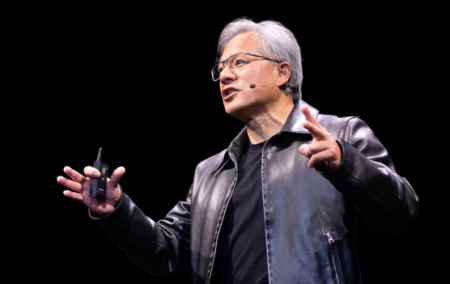
A guy starts a company. He has some shareholders and a board of directors – often made up of people he trusts and knows. The company becomes successful. The shareholders make money; the directors, who also own shares, make money. They meet periodically and praise the CEO because this guy is doing a great job – just look at the financials.
Soon the company is the biggest in the world, with a near-monopolistic grip on a vital market. One can imagine board meetings being great big smiling back-patting affairs.
Then the CEO does a bad thing. Actually, several things: inappropriate bonking of multiple women (including a maybe-smuggler/spy and Nvidia underlings), and possible entanglements with export-control violations (garnished with lesser infractions like refusing to develop a succession plan and humiliating subordinates, allegedly telling one he would cut of his head and “pee on his brain”). He resigns under pressure, the board accepts his resignation, and the share price does not so much fall as plummet (mangling a Monty Python line). Nobody is happy – directors, shareholders, other markets, regulators, Elon Musk…and the president.
The shareholders are upset because they have lost money. Directors are upset because their guy has not displayed sufficient “candour” (meaning – he lied to us!). Suddenly and somewhat unexpectedly (after prodding from a lame-duck president who has demonstrated that he cares little for matters of ethics), he gets hired back. Nvidia’s shares rise 31.5%. The markets applaud this restoration of order. The board promises to continue its investigation of the CEO. Everyone nods and winks.
Which leads to an awkward question: what was the point of this board? Moreover, what is the point of any board, and who is monitoring the people doing the monitoring? If the answer changes whenever the share price does, perhaps the job could be better performed by a spreadsheet, or even an AI?
I have sat on many boards. They are, to a greater or lesser extent, a collegial fraternity. People often know each other quite well and often respect each other. Conflict is generally avoided, until it can no longer be anymore. Even then, the tendency is to smooth over, mitigate, keep problems away from the press and public, because, you know…vested interests. Boards sometimes do fire CEOs, but only as a last resort.
The point of a board is that shareholders need someone to supervise management. Millions of investors cannot collectively interview a chief financial officer, examine export controls or decide whether the CEO has become a liability. Directors are entrusted with that work. They appoint and can dismiss executives, oversee strategy and scrutinise the risks that management might prefer to describe as opportunities.
Much of a good board’s contribution is invisible. It may stop an ill-considered acquisition, insist on stronger financial controls or persuade a brilliant executive to develop other leaders. Successful prevention rarely produces headlines, and directors should not be expected to run the business themselves. The test is whether they ask the questions that would otherwise go unasked, especially while everybody is enjoying the results. Given the torrent of wealth ($13bn) that flowed to Nvidia board directors, one wonders whether difficult questions were ever asked prior to this event.
Misaligned incentives are baked into Nvidia policy – its directors are expected to own shares, which sensibly gives them an interest in the company’s success, but one wonders how this is supposed to foster independent judgement, especially after years of spectacular returns. Who would be willing to challenge the founder without seeming churlish, combative, even toxic?
To be fair, directors losing money alongside shareholders is hardly evidence of misconduct. Owning shares is supposed to encourage them to care about the outcome. The harder problem is deciding which outcome matters – tomorrow’s market recovery or a company that can withstand the next crisis. Both may favour the same decision, but a board has to examine that proposition rather than take instructions from the value of their portfolios. Nobody needs to be corrupt for this to become a problem. Gratitude, familiarity and adulation will do quite nicely. Nvidia described all its directors except Huang as “independent” under the applicable rules in its 2025 proxy statement. That is a meaningful designation, but it cannot measure whether someone has become psychologically incapable of saying: “Jensen, this is unacceptable.”
Perhaps restoring Huang really was the best available decision. A board is responsible for the company’s future, and removing an extraordinarily valuable leader can (and did) impose enormous costs. Moral satisfaction is not a business plan, and directors are entitled to weigh the damage caused by dismissal against the risks of retention. But that defence invites an earlier question. If the company cannot safely function without its founder, what were the directors doing during the years when they could have reduced that dependence by insisting on a succession plan? Apparently, they had asked Huang for a succession plan for years. Indispensability is a business risk, and allowing it to become an argument against accountability amounts to granting the chief executive a form of immunity, which is clearly what has happened here.
There is also an open question worth considering. On 17 November, Nvidia’s chair, Harvey Jones, insisted that they had no intention of rehiring Huang. Six days later the board changed its mind. Trump admitted that he had been involved. What were those discussions about? Surely shareholders are entitled to a convincing account of what changed.
Perhaps Trump reassured them that intelligence had ruled out a national security threat. It still leaves questions about Huang’s judgement, workplace relationships, his adherence to company rules and the information supplied to (or withheld from) directors. A presidential telephone call cannot answer all of those. Nor does a rising share price establish that the board is excused from answering questions hanging above this entire affair – markets are exceptionally good at expressing a preference for getting their money back.
So was this board simply a useless rubber stamp? One may fairly make this accusation, and it is certainly going to be in the sights of many who are appalled at his rehiring, presumably those people who do not have the benefit of shares to cloud their judgement – it is reasonable to expect lawsuits and loud and fractious activism. Courts do generally protect decisions made properly, even when they turn out badly, otherwise every failed acquisition would become a lawsuit. But bringing Huang back while continuing a background investigation into his actions would seem like a red rag to a legal bull, especially where matters like export violations are involved.
Who is supposed to monitor the board? Shareholders elect directors and can challenge alleged wrongdoing in court; regulators enforce the rules within their remit. But shareholders may enthusiastically endorse precisely the decision that troubles everyone else – their incentives are equally misaligned, or at least somewhat obscured by share price.
It is difficult to see where this settles. I am pretty sure the continuing investigation of Huang will go nowhere. I am similarly sure that neither Huang nor any board member will receive any sanction. There have also been promises of “increased compliance”, whatever that means.
Directors should be at least partially judged by whether they make a company capable of surviving its founder. If their principal contribution is to welcome him back whenever his absence becomes expensive, the annual report should file the directors’ photographs under Entertainment.
Steven Boykey Sidley is a visiting professor at the Center for Graduate Studies at Rhodes University and a partner at Bridge Capital and a columnist-at-large at Daily Maverick, Daily Friend and Financial Mail. His new book “Checkmate: How Shoprite Checkers rewrote the rules and won” is published by Jonathan Ball
[Image: via wallpapercave.com]
The views of the writer are not necessarily the views of the Daily Friend or the IRR.
If you like what you have just read, support the Daily Friend.