

I sometimes regret that I am unlikely to have grandchildren. Not for the obvious reasons, although they are compelling enough. There is something rather wonderful about the prospect of a small person entering your life, initially dependent on you for entertainment and the occasional indulgence, and then gradually becoming a person in their own right.
To watch a child grow into a personality of their own, questioning and challenging you along the way, must be one of life’s great privileges. To be called Grandpa, or whatever inventive appellation the child settles upon, would be rather nice, too.
But my regret goes beyond that. It has a more historical dimension, one that I find myself returning to with increasing frequency.
A grandchild born now, or in the next few years, would in all probability be the first person in my family, in a century, to grow up in a world fundamentally different from the one into which I was born. Different, too, from the world inhabited by my parents and grandparents, and by virtually everyone of their generations.
I was born into a world still organised around empire, its aftermath and its attendant hierarchies. The formal structures of colonialism were beginning to unravel in some parts of the world, but the assumptions underpinning them remained deeply embedded. The colour of one’s skin and the accident of one’s birthplace determined, to a very considerable extent, where one belonged and how far one was permitted to go.
Unforgiving place
For Asian, African and Latino people the world was a particularly unforgiving place. Empire had not simply occupied territory and extracted its wealth. It had built an elaborate justification for doing so. It classified people, ranked them, and then presented the ranking as natural and, frequently, benevolent.
We inherited that world, whether we wanted to or not.
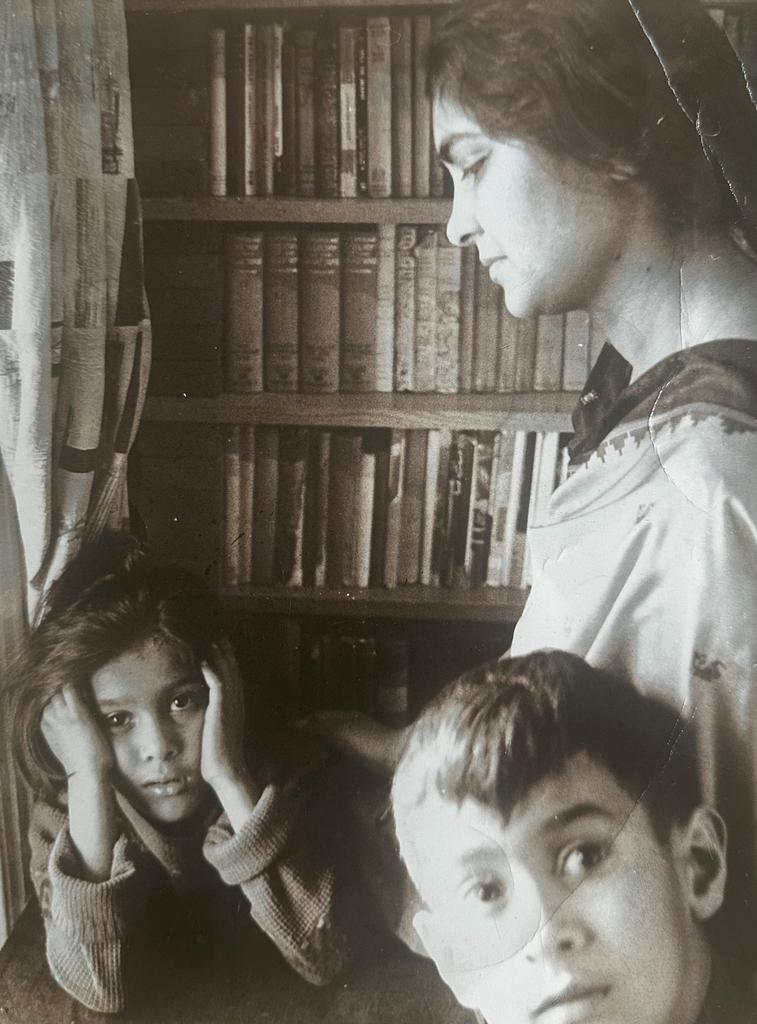
[Amina Cachalia with her children, Coco, left, and the author. Supplied] [Editor’s note: Both Amina and her husband Yusuf, pictured below, were leading figures in resisting apartheid; Yusuf was secretary of the South African Indian Congress and Amina a lifelong activist, whose “outstanding contributions” to the struggle for democracy and human rights earned her the Order of Luthuli in Bronze in 2004. (In 1948, Amina established the Women’s Progressive Union that worked hand-in-hand with the Institute of Race Relations (IRR) with the objective of helping women to become financially independent. In the early 1980s, her daughter Coco played a key role in establishing and running the IRR’s Oral History Project – established in 1982 to preserve the testimonies of people who had resisted apartheid during the mid-20th century – as part of which she edited the 1983 publication, “From Survival to defiance: Indian Hawkers in Johannesburg 1940-1980”, the second issue in the IRR’s Oral history series.)]
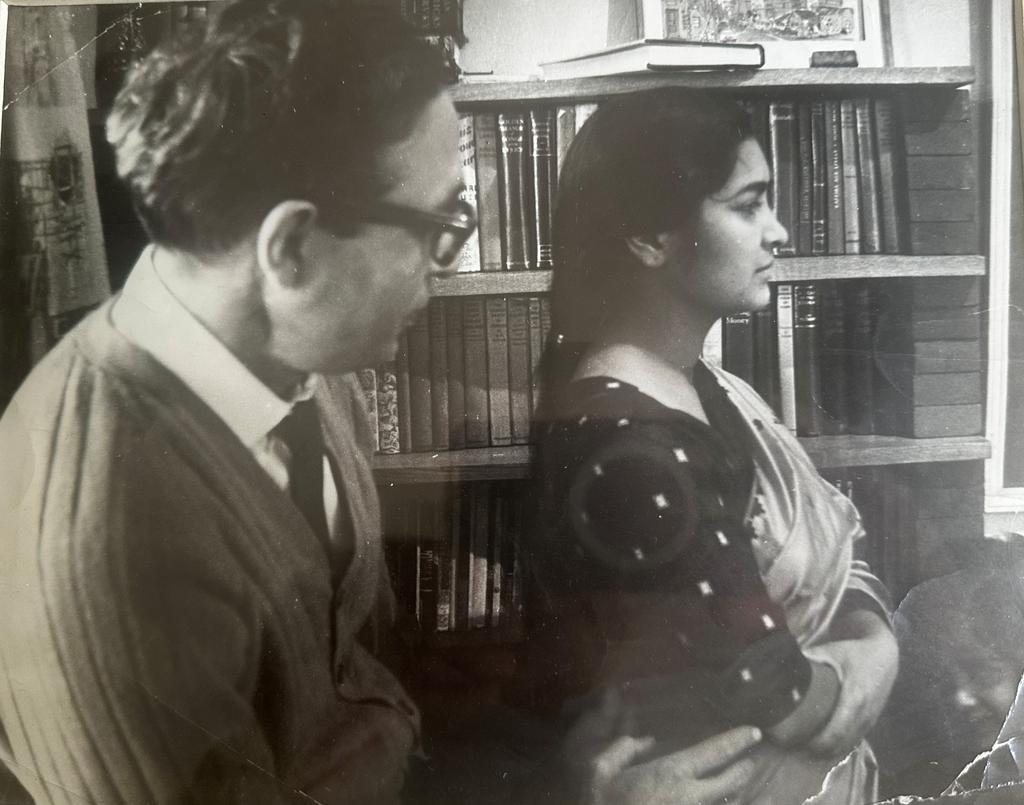
[Yusuf and Amina Cachalia, with their daughter Coco. Supplied]
My own family’s history is bound up in that larger story. The journeys and compromises of those who came before us were more than individual adventures; they were shaped by the economic and political architecture of their times. The movement of people from Gujarat to South Africa, and the making of lives in a country that was never entirely theirs, belong to a much larger history of empire, migration and race.
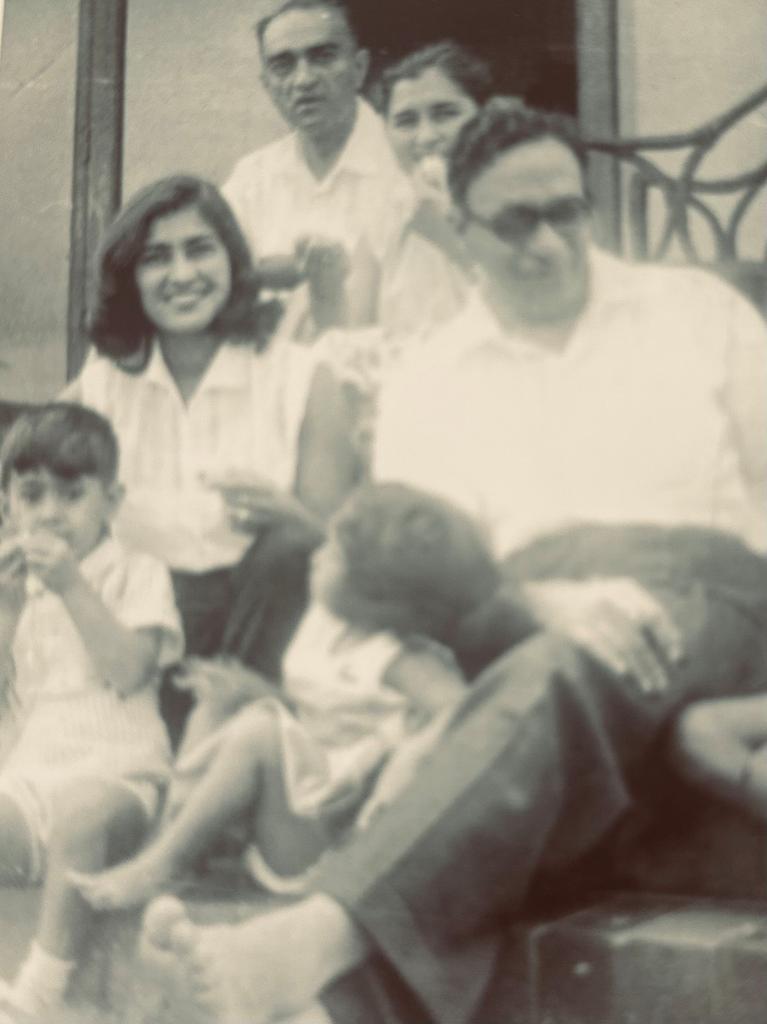
[A family portrait, clockwise from top left: Aziz Kazi, his wife Zainab Asvat (Amina Cachalia’s sister), Yusuf Cachalia, Coco, the author, and Amina. Supplied]
And then there was South Africa.
I grew up in a country in which racial classification was not an incidental feature of public life. It was the organising principle of the state. Apartheid was the particularly grotesque local expression of a much older global pathology: the idea that some people were entitled to determine the lives and destinies of others. We were assigned places, literally and figuratively. Our movements, relationships and ambitions were circumscribed by a system that sought to make its own injustice permanent.
Extraordinary possibilities
I have lived through the dismantling of that system. I witnessed the extraordinary possibilities of 1994, the exhilaration of a country attempting to remake itself, and the disappointments and betrayals that followed. I have taken part in the politics of a democracy whose promise remains considerably greater than its performance.
I have also seen the world change beyond South Africa’s borders. The great European empires have largely disappeared as formal political entities. The colonial powers have had to surrender the pretence that their dominion was a permanent feature of the natural order. The United States emerged as the dominant power of the post-war world, only to find its hegemony increasingly challenged. China has risen. India has asserted itself. Africa, despite its internal contradictions and continuing vulnerabilities, is beginning to occupy a different place in the global conversation. The old certainties are being unsettled.
We are witnessing the transition, sometimes turbulent and often dangerous, towards a multipolar world.
I do not romanticise what is emerging. Multipolarity is not synonymous with justice, nor does the decline of one hegemon necessarily mean the emancipation of those previously subject to its influence. Power has an extraordinary capacity to reproduce itself. New centres of influence can become new centres of domination. China is not a synonym for liberation; nor is the rise of India, or any other power, an automatic guarantee of a more equitable international order. The global South must be careful not to exchange one dependency for another.
But something has changed. The world is no longer quite so easily explained, ordered or controlled from a handful of capitals in the West.
Increasingly open to challenge
The assumption that Western political, economic and cultural models represent the inevitable destination of human development is increasingly open to challenge. Different histories and intellectual traditions are finding space, sometimes assertively, sometimes awkwardly, to shape the future.
And that is what I find myself thinking about when I contemplate the grandchild I may never have.
Such a child might grow up without the psychological inheritance of empire being quite so dominant. They might inhabit a world in which being Indian, African, Chinese, Arab or of mixed ancestry is not something to be explained or accommodated within a hierarchy devised elsewhere. They might take for granted a degree of cultural and intellectual self-confidence that my generation had to struggle to acquire.
They might not have to spend quite so much of their lives negotiating the prejudices and inherited insecurities that shaped ours.
Of course, I would not want to burden a child with the accumulated disappointments or political preoccupations of a grandfather. Nor would I want them to inherit my battles. Every generation deserves the opportunity to discover its own world, make its own mistakes and fashion its own understanding of what matters.
Greater dignity
But I would want them to know something of the journey. To understand that the freedoms they might take for granted were not inevitable. That the world was not always as open as it might appear to them. That people fought, suffered and sometimes died so that others could live with greater dignity.
I would want them to understand that identity is an inheritance, not a prison, and that equality is not an indulgence bestowed by the powerful but a condition of human dignity.
Above all, I would hope they would grow up with a sense of possibility unencumbered by the racial and imperial hierarchies that so profoundly marked the lives of those who preceded them.
Perhaps that is the real source of my regret. It is not simply that I may miss the pleasure of having a grandchild. It is that I may miss witnessing, through another generation of my own family, the consequences of a historical transition for which so many before us struggled, often without knowing whether they would ever see its fruits.
To have lived long enough to see the old order fracture, but perhaps not long enough to see what takes its place.
A consolation
And yet, perhaps there is a consolation. We are all, in one way or another, temporary custodians of a history that began long before us and will continue long after we are gone. We do not own the future. We merely contribute to the conditions in which it becomes possible.
I would have liked a grandchild to inherit that future. Not a perfect world, certainly not a world without conflict, prejudice or injustice, but one in which the old dispensations no longer determine the limits of human possibility.
A child who might look back at the world I inhabited and wonder how we ever thought it reasonable.
That, I think, would have been a rather wonderful legacy.
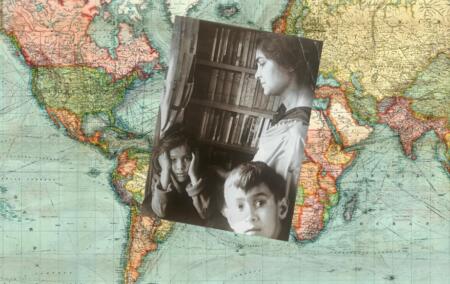
[Image: The author, with his mother, Amina, and sister Coco. Supplied, superimposed on a map of the world, https://www.rawpixel.com/image/9583588/image-art-vintage-illustration]
The views of the writer are not necessarily the views of the Daily Friend or the IRR.
If you like what you have just read, support the Daily Friend