


Johannesburg has a strong volunteer civil society. It has to. Given its infrastructural degeneration and governmental impotence and neglect, the city would undoubtedly look even more like a set in HBO’s award-winning zombie-apocalypse series, The Last of Us, without citizens taking the initiative to plug the gaps and put the band aids on.
Beyond those who paint street lines themselves or fill potholes, there are numerous good-hearted groups with green fingers who strive to keep the city’s green spaces safe, enjoyable and ecologically sustainable. These groups, often alongside residents’ associations, make a vital contribution through hands-on volunteer work and raising and investing after-tax private funds for enhanced security and infrastructure upgrades.
The Wilds in Houghton is the most highlighted success story, but many more groups are also helping to sustain the city’s green spaces, including Melville Koppies Nature Reserve (the city’s oldest nature reserve), Delta Park, James and Ethel Grey Park and Hugh Wyndham Park, to name a few.
And then of course, there’s Zoo Lake, one of the city’s oldest public parks.
Zoo Lake has a rich history that is fundamentally linked to Johannesburg. The land that it sits on was donated to the city council in 1904 by the Wernher-Beit-Eckstein mining group, following the death of Hermann Eckstein the year before.
The Deed of Gift contained a visionary condition: the land would have to remain a public park, open to all people regardless of race. So, from its establishment, Zoo Lake stood apart from the racially segregated norms of both the colonial and apartheid eras.
Zoo Lake has a long tradition of civic paternalism, from pushing back against threatened racial restrictions by the National Party during apartheid, to fending off greedy property developers wanting to siphon off public land for the development of malls and the like. The ‘Friends of Zoo Lake’ has existed in various forms since the 1980s, and in 2015, it was reinvigorated as a formal NPC, called the Zoo Lake Users Committee (ZLUC).
The ZLUC’s founders, Fran and Bill Haslam, sought to deal with severe ecological and infrastructural degeneration and by-law violations, including public alcohol consumption, incessant littering and flagrant drug abuse in public view, not to mention an omnipresence of resident vagrants.
I have been aware of the ZLUC for a few years, but I only met Fran in April this year when donating a few spekboom plants to their gardening committee. A few months down the line, after keeping in touch with her, the ZLUC contracted me to revamp their website and redesign various signboards which had become faded around the lake.
Park’s restoration
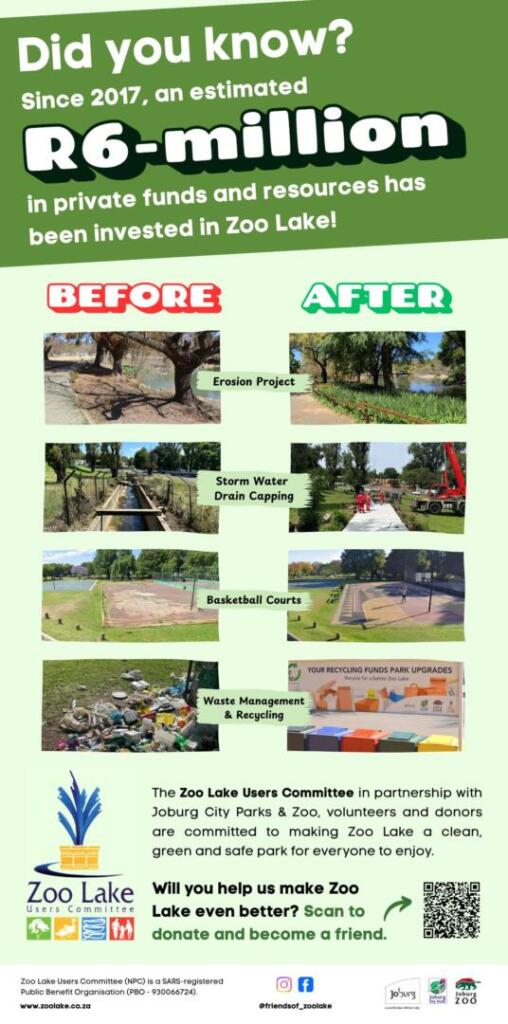
For both projects, I wanted to emphasise how big a difference this committed group of volunteer residents had made. In conversation with the Haslams, it was mentioned that they had raised an estimated R6-million in private funds and resources since 2017 for the public park’s restoration. This R6-million figure, along with before-and-after photos of their projects, would be the focus of the new website and signboards.
At an organised clean-up and tree planting event in late November, where 32 trees were planted and 92 bags of litter were collected, the signboards were unveiled and the website was published. Having spent months working on their messaging, getting the full picture of what their efforts really entail and going through the Johannesburg Heritage Foundation’s historical archives of the park (which are freely available on request), I was inspired to volunteer and see for myself how difficult it is to ‘make a difference’.
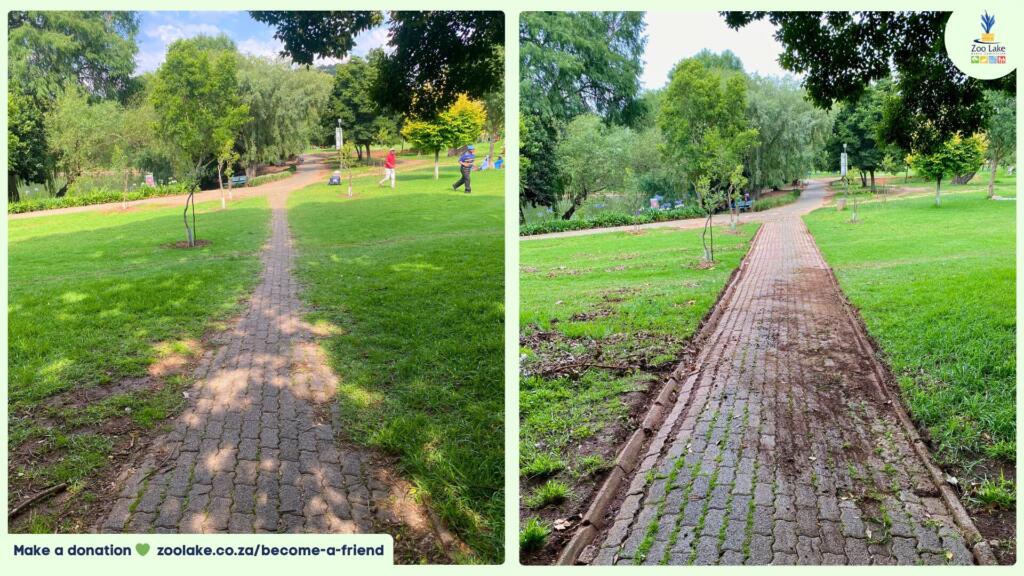
Having used the path in the preceding months, I decided to tackle a 20-metre pathway segment at the foot of Roscommon Road that was being slowly overgrown by a wayward lawn. Looking at Google StreetView imagery, it appeared that the last time this two-metre-wide path was clear was back in 2013.
And so, in early December, every afternoon after work, I set to work clearing sections of the path bit by bit, and relaying the removed grass elsewhere. Completing this one-man job turned out to be about 14 hours’ worth of back-breaking work.
While the result is obviously extremely satisfying – I’m a sucker for a good before-and-after photo – and the feeling of ‘giving back’ is always comforting, what has really stuck with me is the rich array of unanticipated conversations I had with everyday park users. In hindsight, I suppose that it’s not every day that regulars see a young umlungu, spade in hand, shovelling away on a weekday afternoon. As one man of what I guessed was central African descent remarked as he passed one day: “Ha! I have never seen a white man doing work like this!”
While the interactions were largely gratifying, they were also a vivid reminder of the challenges that people face living on the fringes, battling, hustling and grappling with poverty in a society of civil service neglect and unparalleled levels of joblessness.
Piece jobs
After not even two days “on the job” I was asked all of seven times if I had any piece jobs. Over the course of the 14 hours, the requests and interactions would become more varied, obscure and at times, desperate.
One of the first people to approach me was Mdu. He spends his time sitting next to a guy who sells sweets and cigarettes at a parking lot on the northern side of the lake. Smelling distinctly of alcohol, he politely asked if I had a spare pair of shoes for him. I couldn’t gauge what he does exactly, besides chat to the vendor. His alcohol-laden odour gave me some ideas, though I admit it wasn’t easy to discern due to the overwhelming odour emanating from the sleeping vagrant a short distance away.
On my second day, Elton sauntered over. Elton needed “just R120” for a trolley to collect recycling. His original trolley had apparently been stolen a few days before and it was his only means of making kind of livelihood. But because the place to buy the trolleys was over five kilometres away in Brixton, he also needed an extra R30 for taxi fare. Mostly out of curiosity and despite his slightly bloodshot eyes – and my instinct – I decided to give him the cash. We coordinated with another ‘friend’ to give him the money via eWallet. I asked him if I could trust him to use the money as he’d said he would. He assured me that I could.
A little later, I noticed another guy loitering not that far from where I was shovelling. Eventually, this man, Tyson, plucked up the courage to approach me. He was a cook with eight years of experience, he said, but hadn’t been able to find employment for the past four years and had three kids living with him in Braamfontein, north of Johannesburg’s CBD. Sending his CV around to restaurants in the suburbs had so far been in vain. Could I give him anything that would help him feed his three kids? I told him I would think about it. Feeling in a giving mood – it is Christmas after all – I sent him some money when I got home that evening.
When I arrived at the Lake the following afternoon, two vagrants were having a skirmish. Clearly high on something, they would shove and grab at each other and then meander together, erratically pulling out flowers and plants from the rehabilitated gardens. A little while later, one of them approached me.
Conscious of his current mood, I was alert and his telling me that he had been “watching me for the last few days” only made me feel more uneasy. His tone was aggressive, and he asked why no one ever did anything for the vagrants.
“That R6-million,” he said, referencing a new ZLUC signboard, “why don’t you give any of that to the vagrants?”
Rather poetically
I really didn’t want to go into the complex nature of dealing with social problems, so I was grateful that he rambled on and expressed the view, rather poetically, that “we” should also share the “joys” from “our” year-end functions with them too.
When I asked him what his name was, he said, “Obelix.”
“Like the cartoon character?” I asked in surprise.
“Yeah, man,” he said, then added: “Nah bro, of course not, I ain’t no Roman! My name is Leroy.”
On that rather charming note, Leroy sauntered off, throwing freshly picked flowers around like a drowsy flower-girl at a wedding and faded into the surrounding suburbs.
Not long after Leroy’s departure, a woman on a bicycle stopped to thank me: “Thank you so, so much! Wow, it’s so good to see that there are still good people out there. Altruism is not dead!”
On the return leg of her afternoon spin, she asked: “But what can we do about the vagrants and all the drugs!? Oh, the next elections couldn’t come sooner – only Helen Zille can fix this place! Don’t forget to vote next year! Oh, and I’ve got some lovely plants to donate. How can I donate them?”
The next afternoon, I bumped into Leroy again. After managing to dissuade him from vandalising a signboard which I had designed, I asked him if he knew Elton.
“Yeah, I know Elton. How do you know Elton?” I explained merely that we had met before.
“You know,” Leroy continued, “I don’t like people who disturb peace and harm others.” I didn’t know where this was going.
“What do you mean?” I asked.
“You know that Elton? Yeah, right now he’s sitting in jail.”
Whether this was true or not, I would never know, but I’m going to assume that Elton never did get a new trolley – if that’s what the money was actually intended for at all.
The next afternoon, Luther stopped next to me, just to chat. He proudly showed me the cheap goods he had just got at the China Mall in Crown Mines that he was selling as part of his hustle: dog-grooming razors and Bluetooth earphones. He had resorted to being a street vendor after cutting short his sponsored-running athlete ambitions due to an inability to sustain a nutritious enough diet to meet the sport’s demands.
Soon after, Luther now on his way to Rosebank to sell his wares, feeling upbeat at having a non-transactional conversation, Tyson once again sidled up to me. He was very grateful for my donation, but could I spare him another R300 so that he could buy a 9kg gas cylinder, his one having been stolen, so that he could restart his shisa’nyama at the Bree Taxi rank in town and once again provide for his kids and fight poverty? I was sympathetic to the hustle and admired the grit to try make something of himself. I told him I would think about it.
A man named Tom
On what would be the penultimate day of shovelling, I saw Mdu once again in a bright, new car-guard jacket. As I was finishing up, a man named Tom approached me, having parked his car on Lower Park Drive next to the bus stop where a vagrant takes refuge every night.
“Howzit,” he interjected. “I just wanted to say thank you. I often come here and drive past and think what a dire state this place is in. But I guess it’s one thing to complain and another to do something about it. So thank you. And please let me know how I can get involved.”
On what would be my last afternoon, with just a few metres left to clear, a man holding a small, handle-less veggie-garden spade came over and asked if I needed any help. Johannes was a vagrant, but had been doing ad-hoc volunteer work clearing weeds in the path for two years already. When I asked why he did it, he said it helped to give him purpose and stopped his mind from going vrot. He didn’t ask for anything: “I just wanted to come and greet a fellow volunteer. Shap.”
My back was now sore and the tendons in my hands ached, so I was satisfied and somewhat relieved when I brushed away the last bit of soil from the newly cleaned pathway. It also meant, though, that this brief and unusual social experience was over, for now.
However, my social bucket was full. This experience was a visceral, hands-on reminder of the innumerable challenges that South African urbanites face, in all their individually quirky ways. In a city that limps along, neglected by its governmental overlords, we can only smile at the bizarreness that this unique cosmopolitan space endlessly offers up, and perhaps all do our small part that makes it a little bit easier to live in harmony with it.
If you would like to make a donation to the Zoo Lake User Committee please visit their website.
[Image: https://www.zoolake.co.za/]
The views of the writer are not necessarily the views of the Daily Friend or the IRR.
If you like what you have just read, support the Daily Friend