

The Democratic Alliance (DA) is not like the “big parties” of South African history.
The National Party (NP) was never merely a party, but the political arm of a dense social movement backed by institutions such as the Afrikaner-Broederbond, a network of cultural organisations under the Federasie van Afrikaanse Kultuurvereniginge, and a supportive press apparatus in the National Press and many smaller publications and publishers.
The African National Congress (ANC) followed a similar path. It began as an advocacy body for an intellectual elite – not too distinct from the Broederbond – with deep social ties. It went on to build international networks while in exile that persist to this day, and developed a militant wing in Umkhonto weSizwe. For many South Africans today, the ANC is still experienced as something closer to family than a mere political vehicle.
Both the NP and ANC cultivated loyalty that survived electoral setbacks and policy failures (until they didn’t). They represented and represented whole pillars of society.
The DA, by contrast, remains simply a political party – it ends there.
The absence of deeper institutional and social infrastructure has long placed a ceiling on how far the party can go as a force for real change. Every recent election cycle, and perhaps the past few months in particular, have illustrated the point: voters can, and do, reject the DA, return to it, and reject it again from one cycle to the next.
The relationship between the party and its constituency is largely transactional and premised on moment-to-moment support. The NP and the ANC did not, and do not, operate under the same constraint. They built durable loyalty that, for the most part, transcends the moment. The DA has not yet done so, and it has been an open question as to whether it wants to.
Blue Brigade and selfdoen
That is why the recent establishment of the Blue Brigade in Johannesburg is genuinely exciting (though we must remain sceptical).
It seems to adopt the selfdoen mentality long championed by the Solidarity Movement: solve the problem in front of you, rather than lodging a fault report with the municipality and waiting for better days that may never arrive.
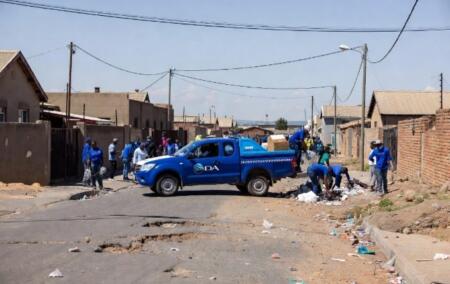
In practice, the Blue Brigade has already begun visible work.
Volunteers in DA-branded clothing, travelling in blue bakkies, have cleared illegal dumping on Kretzschamer Street in Westbury. They have cut overgrown grass and performed basic urban management in neglected wards. They have removed accumulated refuse and begun filling potholes where the city’s capacity has collapsed.
These are modest interventions, but they are concrete and should not be dismissed as superficial. To be sure, they are superficial, but they are not to be dismissed.
Johannesburg’s municipal government has failed to fulfil the promise on even such superficial service delivery. A private actor restoring a measure of order to sidewalks and streets is therefore welcome. If the Blue Brigade achieves nothing more than making parts of the city look as though someone is still paying attention, that alone constitutes progress.
Real test
The real test comes after the November 2026 local government elections.
If the Blue Brigade continues to function whether or not Helen Zille becomes mayor, the DA will have demonstrated seriousness about moving beyond the status of a conventional political party.
Continuity after an electoral victory would show that the party does not assume the newly-DA-governed municipality will automatically perform the work volunteers currently do, because it assuredly will not.
Continuity after electoral defeat would show that the initiative was never merely a campaign gimmick, which will go a long way to securing true respect from local communities.
Either way, permanence would signal an intention to cultivate the kind of loyalty that the older movements once enjoyed and begin normalising the DA as a household phenomenon.
If the model can then be expanded – first to the other metropolitan areas, and later to rural municipalities where a different approach would be needed – the potential is substantial.
The DA currently spends heavily on public relations consulting, often imported from Europe and America to craft electoral messaging and campaigns. Redirecting a meaningful portion of that budget toward sustained Blue Brigade operations would be a more effective use of money. Nothing builds credibility faster than residents repeatedly seeing blue bakkies and volunteers tangibly restoring order on their own streets rather than complaining with them in WhatsApp groups.
Imagine a staunchly ANC household somewhere in Soweto: Every few weeks its members look out the window and see people in DA shirts clearing the sidewalk and filling the nearest pothole. They likely have not seen anyone from the Johannesburg government in ages, and when they do, the interaction is confrontational. Now, DA volunteers are simply doing the necessary work without any expectation of payment or even electoral support (the election, after all, would be over).
Over time, their loyalty to the ANC could well dissolve, not into the general voter apathy that now characterises South African politics, but by at least a curiosity about the blue party that is visibly trying to impose order on chaos. Abolishing the Blue Brigade after November instead would rightly be interpreted as a profound insult.
Eagerness to fix the problem
Residents of our municipalities are not frustrated primarily by the technical difficulty of reconnecting electricity or repairing a road or water pipe. South Africans have a good sense that some things might be complicated.
What does frustrate them is the absence of any evident will or eagerness to act.
Reporting a fault can take hours before the municipality even acknowledges the problem, only for more hours to pass before residents finally hear that officials have been “notified”. By this time, most residents expect that repairmen should already have been on-site, working diligently.
What people want is evidence that someone cares enough about them as ratepayers and citizens to act quickly and keep working until the job is done, whether that takes hours, days, or even weeks. When the power in an area has been out for days, and you see the repair team clocking off at five o’clock sharp – rather than staying glued to the problem until resolved – your sense of respect for government and “civil servants”, rightly, crumbles.
The correct first question for the DA is therefore not whether the Blue Brigade can fill every pothole to professional standards or clean every street in the metro. The immediate need, instead, is the public demonstration that someone is trying.
The DA need not undertake this alone, of course.
It can partner, openly or quietly, with existing selfdoen organisations such as AfriForum, which already possesses relevant experience and infrastructure. In Johannesburg itself there is Jozi My Jozi, a civic initiative that has coordinated clean-ups, lighting projects, and gateway restorations across the inner city. Re-Imagine Randburg is a similar community-driven effort.
These groups already operate in the space between municipal failure and public frustration. Collaboration would multiply impact without requiring the DA to invent everything from scratch.
Who will rescue us?
I have long argued that South Africa’s salvation will not come primarily through the ballot box.
Even a decisive DA victory in Johannesburg would mark only the beginning of an extraordinarily difficult period for those taking office. The city’s simultaneously unfolding crises in water, electricity, roads, safety, and fiscal collapse, are already too large and complicated for any municipal government, regardless of party, to resolve alone. Meaningful recovery requires sustained ground-up effort from civil society and organised commerce.
In the more realistic scenario, the DA still lacks a genuine appetite for the depth of reform required. It will likely govern in an incremental, “easy-does-it” fashion that leaves the governing logic entrenched by three decades of ANC misrule largely intact, merely administered with greater technical competence.
The Blue Brigade is a small but telling indication that at least some in the DA recognise the necessity of an extra-state approach. That recognition is crucial.
True change in South Africa has always depended more on organised civic action than on the formal institutions of government. If the Blue Brigade becomes permanent, expands, and partners with others who share the selfdoen ethic, the DA will have taken a meaningful step toward becoming something more than a political party. It will have begun to build the kind of social presence that historically underpinned lasting political movements in this country.
[Image: Martin van Staden | Grok.com [AI image])]
The views of the writer are not necessarily the views of the Daily Friend or the IRR
If you like what you have just read, support the Daily Friend