

Whether it is fighting poverty, battling corruption, castigating enemies, calling out “battalions of revolutionaries” or establishing War Rooms to manage this or that initiative – not to mention this whole, gaudy cosplay aesthetic of the EFF – our politicians are fond of military rhetoric. It suggests aggression, resolve and sacrifice, a confrontation which will leave behind victor and vanquished.
It’s a pathological mode of politics. But weaving through the shell-hole-like craters afflicting Johannesburg’s roads, and avoiding the Kamikaze-adjacent driving, I wondered if there could be some value if the lessons of military history, success and failure could be applied to the conduct of governance.
Bouncing along over what passes for a road and fearing for my life in the mechanical maelstrom, I had in mind the tank. Probably because I’m wondering if tracked vehicles will be necessary to get around urban Johannesburg in future.
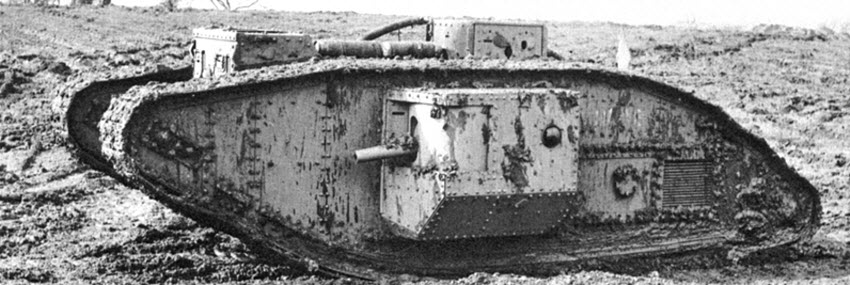
[Image: Mark V tank, Western Front, April 1916. https://commons.wikimedia.org/wiki/File:Picture_of_British_tank_on_the_Western_Front.jpg]
First sent into action by Britain in 1916, the tank was conceived of as an assault platform to break the stalemate of trench warfare. Tracked and armoured, tanks could move across broken ground under fire, and pack a heavy, up-close punch against defenders who had never faced anything like this. (For security reasons, prior to deployment they were described in documents as water tanks, and the name stuck.)
Germany was a latecomer to tank development. The German General Staff was not particularly interested, and in the First World War fielded only 20 domestically-built A7Vs (a monstrous vehicle with a crew of at least 17), along with a few captured allied tanks.
German tanks in the Second World War hold a certain mystique. Don’t confuse this with closet fascist sympathies. There is something iconic about the Panzers, their neat and menacing appearance, the rugged camouflage schemes they adopted later in the war, and even their rousing anthem. (Panzerlied was composed in 1933. While dating from the Nazi era, it has little political messaging, being largely an ode to tankers and their vehicles).
Like much mystique, this mixes a good measure of mythology and fact. The German tank forces of the Second World War performed well initially because of innovative tactics – the use of on-board radios and the concentration of forces – and later because of the experience of their crews. The tanks themselves, however they may have looked, were something of a mixed bag.
The early war Panzers provided mobility, but often inadequate firepower or even protection. The Panzer I is often described as little more than a training vehicle. Against British and French tanks, some of the German armaments were underpowered, and there are numerous accounts of their multiple hits doing little other than inflict dents. German planners spoke of how France, in particular, had both more and better tanks than those fielded by Germany. In the Russian campaign, even the more potent Panzer IIIs and IVs struggled when facing the latest Soviet designs.
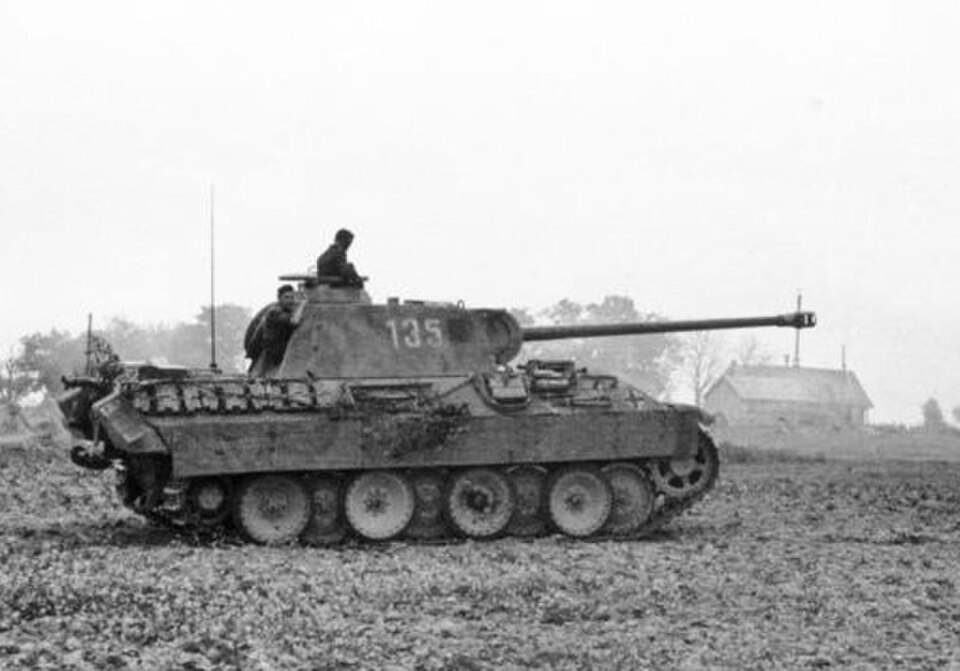
[Image: A Panzer V. https://commons.wikimedia.org/wiki/File:Bundesarchiv_Bild_101I-696-0432-13,_Polen,_Panzer_V_%22Panther%22_auf_dem_Feld.2.jpg]
The Panzer V Panther was intended as a remedy to this. The product of planning going back to the late 1930s, it was to be the hard-hitting steel gauntlet of the German army after the disaster at Stalingrad. Visually, it’s possible to discern in this the contours of today’s tanks. A 45-tonne vehicle, traveling on broad tracks around a series of large road wheels, it mounted an impressive 75mm gun intended primarily for taking on other tanks. Borrowing a design feature of the feared Soviet T-34, it featured sloped armour that gave it added protection from anti-tank fire. This also made it look sleek. First committed in Operation Zitadelle (otherwise known as the Battle of Kursk) in 1943, it went on to serve with various modifications for the rest of the war, with over 6,000 being produced. Its crews painted their tanks in a bewildering variety of camouflage patterns.
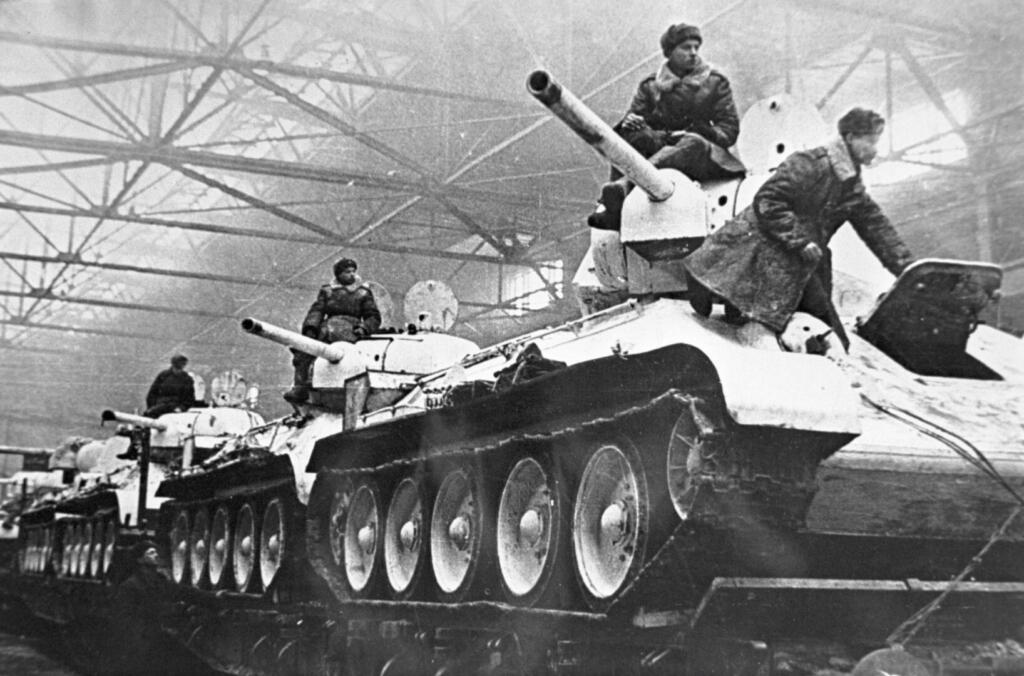
[Image: Soviet T-34 tanks headed to the front. By RIA Novosti archive, image #1274 / V. Kaushanov / CC-BY-SA 3.0, CC BY-SA 3.0, https://commons.wikimedia.org/w/index.php?curid=15579759]
For those interested in such things, the Panther is the epitome of combat cool. Even its name has a razor edge to it.
The Panther was a formidable weapon, no doubt. But it was also a flawed one. Its very size produced a relatively high silhouette that made it a target for enemy anti-tank guns. It weighed some 45 tonnes, against the 25 tonnes of the Panzer IV. This created a series of logistical issues in terms of rail transport, and handling terrain and river crossings.
More seriously, there were chronic problems with the engineering. At Kursk, breakdowns drove German commanders crazy. The final drive gears were not made to pull a vehicle of this magnitude, pumps leaked fuel, which caused engines to catch fire, and the transmission system was subject to frequent failures. Early models suffered transmission breakdowns after an average of 150 kilometres. Among those delivered for Operation Zitadelle – which had been postponed until they arrived – several never even made it into the line.
Part of this was because of the material used. Germany lacked access to some crucial resources and had to make do with substandard parts. The Panther guzzled fuel at a rate that Germany struggled to supply. Part of this was due to German industrial philosophy. It was overengineered. The wheels were interlaced, which complicated any repairs or replacements. Replacing the transmission was an equally arduous task.
It was also being ridden by recruits who had not grown up with cars. A small minority of pre-war German households owned them (probably around 2%). Driving was not a skill to be assumed, and neither was familiarity with engine care. Germany lost its veteran tank crews as the war progressed, and this became a more acute issue.
The Panther was not the only German tank to experience these problems. Much the same applied to the contemporaneous Tiger tanks, while towards the end of the war, monsters like the Jagdtiger compounded them. The Jagdtiger was a 72-tonne turretless tank destroyer, mounting a 12.8 cm gun.

[Image: Destroyed Jagdtiger, in north-eastern France in 1945. By U.S. Army Signal Corps Photo 111-SC-201967 – https://www.100thww2.org/overview/k.html, Public Domain, https://commons.wikimedia.org/w/index.php?curid=14921501]
Lethal to anything it got into its sights, it was tough to manoeuvre, could collapse bridges under its weight, was heavy on fuel (Germany having by then lost its supplies from the Romanian oilfields) and with an engine that was unable properly to carry it. A lousy design all told, but its size, menacing armament and two- or three-tone camouflage made it cool, too.
There were, incidentally, even more extreme designs. The Panzer VIII Maus would weigh in at 188 tonnes and would operate as a sort of mobile bunker alongside infantry. It needed a bespoke railway car for strategic transport and had (innovatively enough) a snorkel system to ford rivers, as bridges could not bear its weight. It was also five times the cost of the Panther. One prototype was completed and can be viewed at the Kubinka Tank Museum in Russia.
Even this pales in comparison to the Ratte. This was a design – probably never a serious proposition, but an engineer’s mindgame – for a landcruiser measuring 35m and weighing 1,000 tonnes. It would mount naval guns, along with an array of secondary armaments, plus an onboard vehicle bay and infirmary. It would also have been unable to use bridges, would have torn up roads, and would have been unable to cross mountain ranges or use tunnels. As no railway car could have carried it, all movement would have needed to be under its own power, with the implications for breakdown and maintenance that implied. In the event, it would probably never have made it into combat, presenting as it did a wonderful target for air attack. Germany had by then comprehensively lost air superiority. Adolf Hitler apparently liked the idea; this is not surprising, as the Third Reich towards the end turned to fantastical ideas about wonder-weapons to turn the tide.
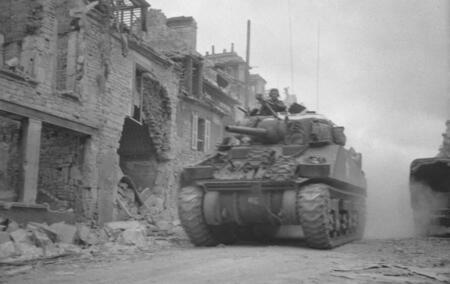
Across the Atlantic, meanwhile, M4 Sherman tanks rolled off various production plants. The first of these were manufactured in 1941; their first use in combat was by Britain and the Commonwealth in North Africa in 1942. Odds were, for the latter part of the war, that an American or British tank operator would have served his time in a Sherman.
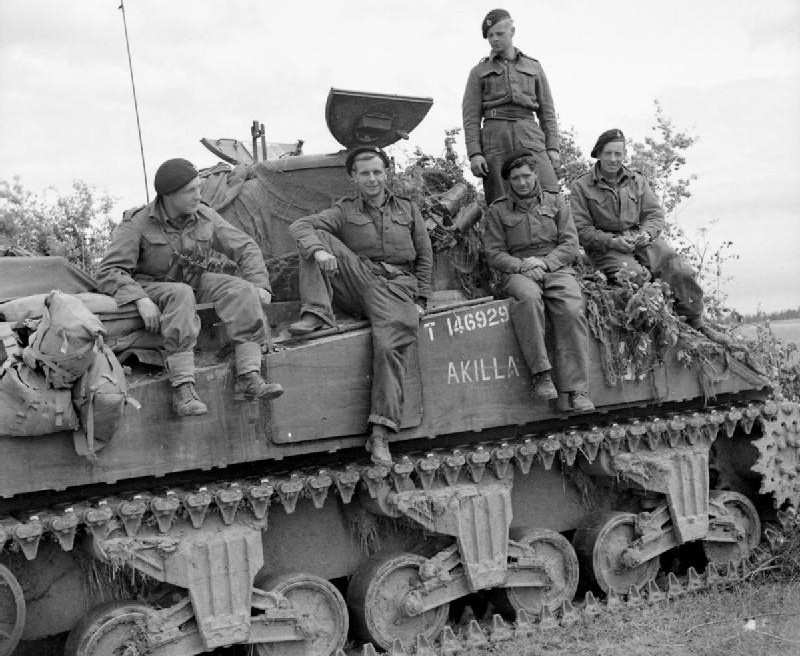
[Image: The crew of a Sherman tank named ‘Akilla’ of 1st Nottinghamshire Yeomanry, 8th Armoured Brigade, after having destroyed five German tanks in a day, Rauray, Normandy, 30 June 1944. B6222 https://picryl.com/media/the-crew-of-a-sherman-tank-named-akilla-of-1st-nottinghamshire-yeomanry-8th-6aa7e3]
It’s an awkward-looking, dumpy thing, with a bulging body (particularly in its early version) and a rounded turret. At between 33 and 42 tonnes (depending on the model), it was generally smaller than the Panther. Its armaments – the 75mm gun and later the 76mm gun – were good ones, though they struggled to deal with some of the armour on the later German vehicles. In the Second World War, it tended to be painted in monochrome green, although some variants did exist. It also served in wars across the world into the 1980s, and was a staple vehicle depicted in Saturday matinee movies. (This is what the US army would have confronted an alien invasion with).
The Sherman, in other words, was common and ordinary. Not cool.
But it did its job, and as far as the war in the West went, this was the tank that won it. It was a reliable vehicle, able to keep going long after a Panther would have needed an engine overhaul. It was designed for field maintenance, so that its transmission could be replaced in a matter of two or three hours.
More to the point, if its gun was outclassed by the Panther or Tiger, it was able to bring exponentially more of those guns onto the battlefield. The Sherman was a true product of the American industrial economy. The United States had pioneered mass production; it was able to pump out sturdy, serviceable machinery, whose parts were entirely compatible with one another, in a volume that no other economy could match. (The Nazis, by the way, scorned the US for this, seeing it as debasing the soul of a people – though their own industry was increasingly reliant on slave labour.) The Sherman’s comparatively modest proportions meant that more could be stowed in the hulls of container vessels for shipping from yards in Michigan and Ohio to depots in Britain and battlefields in Italy and France.
It was a vehicle designed for a motorised society. America was the first society with widespread private motor transport. Youngsters were accustomed to cars and learned to drive as a rite of passage. The transition from a steering wheel to a tank’s tiller was not a huge one.
And it was adaptable. Operational experience led to constant alterations and upgrades. The basic design could accommodate any number of weapons systems to perform specialised functions. Indeed, fitting a British QF 17-pounder gun onto the Sherman gave it near parity with the Panther. (The depth of Anglo-American cooperation in the war was a story on its own. Victor Davis Hansen has argued that democracies have the capacity to work together in a manner that autocracies do not.)
Close to 50,000 Shermans were manufactured. Even after the war, they were fielded on battlefields as diverse as Cuba, India, Pakistan and Tanzania. It was a measure of the success of the design that it continued to be used for a very long time, and was upgraded by its users. An example of this is the Isherman Israeli variant, modified to carry a 105 mm gun, capable of engaging a Cold War era opponent. Chile purchased some of these, and they remained in service until 1999. (The Panther, by contrast, saw very limited use after the war. Some were taken into French service but were considered unreliable and unpopular. There are rumours that at least one was used in the early Arab-Israeli conflicts.)
It may not have been pretty, but the Sherman was effective.
So, what does this have to do with South Africa today?
The difference between the Panther and the Sherman was that one attempted to reach an ideal that was beyond its reach, while the other looked for an adequacy that was suitable to the task and resources at hand. Just so in contemporary South Africa.
South Africa has been a world leader in producing plans. Big, complicated plans, with policy to match, and laws establishing institutions and mandating flows of responsibility. There’s a new one every few years. The idea has been to create an ecosystem of incentives and inducements to manage (sometimes to micro-manage) the decisions of individual decision-makers in both government and the economy. Government would be efficient and effective. It would make the economy bloom and ensure the reordering of society according to an ideological prescript.

[Image: A fairly typical Joburg street scene. John Endres]
Drive through Johannesburg, and the folly of this becomes apparent. Policy pulls in contradictory directions, institutions have been suborned, and the capacity to oversee this is lacking. South African officialdom has rejected meritocracy, the National Planning Commission said some years ago. I keep coming back to it, because that line sums up so much.
The ANC envisages a developmental state – but it must be one reflecting a perfect demographic breakdown. The country is open for business – but not if that means stepping back from any number of irrational disincentives to actually doing business. Corruption must be rooted out – though let’s cut errant party colleagues every inch of slack. Reform is on the way – sort of. We can go on. I suppose when you’re talking about the total transformation of society, trivialities like practicalities get lost.
There is very little sense of prioritisation, or at least none that might prove politically or ideologically difficult. Talking a good game at the next investment conference or promising to fix what you’ve broken (though not admitting you broke it) substitutes for anything tangible. The machine of state has been made too complex and inherently fragile to operate, yet there is a dogged adherence to the design.
It is, in the eyes of a certain type of politician, cool.
So is declaring war on this and promising a campaign about that. There is an air of make-believe about it now. There is no super-weapon coming, no magic policy formulation or coordination agency to steer a new course, and even if there were, it would offer no realistic solution. We have to do things very differently: to choose a core set of target priorities, focus resources on addressing them, and ensure that the plans to do so are workable with what we have. Where these are undermined by state policy – as with, say empowerment demands or saluting to union interests – they need to go. That would be a (political) battle worth having.

[Image: A British Sherman Firefly manned by a South African crew. https://www.facebook.com/groups/survivingshermans/posts]
Incidentally, South African troops were well acquainted with the Sherman in the Second World War. It was the mainstay vehicle of the 6th Armoured Division in Italy. There is a great Sherman Firefly on display in the Museum of Military History in Saxonwold.
South Africa keeps designing Panthers when it needs Shermans.
And as I bounce along Johannesburg’s torn infrastructure, it seems especially clear to me that we need to get out of this shot-out, smoking governance Panther, and mount a functional Sherman. However uncool that may seem.
[Image: Sherman_tank_of_a_Canadian_armoured_regiment in Caen, France, in July 1944. Lt. Michael M. Dean (Canadian Army Film and Photo Unit). https://commons.wikimedia.org/wiki/File:Sherman_tank_of_a_Canadian_armoured_regiment.png]
If you like what you have just read, support the Daily Friend