

AfriForum’s Ernst van Zyl claims to welcome the Free Market Foundation’s “embrace of a frontiersmen mindset”. That’s exactly the problem.
In response to my dismay at the Free Market Foundation’s mission to the United States in support of Solidarity and AfriForum’s 3,000 crosses project, and my broader argument that organisations promoting classical liberal alternatives (or any other alternatives) for South Africa ought not to associate their ideology with the sectarian interests of identity-based lobby groups, the head of public relations of AfriForum, Ernst van Zyl (known online as Conscious Caracal) wrote an argument published by the Daily Friend as a letter to the editor.
It claims to welcome the FMF’s “embrace of a frontiersmen mindset”.
Talk versus action
The first paragraph, without naming me, implied that my opposition to the mission marks me as left-wing, unreasonable, and irrational. Later, people who denounced the FMF’s “new approach”, as I did, are derided as “left-leaning liberal critics”.
“The running joke in South African conservative circles for over a decade has been: Conservatives take action and build; classical liberals host panel discussions and write opinion pieces,” he sneered.
His core argument is that ideological advocacy is pointless in the face of an ANC-led government that is deaf to public debate and committed to the National Democratic Revolution.
He misunderstands public advocacy. No sensible policy advocacy group limits itself to change the course of the ruling party, and resigns itself to failure if it cannot be swayed. They seek to influence the broader public debate, and change the minds of voters.
Van Zyl writes that, “The future of diplomacy is inevitably going to be increasingly decentralised.”
That is a highly questionable assertion. For non-state actors to recruit the power of foreign governments to put pressure on their own legitimate democratic governments, over ideological differences, is highly problematic. Even if they’re right it is a hostile tactic that closes all other avenues short of outright war.
“Since their founding,” he wrote, “AfriForum and Solidarity have understood that the only language the ANC listens to is power and therefore, to bring about real change in South Africa, one must become fluent in it.”
In other words, “Genoeg gepraat. Nou gaan ons baklei.”
Sectarian hostility
The idea that I’m “left-wing” in any way, shape or form is, of course, absurd. That is merely the binary political pigeonholing of someone who thinks anyone who isn’t right-wing must by implication be left-wing.
I don’t particularly care what Van Zyl calls me. What I do care about is that his letter betrays exactly the sort of ethnic prejudice that I described in my articles.
By evoking the image of “frontiersmen”, Van Zyl dropped the mask.
America’s famed frontiersmen were indeed men of action, as Van Zyl claims. They were brave, determined, and self-reliant. They conquered the American west and built a great new nation upon it.
In doing so, they also killed millions of Native Americans and pushed the remainder into small “Indian reserves”, as if they were wildlife. It is often said that the Winchester Model 1873 repeating rifle (or in other versions, the Colt Peacemaker) was “the gun that won the west”.
The exact scale of the slaughter is disputed, but by the turn of the 20th century there were only about 237,000 Native Americans left, and this remainder had lost 98% of the land they once occupied. There are, of course, many nuances to this history, and both sides in the conflict are guilty of atrocities, but it isn’t unreasonable, as some sources do, to call it an “Indigenous Holocaust”.
That is the history Van Zyl chooses to invoke to legitimise AfriForum’s (and the FMF’s) campaign against South Africa’s democratic government.
Voortrekkers
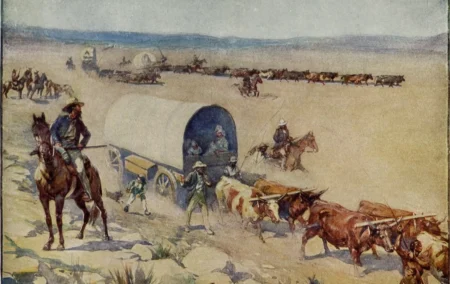
The local equivalent of the American frontiersmen were the similarly named Voortrekkers.
Again, they were courageous people, fleeing British oppression and making a brave go of building a nation in the interior of South Africa. That Voortrekker women marched barefoot and pregnant across the Drakensberg mountains was drilled into generations of Afrikaner children.
The Great Trek north wasn’t anywhere near as genocidal an enterprise as the American expansion west, but it was far from bloodless. It, too, was won by force – in this case, by “Ou Sanna”, as the muzzle-loading flintlock musket was called.
The march of the Voortrekkers was accompanied by a presumption very similar to the Manifest Destiny of the American frontier: the chauvinistic belief that colonial expansion was self-evidently justified by the exceptionalism of the colonists.
The Voortrekkers believed their God had ordained them to be masters of the lands they settled, and that he helped to defeat native populations that resisted or harrassed them. That Afrikaners are God’s chosen people, analogous to the Israelites escaping slavery in Egypt, was also drilled into Afrikaner children back in the day.
The belief in Afrikaner exceptionalism is most pointedly expressed in the Day of the Vow – the central theme of the Voortrekker Monument. On that day, 16 December, while the rest of South Africa commemorates reconciliation, Afrikaner nationalists celebrate their victory over Dingaan’s Zulu army at the Battle of Blood River in 1838. They attribute that victory to divine intervention – implying that God chose the side of the Voortrekkers against an overwhelming horde of black savages.
That is exactly the sort of ethnic partisanship with which I took issue.
If you’re not with us…
Martin van Staden, one of the FMF’s self-appointed “diplomats” (alongside David Ansara and Mark Oppenheimer), underscored this divisive attitude in a comment on Van Zyl’s letter: “Baie dankie Ernst. This means a lot, and classical liberal thinkers stand with the doers-of-liberty like AfriForum with pride. While our opponents stand should to shoulder with the likes of Bernie Sanders, Julius Malema, and the ANC ‘in defence of South African sovereignty against the right-wing’, I happily stand shoulder to shoulder with AfriForum and Solidariteit who have only ever contributed – never diminished – to the realisation of individual rights and limited government.”
So if you don’t stand proudly with Solidarity and AfriForum, you “stand shoulder to shoulder with” socialists, militant fascists and African nationalists.
This is exactly the sort of divisive partisanship with which I took issue, channelling countless partisan leaders, including Lenin and Mussolini: “If you’re not with us, you’re against us.”
It suggests that he considers everyone who does not stand with AfriForum an enemy of “individual rights and limited government”. Not only is that unadulterated bollocks, but how does he think that will go over with the majority of South Africa’s population?
Expediency
AfriForum appeals to individual rights only inasmuch as it is useful to their group interests, and supports limited government only inasmuch it pursues Afrikaner self-determination.
I fear Van Staden has been misled. AfriSol is an ethnic nationalist movement. Its appeal to the values that Van Staden claims to support is an expedient façade, carefully curated to conceal the separatist, collectivist, identity politics underneath.
I should also disabuse him of the notion that he speaks for “classical liberal thinkers”. Like Van Zyl, he most certainly does not. I can point to many – not only at the Institute of Race Relations, but also at the Free Market Foundation itself – who object to aligning classical liberal or free market advocacy with AfriSol.
There will be blood
Van Zyl writes: “…the ANC regime reacting with hostility towards those who successfully resist the NDR is a minor storm to weather, compared to the absolute nightmare of violence and destruction that will unfold if the cadres get everything they’ve wished for from their grim Father Christmas lookalike hero, Karl Marx.”
Just days earlier, the Thabo Mbeki Foundation said in statement: “As AfriSol celebrates whatever it might consider to be its victory, if such victory serves to perpetuate any element of the apartheid system, they should know that not only will that victory be short-lived, but also that it will provoke a level of violence which will cost many lives, including those of Afrikaners.”
So, we have two factions, both of whom assure us that if the other prevails there will be blood. And the FMF thinks it is a good idea to publicly hitch the free-market wagon to one of these factions.
This is why I asked Van Staden whether he wants to convince people, or go to war. Because violence is where this kind of confrontation ends up.
Negotiated settlement
The founding legend of the New South Africa is that a negotiated settlement and commitment to democracy averted a bloody racial civil war.
That is a political environment in which diverse people with often conflicting interests engage in dialogue to convince their compatriots to support policies that will benefit all South Africans, or are otherwise morally justified.
It is inarguable that individual liberty and free markets will benefit all South Africans.
It is far less clear that AfriSol’s recruitment of the Trump administration to punish the democratically elected government of South Africa will benefit all South Africans.
One can make the hypothetical argument that the fall of the ANC will benefit all South Africans. It probably will, depending on what succeeds it. But if that happens through hostile foreign interference, the chances are better than even that the majority of South Africans will resent it.
That is a problem in a unitary democracy. As a friend of mine wondered, are they trying to help the EFF and MK Party?
Communitarianism
Now I am aware that some people at the FMF, including Van Staden, are dead keen on a decentralised, federalist form of communitarianism, in which the country splits into multiple identity-based enclaves – one for Afrikaners, one for Zulus, one for Vendas, one for… (stop me if you’ve heard this idea before).
But that would be a betrayal of the classical liberal belief that individual liberty and free markets benefit all people, regardless of race or other identity markers. It would also be a betrayal of the IRR’s titular commitment to non-racialism.
The FMF’s dalliance with Afrikaner identity suggests, in the public mind, that free markets can only succeed in ethnically homogeneous societies, and are reserved for those who hew to a mostly Western civilisation. By implication, it suggests that those South Africans who don’t identify with the West are simply not cut out for this kind of civilised society.
They will swear high and low that this belief is not racist, but of course it is. Communitarianism is nothing other than “separate development” dressed up in the dapper suit of a modern, liberal gentleman. It is a disguise.
The battle of ideas
Van Zyl would like to elevate bold action above mere talk and dialogue.
That is dangerous rhetoric. It is, as he openly admits, the exercise of raw power. It is coercive. You can’t force people to accept liberal democracy by threats or extortion.
The Institute of Race Relations has often used the slogan, “the battle of ideas”.
To quote its strategy: “Our approach to solving socio-economic problems goes beyond the activism that lessens the symptomatic pain of bad policies. We take aim at the root cause of the symptoms: the ideologies, ideas, and policies that underlie them. This is why we engage in the battle of ideas.
“‘Battle of ideas’ theory provides a framework for exerting influence and achieving lasting policy change. This is accomplished over time by promoting and injecting ideas into public discourse and opinion, which eventually inform the policies on which governments base their decisions.
“When a dominant school of thought collapses or is exhausted, the new paradigm and framework of solutions will be most heavily influenced by the ideas of whoever was most successful in promoting their ideas before the change.”
What Van Zyl forgets is that the danger isn’t only “the ANC regime reacting with hostility”. In fact, that is the least of the dangers. The danger is the South African people reacting with hostility. And if they react with hostility to AfriForum, then they will now, by association, react with hostility to the Free Market Foundation.
Balkanisation
I want to be clear, here. My reasons for opposing AfriSol and my reasons for opposing the FMF’s association with it are distinct.
I support much of what AfriSol does and I recognise its right to advocate on behalf of its members. I do not conflate it with Afrikaners as a whole, and bear Afrikaners no ill will. Van my beste vriende is Afrikaans.
I disagree with AfriSol’s nationalist, conservative, and separatist instincts, and think its private diplomacy is both deceptive, and playing with fire.
I do not share their belief that all avenues of persuasion and democratic politics have been exhausted in South Africa, and that the only alternative is hostile action and power politics.
On the contrary, I think this sort of divisive activism risks putting a spark to dry tinder. It invites balkanisation into mutually hostile enclaves, each of which swears the other will bring down “an absolute nightmare of violence and destruction” upon us all.
Free markets tarnished
My issue with the FMF’s association with AfriSol is separate from these issues.
I don’t want to see the cause of free markets tarnished by an overt partnership with one side of an ethno-political struggle that is deeply ingrained in the South African psyche, and in which each side promises catastrophic violence should the other side prevail.
That is to admit there is no hope of a peaceful settlement, and no prospect for racial reconciliation in South Africa. That is to give up on the battle of ideas. That is to give up trying to influence public opinion. That is to give up on democracy, peace and civilised debate itself.
Some of us still believe in public discourse and moral suasion. Some of us still believe in a South Africa that belongs to all who live in it, united in our diversity. And while persuading the ANC almost certainly is a lost cause, persuading the people of South Africa to support a liberal alternative is not.
That the FMF is willing to associate the cause of free markets with controversial ethnic sectarianism – and to proudly accept the mantle of “frontiersmen” with all the colonial baggage that entails – should alarm everyone who believes in free markets, or in a classical liberal future for all South Africans.
[Image: The Voortrekkers, ca. 1909, by G.S. Smithard and J.R. Skelton. Public domain]
The views of the writer are not necessarily the views of the Daily Friend or the IRR.
If you like what you have just read, support the Daily Friend