

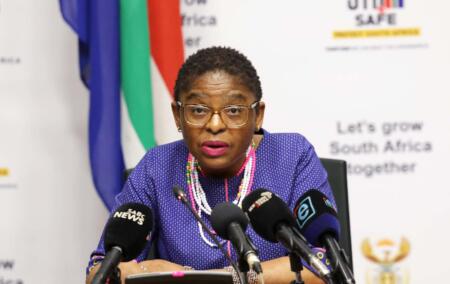
Minister in the Presidency Khumbudzo Ntshavheni recently defended South Africa’s Black Economic Empowerment (BEE) policy against the United States’ criticism. The Minister was responding to questions regarding how South Africa intends to overcome its diplomatic impasse with the United States. This was after the announcement by the President Donald Trump administration that is considering sanctioning politicians and businesspeople yet to be named for various acts including supporting and enforcing BEE.
According to the Minister Ntshavheni, BEE is a matter of national interest, one the country is not yet ready to move on from yet. “BEE is not for itself. It’s for the transformation of this country and given that we have to transform and make sure that participation of all South Africans in the economy of this country, we have to look at what is in our national interest,” she went on to elaborate.
Merely two days after Minister Ntshavheni’s comments former African National Congress spokesperson, Pule Mabe’s tender rigging case which related to a R27.6 million procurement contract came to a head as his bid to stop asset forfeiture proceedings against him and his company had failed. On that same day, former ANC member of parliament and Minister of Defence, Mapisa Nqakula, was found in contempt of court after failing to appear to her court hearing where she is fighting allegations of soliciting bribes and kickbacks from a tender recipient.
Ms Ntshavheni’s interpretation of the US motives for targeting BEE is that the Trump administration disguises their ambitions to access critical minerals South Africa possesses. This could very well be the case although the Minerals and Petroleum Resources Development Act which nationalises minerals poses a bigger threat to that theory than BEE and the Expropriation Act which have been the target of President Trump’s ire. However, the disguise of BEE as a ‘national interest’ which is the most blatant, non-conspiratorial one, seems to elude her. It is tall order when BEE defenders demand that we perceive the policy as a benefitting the nation when so much evidence has already demonstrated the policy enables crooked officials to siphon of taxpayer funds to benefit the ANC and their members. Thinking of BEE as more than the cadre upliftment scheme it is requires that we forget about the first era of the state capture under President Jacob Zuma where the wholesale looting state owned enterprises (SOEs) through public procurement contracts took place.
Chief Justice Zondo weighs in on this question about the lens through which the ANC perceives what is in the best interest of South African during the state capture reports. He was responding to the testimony of Gwede Mantashe who had appeared before the commission in his then capacity of ANC Chairperson. He found “the ANC’s self-identification as a leader of society” to be causing the “the conflation two notions: the interests of the party and the constitutionally enshrined public duty of those in government.” In evaluating policies that enable this commingling of state and party affairs, BEE – as a cadre deployment funnel – comes top of mind. BEE has corruption embedded into it as a feature rather than a bug and corruption is the ultimate fate of any policy and institution that forfeits meritocracy for factors that are irrelevant to the job at hand.
Observing of race and gender quotas, as BEE requires, has over the years granted the ANC as a majority party in government with enormous discretion to staff the government with their own party loyalists, friends and families. Doing BEE ethically fails at this critical juncture. At developing frameworks that disabuse government from personal relationships, kinship and cadre credentials engendering favouritism. BEE makes it impossible to create impersonal institutions that are defined by merit-based rules which apply uniformly to everyone and can repel corruption. BEE is how ANC governments acquired sufficient leverage to negotiate state contracts to benefit the party.
Their modus? During state capture, multinational companies entered what are effectively rent-seeking agreements with local, cadre-linked companies to launder their level 1 B-BBEE score rating to access South African multibillion rands procurement contracts and the BEE premiums accompanying them. In addition to ownership sharing requirements, BEE enforces inflated prices through lawful and unlawful premiums. Licit premiums cost taxpayers between 11.1% and 25% and are paid to the bidding companies for contracts above R50 million for the former and below R50 million for the latter. Whilst illicit premiums are extorted through bribes and kickbacks. Both kinds of premiums divert spending away from service delivery. Illicit premiums erode budgets allocated for government contracts and causes project and service delivery delays. This is the story behind the captures of Eskom, Transnet, SAA, PRASA, Denel and often the ANC found itself in the centre of many rent-seeking controversies.
What this has meant for South Africans is their taxes were squandered and misappropriated to fund everything from bribes to lawful premiums to and the post-state capture damage bailouts. Taxpayers are estimated to have spent between R500 billion and R600 billion in 15 years bailing out the captured SOEs. The decaying of these state-owned entities also comes at another price we are all familiar with. For Eskom – loadshedding and electricity tariff increases to the tune of 190% since 2014. Transnet was no different. The logistical constraints caused by state capture forced industries such as mining companies to cut production to suit Transnet’s diminished capacity. These and other bottlenecks were estimated to cost the economy R1 billion daily in 2025.
PRASA and the infamous trains that did not fit deserve a longer mention as the judgement in the high court case laid bare the true nature of these BEE deals as that too was a BEE-deal gone wrong. As the local BEE partner, Swifambo Rail Leasing, was found by the presiding judge to be no more than a front company for the Spanish manufacturer, Vossloh España. A procurement contract for the supply of locomotives worth R3.5 billion which later ballooned to R5 billion was set aside by the Gauteng High Court after the Swifambo delivered train carriages that were too tall to fit South African rail infrastructure. PRASA awarded this contract to Swifambo despite the latter not having any experience in the rail industry. Crime investigating entity, Corruption Watch claim that some of these funds were siphoned into various avenues including wine farms, private trusts, luxury properties and ultimately, the ANC.
The exact comments by the presiding judge pierced through the veil of this BEE deal describing Swifambo as no more than a “token participant” that Vossloh paid off “in exchange for the use of its B-BBEE rating”. The judge went on, “Vossloh could not bid on its own. Instead, it concluded an agreement with Swifambo in which its B-BBEE points were exchanged for money.” He condemned the contract as amounting to “exploitation of the intended beneficiaries, being black people as defined in the B-BBEE Act…” During the litigation to get the contract cancelled, Dr Popo Molefe, PRASA board chair at the time deposed to an affidavit that Swifambo Chair, Auswell Mashaba, met with Angolan businesswoman and alleged close friend of President Zuma’s, Maria Gomes, at her request. The purpose of meeting was to discuss the 10% value of the contract which Ms Gomes claimed was due to the ANC as a “benefit of the movement”. An allegation the ANC denied.
The judge’s remarks may be addressed to PRASA, but their nature pulled back the curtain on the false legitimacy covering many such BEE deals. An unfortunate number of them proved to really be BEE rating laundering arrangements rather than a genuine collaboration in which partners match each other’s skills and compliment one another’s contributions. The racial and gender exploitation may be irresistibly financially lucrative, but it is still corruption. When Eskom, PRASA, Transnet, and other entities were broken from within, ordinary citizens paid the price for it. Even without corruption, lawful BEE premiums take away from money that could be spent on actual service delivery. ‘Transformation’ that is based on inflating the cost of stationery for rural schools or medical equipment in government hospitals as BEE premiums do solely to make cadres richer may be legal, but we cannot continue pretending that it is empowerment. It takes away from spending on actual public goods and services upon which low-income households, most of which are black, rely on to lift themselves from poverty.
Since its inception BEE served to enrich tendering, politically connected individuals, politicians themselves, and businesspeople. The ANC maintains this system despite evidence of it hollowing out state institutions and compromising service delivery because it sustains their patronage networks without which the party’s political offering would be found wanting. Giving up BEE risks the party losing the control it exercises over government resources and resultant economic opportunities they have used to maintain their support base, rather than the pretence of ‘transformation’. This is the greatest source of the ANC’s resistance to upending BEE, nothing of this so called ‘national interest’. Minister Ntshavheni and other BEE supporters do not get to claim that this benefits anyone other than political elites and ANC patronage ecosystems.
[Image: https://www.flickr.com/photos/governmentza/54140343867]
The views of the writer are not necessarily the views of the Daily Friend or the IRR.
If you like what you have just read, support the Daily Friend