

The DA loves to catch its rivals out on bad statistics, but when Greenpeace offered an alarming number on air pollution, it swallowed it whole.
Last week, I urged readers to vote DA, notwithstanding some “howlers” in the party’s manifesto. Among them, I listed a Greenpeace estimate of the cost of air pollution, called it fiction, and promised to explain why “later this week”.
Here, a little late, is that explanation.
The manifesto says: “In South Africa, air pollution is concentrated in major industrial centres like the City of Johannesburg and Ekurhuleni, and mining towns in Mpumalanga and Gauteng. A 2025 report by Greenpeace Africa estimated that air pollution costs the South African economy up to R960 billion annually, around 14 percent of our annual GDP, and contributed to 42 000 deaths in 2023.”
The DA is not usually so credulous. When Census 2022 produced numbers it didn’t like, the party demanded that Stats SA bring in “trusted academics, economists and demographers” to test them, citing an “unprecedented 31% national undercount”.
Yet when a global eco-lobby group with an obvious agenda offered an alarming number that supports its own environmental instincts, the DA copied it into its manifesto without a second glance. It even copied it wrongly. R960 billion is Greenpeace’s central estimate, not an “up to” ceiling. Its range runs from R518 billion to a staggering R1.5 trillion.
None of this is to deny that fine particulate pollution harms health, or that Eskom has spent years dodging its emission limits. The question is whether these numbers mean what the DA says they mean.
They don’t.
What R960 billion buys
Turn to the appendix of Greenpeace’s report. Of its R956.8 billion total, R882.5 billion – fully 92% – is the notional value of 42,000 statistical lives, priced at R20.4 million per adult and twice that per child.
The only item that resembles actual healthcare spending is emergency room visits for asthma. They come to R145 million, or 0.015% of the total, and even that is scaled from what an asthma visit cost in California in 2010. Everything else puts a price on premature births, years lived with disability and sick days.
None of that is money the state spends. For perspective, R960 billion is more than three times what the state will spend on health in 2026/27 (R310 billion).
A value of statistical life (VSL) is not money anyone spends or loses. It is an estimate of what people would pay to reduce a small risk of death. Greenpeace starts from an American figure, derived from the wage premiums workers demand to take dangerous jobs.
Adding those up and calling the total “14% of GDP” confuses a measure of risk tolerance with national income.
Every life is of equal worth. That is a moral claim, however, not an economic one. To know what a death costs the economy, you would estimate what that person would have earned over the rest of their life.
In South Africa’s most polluted areas, that would be a lot less.
In guidance on valuing lives in poorer countries, Harvard University public health experts put the future earnings of an average adult at about 20 times income per head. Greenpeace’s VSL uses the American ratio of about 160 times income per head – eight times higher.
The median South African employee earned R5,417 a month in 2022, and R7,500 in Gauteng. A Gauteng worker on the median wage with 20 working years ahead of them would earn R1.8 million – less than a tenth of Greenpeace’s price tag. That is to say nothing of the expanded unemployment rate of 44.0%. Nobody demands a risk premium for a job they don’t have.
The World Bank and the Institute for Health Metrics and Evaluation did the sums both ways in The Cost of Air Pollution. In 2013, all forms of air pollution cost South Africa forgone labour output equal to 0.20% of GDP. Valued by VSL, the welfare loss was 3.12% of GDP. Greenpeace’s 14% is 70 times the first figure, and more than four times the second.
Greenpeace admits its VSL is higher than the figures derived by others, but prefers its own figure, “which we judge to be more credible”. To look moderate, it points to the R53 million per life in a cost-benefit analysis written by consultants to Eskom. Yet a 2019 review of that analysis, funded by Greenpeace itself, called Eskom’s VSL “too high”, and “the only part of the Eskom analysis that provides any possible bias to overestimation”.
Counting the dead
The 42,000 deaths were not counted. They were modelled, from satellite estimates of particulate pollution and the risk curves of the Global Burden of Disease (GBD) study. The 95% confidence interval runs from 23,000 to 67,000.
Greenpeace can’t even describe them consistently. Its key findings say fine particulates “contributed to” 42,000 deaths, the wording the DA borrowed. Its main text says exposure “led to” them. Its press release says 42,000 South Africans “lost their lives due to” fine particle pollution. Those are vastly different claims.
Models like this don’t blame every stroke or heart attack on pollution. They attribute a fraction of each cause, between about 12% and 25% in South Africa, according to the Health Effects Institute. But the same stroke is also counted against smoking, high blood pressure, diet and inactivity. Deaths attributed to different risks, as Our World in Data explains, “cannot be added up, and they do not sum up to 100%”.
In the model’s terms, each of those deaths would have been avoided without the pollution. The same deaths might equally have been avoided without the cigarettes or the salt. Of the 42,000, about 29,300 are from stroke, heart disease, diabetes and dementia, and fewer than 11,000 are from respiratory illnesses.
What changes?
The toll also keeps growing, although the pollution in the air does not. The World Bank put South Africa’s deaths from all air pollution, household smoke included, at 20,398 in 1990 and 19,802 in 2013. A decade later, Greenpeace attributes 42,000 deaths to outdoor particulates alone, while conceding that air quality has barely changed in a decade.
Population growth doesn’t explain it. The population grew by about 20% between 2011 and 2022. Greenpeace explains it itself: its estimates are higher “due to new and strengthened epidemiological evidence reflected in the risk model”.
The air didn’t change. Only the model did.
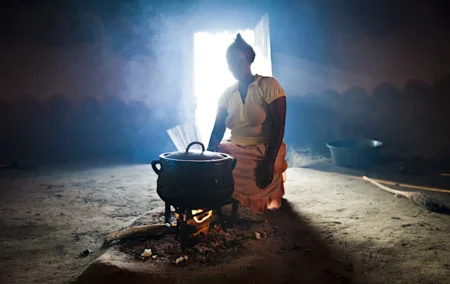
Meanwhile, Greenpeace brushes aside household air pollution, saying it “plays a smaller role” in South Africa. Yet 8% of households still cook mainly on wood or coal, and a quarter use open fires as an alternative source of energy for cooking. Household cooking smoke was linked to almost 9,000 deaths in 2012. Household fires also feed the outdoor particulates behind Greenpeace’s 42,000. Energy production accounts for only 23% of them.
As I argued in a 2016 paper for the IRR, a sole focus on industrial pollution ignores a major cause of pollution-related illness. The problem for Greenpeace is that with smoke from household fires (as I wrote in 2023) “there is no big bad corporation to attack”.
Follow the agenda
Why would Greenpeace want a big number? Read its recommendations: a “polluter-pays levy” on industry, a Clean Air Act with “time-bound sectoral emission caps”, penalties for “defaulting companies”, and an end to “reliance on coal, oil, and gas power”.
Its press release says “polluters are poisoning our air and putting profits above people”, and demands an end to “corporate impunity”.
Most green lobbyists, as I’ve written before, are eco-socialists. Protecting the environment is not their goal. If it was, they’d consider the polluted wastelands of the old communist bloc – and today’s socialist backwaters – evidence enough that for all its faults, capitalism is better for the environment than socialism. What they actually want is more state control over industry and less capitalism. Alarming statistics is how they hope to get it.
Alarm also pays. Environmental groups are no less motivated by material gains than the oil companies they campaign against, because their income depends on donors who must be kept frightened.
Greenpeace’s co-author, the Centre for Research on Energy and Clean Air (CREA), has form. Its contributor Lauri Myllyvirta campaigned against coal at Greenpeace before joining CREA, and I took apart one of CREA’s earlier South African death tolls in 2023.
Check your sources
None of this means South Africa’s air is clean, or that Eskom should be excused from obeying the law. It means that policymakers cannot trust Greenpeace’s numbers blindly.
The DA’s manifesto suggests they can, which is embarrassing. A party that demands academic scrutiny of the census swallowed agenda-driven propaganda from a global NGO hook, line and sinker.
I’m disappointed. It would be nice to have at least one political party whose factual claims one could rely on.
[Image: Indoor air pollution cannot be blamed on capitalist corporations, which is why Greenpeace raises the alarm about outdoor pollution only. Afri-Genie]
The views of the writer are not necessarily the views of the Daily Friend or the IRR.
If you like what you have just read, support the Daily Friend