

Several inaccuracies and misleading statements in Trevor Oertel’s opinion piece, no doubt to discombobulate the reader into believing a convoluted and contradictory piece of writing, require some attention.
As two of the lead researchers for the peer-reviewed research paper criticised in his piece, we would like to provide clarification to Oertel and to readers of the Daily Friend.
Language used to discredit
First, we have previously addressed misleading usage of the term “animal rights organisations” when referring to organisations focused on animal welfare and well-being, both of which are established concepts in South African legislation.
We note that the use of “animal rights organisations” has increasingly been used to paint the work of organisations who prioritise improving the welfare and well-being conditions of animals, particularly those used for commercial purposes, as extremist and unjustified. The terminology is incorrect and only serves to discredit organisations like ours, which are actually grounded in scientific, fact-based evidence.
Misleading comments on animal welfare and conservation
Oertel incorrectly criticises the Blood Lions research report in the following lines:
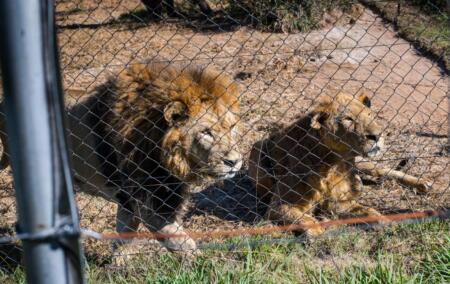
“A recent report published by the animal rights advocacy group, Blood Lions shows two lion enclosures at the same facility (this is not indicated), one an enclosure that is deemed acceptable and a small enclosure deemed “totally unacceptable” because of its size.”
The lion enclosures Oertel mentions here are NOT from the same facility and the smaller enclosure does NOT illustrate a management camp. The smaller enclosure is in fact the solitary lion’s only enclosure space with a small night house, the door of which can be seen behind the lion on the image in question.
Oertel further mentions that NSPCA inspections have unsurprisingly resulted in few animal cruelty prosecutions.
A low number of prosecutions does not necessarily indicate that the industry is devoid of cruelty, neglect or welfare issues, but rather is a sign of poor law enforcement for animal welfare and outdated legislation that only serves to minimise grievous harm to animals.
South Africa’s legal system and judges struggle to adequately handle animal welfare cases as a result of the outdated Animals Protection Act, lack of legal resources, training and capacity, and legislative restrictions on what is deemed ‘unnecessary suffering’.
Oertel states:
“And perhaps in years to come, we will appreciate the conservation value of South Africa’s captive-lion breeding industry. As wild numbers continue to plummet, a fact the animal rights industry constantly reminds us of, we may rely on these lions’ descendants to repopulate habitats across Africa”.
By his own admission earlier in the article, he states that lions in the commercial captive industry cannot be released into the wild. This statement also neglects peer-reviewed research indicating serious red flags: not only is it established that the commercial captive predator industry lacks conservation value, it also poses risks to wild lion populations.
The industry has yet to produce a credible evidence base to suggest the captive industry benefits wild lion populations.
What a phase out of the industry would actually entail
Oertel asks numerous questions around the issue of what would happen to the lions if the income needed to care for them was ‘deliberately strangled’.
We should start by stating that the lion-bone trade only started in earnest around 2013, a revenue stream from the early days linked to wildlife trafficking syndicates.
Before that time, lion breeders managed to make ends meet without this extra income from the bone trade. However, with a steady decline in the availability of tiger bones for traditional medicinal purposes in SE Asia, South African lion breeders, and in particular those involved in captive lion hunting, saw an opportunity to make their business more profitable by selling the skeletons that were in effect a by-product of hunting.
This led to lions being bred specifically for their bones with considerable animal-welfare implications.
It needs to be pointed out that any economic activity comes with its unique costs and overheads. When breeding and keeping any animals for commercial purposes, as is the case in farming traditional domesticated animals, feeding and adequate veterinarian care to ensure minimum welfare standards of the animals involved should be part and parcel of their business plan and model.
In other words, farmers who decide to breed and/or keep wild animals, like lions, are responsible for adequate feeding and the veterinary care of the animals involved. If they cannot meet such costs, they should not be in business.
After all, welfare is not a nice-to-have option, it is a non-negotiable, legal requirement and the Animal Protection Act S2(1) is very clear on an animal owner’s responsibility with regards to their welfare. In addition, an animal well-being clause is now included in South Africa’s biodiversity legislation that the ConCourt ruled on recently.
Industry players assumed the inherent risk when they entered a contested economic space. Therefore, in case of an intended phase-out, the responsibility lies squarely with the industry to deal with the lions in their care.
However, that doesn’t mean that in a future phase-out the welfare of both humans and animals shouldn’t be carefully considered and planned with a solid roadmap of transition and solutions that are in line with legislation and have a set timeframe. Such a roadmap has already been proposed by the Ministerial Task Team on Voluntary Exit that considered the merits of unintended consequences and undertook a SWOT analysis on all potential exit options.
It is important to note that there are other examples where a government commitment to end commercial captive breeding of a wild animal species, via a phased approach, has been taken.
Steps including mass sterilization and micro-chipping of animals, in addition to economic packages such as compensation and grants for sustainable alternative livelihoods, have been applied with regards to Asiatic black bears in South Korea and sea turtles in La Réunion. In Vietnam, they are at the tipping point in ending the bear-bile industry with the number of bears now down to 90% (from 4,300 in 2005 to just under 400 in 2020).
This was achieved through creation of laws that made bear-bile extraction illegal, improving enforcement, and allowing the microchipping of bears to prevent entry of new bears into the industry.
Potential challenges to alter or ultimately dispense with an industry should never be an excuse to continue the status quo, especially when an industry has received years of worldwide condemnation damaging South Africa’s reputation, is highly unregulated and rife with animal-welfare and well-being concerns, as our peer-reviewed paper on assessing animal welfare conditions in South African captive lion tourism venues clearly showed.
[Image: Stephanie Klarmann]
The views of the writer are not necessarily the views of the Daily Friend or the IRR.
If you like what you have just read, support the Daily Friend