

The paleo-libertarian branch that split from the mainstream around 1990 left behind a non-racist trunk, I argue in this third of a four-part essay.
In part two of this series, I traced how one branch of libertarianism – the paleo-libertarianism of Murray Rothbard, Lew Rockwell, Ron Paul and Hans-Hermann Hoppe – chose an alliance with the far right, from Rothbard’s “Outreach to the Rednecks” in 1992 to Curtis Yarvin, whom JD Vance calls a friend.
Critics on the left (see part one), such as the historian Quinn Slobodian, say that branch has roots in the “highly racialized” views of Friedrich Hayek, and ultimately in Ludwig von Mises, and that, consequently, racism runs through the whole neoliberal or libertarian tradition.
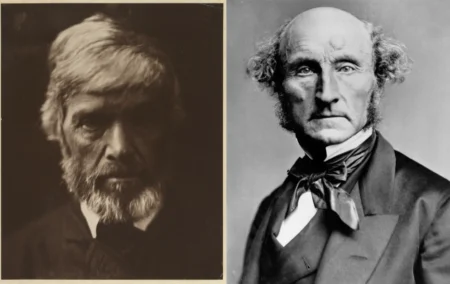
It doesn’t. The liberal and libertarian tradition the paleos left behind answered them long ago. That answer begins with a 19th-century Scottish racist and the English philosopher who rebuked him.
An acolyte of Carlyle
Curtis Yarvin, “the ‘house philosopher’ of the New Right”, claims to have moved from Ludwig von Mises, via Murray Rothbard and Hans-Hermann Hoppe, to become a follower of the Victorian-era essayist, historian and philosopher Thomas Carlyle.
Carlyle was a notorious racist, who held anti-democratic and authoritarian views. He was a literal white supremacist, in that he thought black people to be natural subordinates of white masters. His political philosophy was proto-fascist: great men make history, and the masses owe them obedience. He scorned both parliamentary democracy and laissez-faire economics, which he dismissed as “the dismal science”.
During their final days in the Führerbunker in 1945, Adolf Hitler and Joseph Goebbels sought solace in Carlyle’s History of Frederick the Great, so wrote historian Hugh Trevor-Roper in The Last Days of Hitler.
John Gross, a literary critic sometimes dubbed “the best-read man in Britain”, wrote of Carlyle that “[h]e points forward, not indeed to fascism itself, since after all he never crossed over into the realm of active politics, but to the trahison des clercs [treason of the intellectuals], the long procession of artists and intellectuals whose hatred of the modern world has led them to flirt with brutally authoritarian regimes or to clutch at obscurantist dogma.”
This is the Carlyle of whom Yarvin declared himself to be an acolyte.
But John Stuart Mill answered Carlyle long ago.
In 1850, Mill replied to Carlyle’s claim “that one kind of human beings are born servants to another kind”.
Mill said “a doctrine more damnable, I should think, never was propounded by a professed moral reformer”.
He accused Carlyle of “the vulgar error of imputing every difference which he finds among human beings to an original difference of nature”.
Then he added that if the premise were true (which he never conceded it was), this would still not establish a right of domination or oppression: “[W]ere the whites born ever so superior in intelligence to the blacks … it would not be the less monstrous to assert that they had therefore a right either to subdue them by force, or circumvent them by superior skill.”
Rothbard wrote in glowing terms about The Bell Curve, which in 1994 breathed new life into “scientific racism” and “race realism”. John Stuart Mill answered it 144 years before it was published.
Was Mises racist?
Mises expressed some views that reflected an era in which racism was ubiquitous and opposition to it yet fragile. Still, it is not hard to acquit him of Slobodian’s charge of leaving the door open for his followers’ racial politics.
In 1944 he asked: “How can we expect that the Hindus, the worshipers of the cow, should grasp the theories of Ricardo and of Bentham?” And: “There are few white men who would not shudder at the picture of many millions of black or yellow people living in their own countries.”
Slobodian quotes both these lines in his argument, and at first glance they appear to be slam-dunks. However, I will concede only that Mises acknowledged racial prejudice as a political reality he could not wish away.
Mises admitted he did not know what future scientific work might discover about the nature and consequences of race, but also declared himself unconvinced by what it had found to date.
In Socialism (first published in German in 1922), Mises wrote: “Scientific knowledge of the innate qualities of man is still in its infancy … [W]e cannot really say any more about the inherited characteristics of the individual than that some men are more gifted from birth than others. … We know that we are justified in differentiating between races and in speaking of the different racial qualities of individuals. But so far, attempts to find somatic characteristics of racial relationships have had no result.”
Writes Magness: “The research questions and authors Mises was attacking have long fallen into scientific disrepute. At the time Mises composed the passage in 1922, however, eugenic theory was near the peak of its academic acceptance – and, in the economics profession, largely situated on the progressive left. … In the next passage, Mises therefore lambasted the poor scientific quality of the race-theory arguments in no uncertain terms: ‘It is impossible to condemn too emphatically the procedure of the “race experts”.’”
When Slobodian quotes Mises saying “it may be assumed that races do differ in intelligence and will power, and that, this being so, they are very unequal in their ability to form society”, one is led to believe that Mises accepted the race theory of his age to be valid.
Context matters
Reading the original text, however, reveals that Mises did no such thing.
He was not asserting it as fact, but recounting the hypothesis, to show that even if it were true, the race theorists’ political conclusions would not follow.
Magness writes: “Scientific racism was not a challenge to the theory of free exchange, as had been claimed. It was ‘irrelevant so far as Liberalism is concerned,’ as Mises explained: ‘Even the race theory cannot shake the assertion that civilization is a work of peaceful co-operation’.”
So, Mises held that no answer to the scientific question of race could justify unequal rights or racial conflict. That is Mill’s argument again, 72 years later: even if you grant the premise, it still gives nobody the right to rule anybody else.
In his 1927 book Liberalism, Mises called European rule in Africa and Asia an “intolerable condition”, and said “we must strive for its abolition”. He attacked the field of eugenics, and his later works, such as 1944’s Omnipotent Government, contained philosophical broadsides against Nazism, singling out the errors and evils of Nazi racial theory in particular.
The “Hindu” line appears in that same 1944 book, immediately after he mocks “scores of millions of Germans” for believing that Germany had won World War I. His disdain for the ignorance of the masses was not limited to non-white populations.
And the “shudder” line immediately follows this sentence: “Even men who are fair in their appraisal of the qualities and cultural achievements of the colored races and severely object to any discrimination against those members of these races who are already living in the midst of white populations, are opposed to a mass immigration of colored people.”
So, Mises is not stating his own views, but those of others. Context matters.
Magness and his co-author conclude: “This reality contradicts Slobodian’s findings that Mises’s works give nourishment to racism.”
He accuses Slobodian of “selective excerpting and associated misreading” of Mises in his attempt to paint the entire neoliberal project as racist, or at least imperialist, from his position on the left.
Mises considered the then-common beliefs about race-related differences between peoples to be a matter for science to settle, but whichever way the science ultimately pointed, he was not racist in his politics, was unconvinced by the race theory of his day, and denied that it could justify unequal rights even if true.
He closed down any political “opening” for later racists to drive a “proverbial truck through”. Slobodian’s claim to the contrary is not sustainable.
How about Hayek?
Hayek had his prejudices too. In a 1983 interview, quoted by Corey Robin, he said he disliked “the Near Eastern populations, which I still dislike because they are fundamentally dishonest”, and called Indian students at the LSE “Bengali moneylender sons” and “a detestable type”.
That is ugly, and I won’t excuse it. Yet for all his personal prejudice, race plays no part in his work.
In The Constitution of Liberty (1960), he wrote: “To rest the case for equal treatment of national or racial minorities on the assertion that they do not differ from other men is implicitly to admit that factual inequality would justify unequal treatment”. Instead, he argued, “people should be treated alike in spite of the fact that they are different.”
Hayek did not deny that people differ. He denied that differences, real or imagined, give the state any grounds to treat them differently. Even if the race realists were right, Hayek’s principle gave them nothing.
In The Fatal Conceit (1988), he added: “Our genetic inheritance may determine what we are capable of learning but certainly not what tradition is there to learn.” The extended order of a free society, he argued, needs “restraint on the innate feelings of the micro-order, the small group”.
Rothbard set out to rouse those feelings. Hayek wanted them restrained.
And Slobodian knows this. His own paper concedes that Hayek “eschewed biological categories of race”, and that when Rothbard and Hoppe embraced racial science, they fell “clearly afoul of Hayek’s … charge of ‘scientism’”.
I granted in part one that Hayek’s talk of “primitive” societies sounds racialized to modern ears. But racialized language is not race theory. When Slobodian calls Hayek’s and Rothbard’s narratives both “highly racialized”, he files the man who rejected race science alongside the man who embraced it. That is misrepresentation.
Mont Pelerin
The society Hayek founded, the Mont Pelerin Society (MPS), usually, though not always, held his line.
The MPS never took a collective position on race. Its members’ own writings, however, show that most rejected race as a basis for law, and several of them made the standard economic case against it.
W.H. Hutt, a founding member who taught in Cape Town for 37 years, showed in The Economics of the Colour Bar (1964) that South Africa’s racial laws grew out of white unions’ demands for protection from black competition.
Gary Becker, the Society’s president from 1990 to 1992, argued in The Economics of Discrimination (1957) – and in his later Nobel lecture – that discrimination costs the discriminator, and that competition wears it down.
In South Africa’s War Against Capitalism (1989), Walter Williams wrote: “Apartheid is the result of anticapitalistic or socialistic efforts to subvert the operation of market (capitalistic) forces.”
Milton Friedman toured South Africa in 1976. He observed that the market “is color blind”, and said in a speech that he found apartheid “so galling”.
Where these men differed from their critics was not over whether race should decide rights. The disagreement was over how fast to extend the franchise, and how to prevent a new majority from doing to a minority what the old one had done.
For the transition, Hutt proposed a non-racial franchise weighted by income. He insisted in 1965 that “majorities shall have no power to enrich themselves through government at the expense of minorities.”
Friedman doubted that “majority rule” in Rhodesia would amount to more than one elite replacing another, which would “mean both the eviction or exodus of most of the Whites and also a drastically lower level of living and of opportunity for the masses of Black Rhodesians”. He pointed to “the typical experience in Africa”, most recently in Mozambique, in support of this claim.
Critics argue, with considerable force, that an income or property ownership qualification would have kept white voters in charge just as surely as an explicitly race-based franchise. But the one-party states, military dictatorships, and elitist kleptocracies that followed independence across the continent argue that their fears were not idle.
The members of the MPS were mostly, but not all, opposed to racism. Wilhelm Röpke, the Society’s president in 1961–62, defended apartheid in openly racial terms in 1964, shortly after leaving the Society. Enoch Powell remained a member through his 1968 “Rivers of Blood” speech. But they were the exceptions, not the rule.
Rejecting prejudice
Milton Friedman opposed fair-employment laws as firmly as Rothbard did, on the grounds that private discrimination is a matter of personal freedom.
But in Capitalism and Freedom (1962), he also wrote: “I believe strongly that the color of a man’s skin or the religion of his parents is, by itself, no reason to treat him differently”.
Of bigots, he said: “I think the less of them for it.”
Friedman’s proposed remedy for racism was “to persuade our fellows to be of like mind, not to use the coercive power of the state”.
Both Friedman and Rothbard claimed to reject state action. Friedman condemned the prejudice. Rothbard defended it, then wanted sovereign borders drawn to enforce it.
When the Ron Paul newsletters surfaced in 2008, Cato’s David Boaz wrote: “Those words are not libertarian words.”
Quoting Ayn Rand – “Racism is the lowest, most crudely primitive form of collectivism” – he said their authors “are not our comrades, not part of our movement”.
After Charlottesville, Steven Horwitz rejected the very excuse Rothbard’s Bell Curve review leant on: “Libertarians have apologized far too often … for those who claimed that their anti-Semitism or racism is compatible with their libertarianism because it’s just a ‘private view’ and they don’t wish to enforce it with political power. That excuse making needs to end.”
Racist offshoots
The paleos knew their enemies. The Rothbard-Rockwell Report’s gossip column listed Cato and the Reason Foundation among those who helped the campaign to keep “illegal aliens on the dole”, and frequently attacked “left-libertarians” like Hayek.
Libertarianism’s left-wing critics attacked from the other side. Benjamin Fogel’s quote from that 1980 issue of Reason, about apartheid South Africa supposedly having moved towards libertarianism, is a case in point.
The article itself provides the missing context: it praises the achievements of Leon Louw and the Free Market Foundation in their clandestine efforts to bring down government spending, reduce taxes, remove racist transport laws and restrictions on black trading, relax migration laws and public segregation, and extend private property rights to black people.
“Nowhere in the world is the distinction between ‘right-wing’ and ‘libertarian’ so evident,” the article says.
It quotes Louw himself: “I’m an abolitionist. What’s wrong is wrong.”
The opening line – “It is possible that in the past decade no country has moved further toward a libertarian society than South Africa” – was provocative polemic, and not a little absurd given that the country still denied most of its people the vote. But the substance of the article praised apartheid’s libertarian opponents, and not apartheid. Suggesting otherwise is dishonest.
And that was not the only occasion on which that one line was abused in this manner. In 2014, the magazine had to defend itself against the far-left journalist Mark Ames, who cherry-picked a single (much-challenged) author who wrote four articles for them in the 1970s, and also misrepresented the 1980 line, to claim that Reason supported apartheid “as a matter of faith” for two decades.
Generalising from the paleos to the entire libertarian and classical liberal tradition was, and remains, popular among the left-wing critics of individual liberty and free markets. That’s how perfectly innocent ideologies get tainted by association with the racist offshoots that their mainstream rejected.
A sharp turn to the right
Quinn Slobodian’s case against libertarianism is tidy. On his account, the racial politics of Murray Rothbard and Hans-Hermann Hoppe grew from seeds Mises and Hayek left in the soil. Both men called themselves heirs of Mises, and both worked under the Mises Institute’s roof. The lineage looks obvious.
When reading papers, however, one should always read the footnotes. And the footnotes in this case tell another story.
When Hoppe argued in Democracy: The God That Failed that a society may keep out “unlike” people, he did not lean on Mises. He cited the anti-immigration journalist Peter Brimelow, the eugenicist J. Philippe Rushton, the race-and-IQ philosopher Michael Levin, the eugenicist sociologist Alexander Carr-Saunders, and Jean Raspail’s novel The Camp of the Saints. His epistemic scaffolding came from the Frankfurt School’s Jürgen Habermas, under whom Hoppe studied. He dismissed Mises’s case for free migration as a relic.
Rothbard’s late turn took the same exit. As late as 1980 he defended open immigration, in 1981 he said Mises was “uncompromising” on the subject, and in 1985 he attested to his “abhorrence” of apartheid.
His later politics of race and nation arrived through paleo-conservative allies: Sam Francis, whom he hailed as “our Pareto, our Gramsci”, and Pat Buchanan.
Racism did not spring from within libertarianism, as Slobodian and other left-wing critics would have us believe. It was imported from outside the Austrian School, largely by Murray Rothbard’s deliberate alliance with far-right racists.
Collectivism by another name
Racism, as I’ve argued before, is “perhaps the crudest of collectivist ideas”. It judges people by a physical characteristic they did not choose, not by what they say or do. A libertarianism that sorts people by race has stopped being libertarian.
The paleo-libertarians are not the heirs of classical liberalism. They walked out of it, with their eyes open, adopting a right-wing populist strategy in search of support from white supremacists. The consequence of their alliance is what we today know as the alt-right, or the new right, or the post-liberal right, or MAGA, or – in the words of Elon Musk – “dark gothic MAGA”.
The tradition they left – Mill, Mises, Hayek, Rand, Friedman, Becker, Williams – did not follow. It always rejected racism, and still does.
Four years ago, when the paleo-libertarians captured the US Libertarian Party and jumped on the Trump train, I expressed my exasperation with libertarians. I explained why I believed they had tarnished the label, and why I now describe myself as a “classical liberal” instead.
As it turns out, the root of my discomfiture goes back to Rothbard’s racist turn in his later life.
Unbeknownst to me at the time, Jeremiah Johnson had written something similar in the magazine Liberal Currents, which, like Reason and the Cato Institute, rejects paleo-libertarianism and its conservative and outright prejudiced ideas. I have added it to my regular reading list.
The non-racist side
I hope I have succeeded in my argument that the mainstream of libertarian thought, which is nowadays better described simply as classical liberalism, rejected racism, scientific or otherwise, all along.
In part four of this libertarian introspection, I’ll examine the paleo-libertarians’ favourite idea: that property rights and the right to free association leave open the door for the establishment of “liberal” enclaves where people get to choose their neighbours, including on racial grounds.
They make it sound libertarian, and to South African ears, that formulation will sound very familiar.
[Image: Carlyle and Mill.webp]
[Caption: The racism of the authoritarian Thomas Carlyle (left, by Julia Margaret Cameron, 1867) was rebuked by the liberal John Stuart Mill (right, by the London Stereoscopic Company ca. 1970). (Public domain photographs.)]

The views of the writer are not necessarily the views of the Daily Friend or the IRR.
If you like what you have just read, support the Daily Friend.