

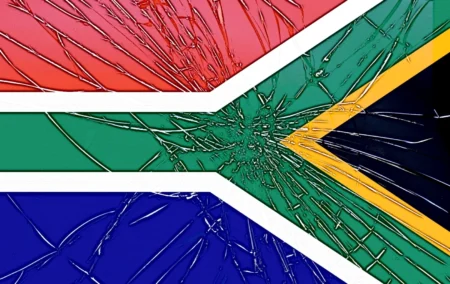
South Africa’s enclavists have learnt not to talk about race. Yet proxies of faith, culture and community echo Murray Rothbard’s Grand Apartheid all the same.
In the first three parts of this series, I reviewed the libertarian tradition, which some critics on the left have described as being the wellspring of “libertarian racism” on the new right (originally known as the alt-right).
I found that the accusation of racism has merit in the case of the paleo-libertarian branch established by Murray Rothbard, Lew Rockwell, and Hans-Hermann Hoppe. That branch sought to ally with paleo-conservatives and white nationalists in the hope of widening the electoral appeal of libertarian ideas.
However, the charge that this racism originated in the neoliberal tradition of Hayek and Mises cannot be sustained. On the contrary: paleo-libertarianism imported racist views from outside the neoliberal tradition, and the trunk of the libertarian movement they left behind clearly rejected race as a determinant of political status.
In this final part, we’ll look at a popular paleo-libertarian idea: that property rights and freedom of association leave the door open to a federation of enclaves where people can enjoy “freedom” among their own kind, and get to choose their neighbours.
Something that sounds a lot like this idea has gained an awful lot of ground in public discourse in South Africa, of late.
Rothbard’s “Grand Apartheid”
In April 1994, as South Africa prepared for its first democratic election, Murray Rothbard wrote in “The Vital Importance of Separation” that “the only hope right now, for liberty, prosperity, or any shred of civilization in South Africa is the adoption of Grand Apartheid”.
In Rothbard’s writing, “Grand Apartheid” described the total separation of the races into separate geographical areas, each of which would be self-governing without domination of one race by another. He thought this to be Verwoerd’s vision, and contrasted it to “Petit Apartheid” (not to be confused with petty apartheid), under which white people ruled over a multi-racial society. Rothbard was clear that he meant “not just cantonization, but separate sovereign nations”.
Innocently, he asked: “Why is it ‘racist’ to want to be left alone?”
Thirty-two years later, South Africa’s ethnic nationalist right speaks of “enclaves”, “micro-republics”, and “federalism”, where people can practise what the Constitution recognises as “the right of self-determination of any community sharing a common cultural and language heritage, within a territorial entity in the Republic or in any other way”.
The vocabulary is more politically correct, but the echoes of Rothbard and his fellow paleo-libertarians are unmistakeable.
About secession and racism
Wanting to secede is not inherently racist. Not everyone who argues for secession or self-government is a racist. I know, because in 2020 I wrote that “the time for secession has arrived”.
That support was tentative and came with caveats. I expressed doubt that the idea would ever succeed. It concerned a province, not a people. My arguments were “not about racial, cultural or language identity”, but “purely socio-economic”. I objected to the “pall of nationalism, and even racism” that hung over some of its promoters. And it was written in the depths of the pandemic lockdown during a bout of unusual pessimism and despair over the prospects for a liberal future for South Africa.
Circumstances have changed. When the facts change, I change my mind. Then, I saw no alternative; now, I do. Consequently, I no longer support secession of any kind and went on to write, four years later, “Bring back the Rainbow Nation!”
I am also not accusing anyone else in this column of being a racist. Whether an enclave project is actually motivated by racism, merely panders to racial prejudice, is entirely innocent but appeals to the racists among us, or is unfairly perceived to be racist by others, makes little difference to its impact on the prospects for racial harmony and peaceful coexistence in a unitary constitutional democracy.
Enclavisation
By “enclave”, I mean a significant contiguous territory, larger than a single gated estate or a small town on a privately owned farm (like Orania).
Frans Cronjé, who often speaks of “enclavisation”, mostly describes something else: gated golf estates, traditional leaders, the taxi industry and gangs, filling the space a failing state leaves behind. He denies that South Africa is “a fundamentally divided society”, and The Common Sense, where he writes, predicts that “the bulk of the ensuing enclaves will be completely multi-racial”.
That scenario, apart from the opportunities it provides for criminality, is not hugely problematic. In fact, decentralised community self-reliance is a rational and prudent response to a government that cannot (or will not) serve the purpose for which it was elected. That people and companies should prepare for a future of such small, diverse enclaves is good advice.
A far greater concern is the idea of establishing a federation of enclaves based on ethnicity or culture.
Echoes of Rothbard
Rothbard called South Africa “a bastard product of British imperialism”. Koos Malan, writing in The Common Sense last year, calls the state “a product of late nineteenth and early twentieth-century British imperialism”, and adds: “It is not a nation-state; it is a multi-nation state.” The FF Plus’s Corné Mulder called it “this artificial colonial construct”. Lex Libertas, the independent advocacy group led by Ernst Roets, says “the country should be viewed as a region composed of multiple nations, rather than a single unitary state”. (To be fair, I made that argument once myself, without being aware of Rothbard’s view.)
Rothbard wrote that the ANC wanted a unitary nation “so they can loot and plunder the successful white minority”. In 2024, Roets, then head of the Solidarity Movement’s Afrikaner Foundation, told a conservative summit in Bratislava that the ANC had written “more than 116 race laws, aimed at excluding and exploiting the white minority in particular”.
I oppose race law as much as he does. The echo lies in the framing: I view racial law as a measure of redress that has been taken to excess and no longer serves its intended purpose; Roets views a unitary state as a machine intended to plunder a minority. The claim of intent is a claim too far.
Rothbard mourned the abandonment of Grand Apartheid. Robert Duigan, a political researcher and author who campaigns for Cape independence and goes by the handle Marhobane online, says the homeland plan failed because the state “simply could not give away enough land” to turn the Bantustans into functioning states. He does not defend apartheid’s racial caste system. His complaint is that the partition did not go far enough.
There is one departure. Rothbard blamed “fierce US/UN sanctions and boycotts” for the Afrikaners’ surrender. His political heirs ask Washington for help. Lex Libertas wants the US and its allies to “deliver an ultimatum” to Pretoria, and has asked the White House to broker talks that could lead to “sustainable settlements” for minorities. Duigan would have America “capture three ports”.
Faith, culture, language
Hardly anyone in this debate argues openly for racial separation. They know better. They speak instead of faith, culture, language and community.
In February, Lex Libertas hosted a “Future of Nations Conference”, which opened at the Voortrekker Monument in Pretoria. It attracted separatist-minded delegates from South Africa, Europe and the United States.
In his summary of the conference, Peter Hammond – who opened the conference with a Bible reading and Christian prayer – wrote: “A nation is an ethnolinguistic people group with a shared faith.”
He added that “some speakers described a nation as collective memory, culture and community.” His summary continues: “We need to reject those who reject our God and who reject our culture and people.”
That is even narrower than Rothbard. To Rothbard, the nation “cannot be precisely defined; it is a complex and varying constellation of different forms of communities, languages, ethnic groups, or religions”.
Insisting on homogeneity on any one of those traits would be problematic. Hammond’s definition demands homogeneity in ethnicity, language, culture and faith all at once.
Proxy markers
Others use similar markers. Solidarity’s 2018 demographic study, Geanker in Afrika, as TimesLive reported, “only looked at white Afrikaners”, defined as people who told the census they were white and spoke Afrikaans as a mother tongue.
Martin van Staden, who now heads AfriForum’s new Institute for Federalism (and, like me, is a Council member of the IRR), said in his inaugural lecture: “AfriForum and the Solidarity Movement – as Afrikaner institutions – have been practicing federalism for a generation from within the Reformational federalist tradition. It is true to say that many, perhaps most, among previous generations of Afrikaners have been unitarists, but the tradition lives in the Afrikaner heritage and has been made real in recent history.”
The “Reformational federalist tradition” to which he refers emerged from “covenant theology”, a Protestant view which asserts that society is structured as a network of communities in covenant with God, based on consent and mutual association rather than imposed hierarchical authority.
He said “Afrikaners have no more interest in governing anyone else as a minority”, but will also not allow anyone else to “dictate that they must live in chaos”.
“Afrikaners do not wish to interfere in other people’s business,” he said. “But this community is now increasingly also displaying, in big, bold letters: ‘Commit no nuisance here.’”
That phrase was used by the attorney-general of the Cape Colony to tell London to cease sending convicts to the Cape, so in this analogy, it suggests non-Afrikaners are akin to unwanted criminals. This is very suggestive of Hans-Hermann Hoppe’s keep-out signs.
“Not about race”
Defenders of federalism (or enclavism, or separatism, or secessionism) say this has nothing to do with race. “These movements are not about race; they are about irreconcilable values,” Robert King wrote in a letter to the editor answering an earlier column of mine on the subject.
A writer on Orania’s website begs to differ: “ons is etnies homogeen” (we are ethnically homogeneous).
But let’s take our reader at his word. Consider how the enclave is meant to work.
Malan, under whom Van Staden studied constitutional law, explains that enclaves “naturally involve demarcation and movement control”, of which “the most effective is access control”. The enforcer is “lawful violence”, provided “by formations of private and community security”.
The paleo-libertarians had a model for that, too. As I showed in part two, Lew Rockwell praised a Cleveland enclave where criminals, who “were black”, were punished on the spot, calling it “rough justice and eminently libertarian”.
Hoppe wrote in Democracy: The God That Failed that not wanting to live near “Blacks, Turks, Catholics or Hindus” did not mean one did not want to “trade with them from a distance”.
Duigan’s plan for Afrikaner towns includes “unemployment drainage – drawing away unemployed elements from neighbouring informal settlements” by establishing labour-intensive projects, “preferably in another province”.
Put it together: a nation-enclave defined by ethnicity, language and faith, on demarcated territory, with movement controlled by private force, trading with outsiders from a distance.
That is hard to tell apart from Grand Apartheid. Whether anyone intends this, or openly admits this, is beside the point.
Already decentralised
The enclavists’ complaints suggest a South Africa that is far more centralised than it actually is.
Section 40 of the Constitution establishes government as “national, provincial and local spheres of government”, with distinct powers. Van Staden himself concedes: “We have a formally federal Constitution that lacks the substance of federalism.”
The cure for that is to use the powers that exist. Richard Stephenson, a former deputy leader of the Cape Party, now believes that “the Western Cape’s future is best served by greater autonomy within South Africa, not separation from it”.
He argues that “the independence movement too often mistakes the ANC for South Africa”, and that “self-government worthy of the name must protect minorities and political opponents, not merely give territorial majorities what they want”.
Seeking greater devolution of powers for provinces or local governments may or may not be desirable (I can think of many local governments that certainly should have no additional powers devolved to them). A formal federation of nations or “micro-republics” (as Malan calls them) is quite another matter.
It would mean renegotiating a constitutional settlement that, as I wrote in September, was “hard-won and paid for with blood”. That is a very dangerous proposal.
Section 235
Section 235 of the Constitution “does not preclude … recognition of the notion of the right of self-determination of any community sharing a common cultural and language heritage, within a territorial entity in the Republic or in any other way”. But it does so only “within the framework” of “the right of the South African people as a whole to self-determination”, and only as “determined by national legislation”.
As Paul Hoffman of Accountability Now puts it, “a majority of the national parliament, not a plebiscite or referendum, is the chosen and only legal route”.
A unilateral declaration cannot stand. Any claim to a self-governing enclave needs at least a majority, and possibly more, in both the National Assembly and the National Council of Provinces.
The enclavists know this. Malan writes that “constitutions, whatever their claim to supremacy may be, do not have the final say”.
Phil Craig of the Cape Independence Advocacy Group writes that self-determination “is not, in the final reckoning, subject to the consent of the national majority”, though he concedes that communities “would be compelled to enter into negotiations with the national government”.
He ends: “The question that excites me is who will be the first to open Pandora’s box.”
Perhaps he hasn’t read Hesiod; the moral of that story was not to open it; doing so brought great evils upon the world.
Whose norms, whose roads?
Even the most homogeneous region in South Africa holds people who may not share the norms its leaders want to impose: secular Afrikaners, gay Afrikaners, English speakers, people of mixed descent, and Afrikaners who want nothing to do with the Boere nationalists.
Rockwell complained in 1990 that libertarians “equate freedom from State oppression with freedom from cultural norms, religion, bourgeois morality, and social authority”, all of which he argued were legitimate curbs on individual liberty.
They are no such thing. Individual freedom means the right to live unmolested by society, however that society chooses to organise itself. Oppression by the church is no more legitimate, and no less inimical to freedom, than oppression by the state.
Freedom from norms imposed by those who govern you is the essence of individual liberty. A government that enforces religious, cultural or traditional norms is illiberal, whether it sits in Pretoria, in a micro-republic, or in a homeowners’ association.
Painting a federation of enclaves as an expression of classical liberalism is, quite simply, absurd.
“Love”
Roets, in Bratislava, rejected the charge that his movement stands for exclusion. “We are on the side of love. Love for God, love for tradition, love for culture, love for community, love for our families”.
But love for a particular God, a particular tradition and a particular culture implicitly excludes those who do not share them.
What becomes of the openly gay Afrikaner, or the drag artist raised inside such a community? What becomes of the comedian who skewers the hypocrisy of the dominee?
I do not know, and nobody has said. Malan, to his credit, admits the tension between individual claims and “the integrity of the habitative community”, and concedes: “There is no simple formula for adequately dealing with this tension.”
Movement
Then there is the question of movement. “Everyone has the right to freedom of movement,” says section 21 of the Constitution, and “every citizen has the right to enter, to remain in and to reside anywhere in, the Republic”.
An appeal to communal property rights does not answer this, because property rights are individual. A community does not own a territory, even if its members own all the plots in that territory. The roads between them, the thoroughfares, the town square and the veld beyond are not theirs to close.
Rothbard saw the problem. His answer, in “Nations by Consent”, was “contractual access rights for enclaves and exclaves”. His own example, the Armenians of Nagorno-Karabakh, faced “blockade by Azeris”.
Walter Block, in a book on road privatisation published by the Mises Institute, worked out what that would mean.
Existing owners would be grandfathered in, but “complete newcomers … could be charged as much as the market will bear”.
Discrimination, he predicted, “would likely take place on the basis of uncivilized or obstreperous behavior, not mere skin color (unless the two were highly correlated, and the latter could be used as a cheap proxy variable or indicator of the former)”.
He then named “blacks for ordinary crime” as a group likely to be “singled out for heavier scrutiny … and perhaps in some cases even forbidden entry”. For the reasons behind his crime statistics, he cites The Bell Curve.
South Africa’s enclaves would not be built on empty land. They would be fitted onto towns that already have mixed residential areas, and poor neighbours, who would be Block’s newcomers. The Common Sense, in an anonymous editorial, “Is There a Future for White South Africans?”, imagines “guards with guns at the gates” and “the Wild West outside those gates”.
The problem is that to keep people out of an enclave, you need authority over its public land and everybody’s private property. That is a state by another name.
State-proofing is legal
None of this is necessary. Nothing in South Africa’s present dispensation prevents communities from trying to “state-proof” themselves, or from taking care of their own.
The Solidarity Movement, Roets said, has built “more than 50 institutions” funded by 700,000 members: support for Afrikaans schools, the Akademia university, and the Sol-Tech technical college. Orania relies on private property law, and its defenders describe it as “self-determination within a democratic and constitutional framework”.
None of it is illegal. None of it requires formal geographic federalism or self-governing enclaves.
Flip Buys said as much in 2015. The Solidarity Movement’s plan sought “maximum autonomy within the framework of the Constitution”, and was explicitly not an effort “to establish parallel governmental structures” or “an apartheid ‘volkstaat’”.
So why demand territory? Geanker in Afrika offered one answer, as TimesLive reported: where Afrikaners are “somewhere in the majority”, political power comes within reach, “which implies they can use taxpayer’s money instead of private funds”.
Duigan offers another: build enough autonomous towns, and “no need for the recognition of a volkstaat will be necessary – it will already exist”.
A claim over territory adds two things that private institutions cannot: control over who lives there, and control of people’s taxes. Both depend on keeping a majority. So a territorial claim is needed only if the goal is ethnic homogeneity.
Left alone
So, to answer Rothbard: no, it is not racist to want to be left alone. Nobody needs a border for that.
Wanting a territory where others may not live, or must keep to norms they did not choose, is something else, whatever the motive. Choosing your neighbours is more than simply being left alone.
Given South Africa’s history, and the ethnic-nationalist locus of today’s enclave talk, it is disingenuous to claim that this time the motives are perfectly pure and oh-so liberal.
Perception alone is enough to scuttle the federalist idea; it would hard to convince anyone that ethnically, culturally, linguistically or religiously homogeneous enclaves do not have racist intent. I’m not even sure that such a perception would be wrong.
The paleo-libertarians walked out of the classical liberal tradition, donning the mantle of white supremacy in pursuit of popularity with the far right. In South Africa, their echoes threaten to walk us back towards a narrow-minded, parochial form of separate development.
Those of us who care about freedom and non-racialism should not follow the great trek away from a united South Africa, and out of classical liberalism.
[Image: shattered-flag.webp]
[Caption: The right way around, South Africa’s flag symbolises unity flowing from diversity. That ideal is being shattered. (Illustration by author.)]
The views of the writer are not necessarily the views of the Daily Friend or the IRR.
If you like what you have just read, support the Daily Friend.